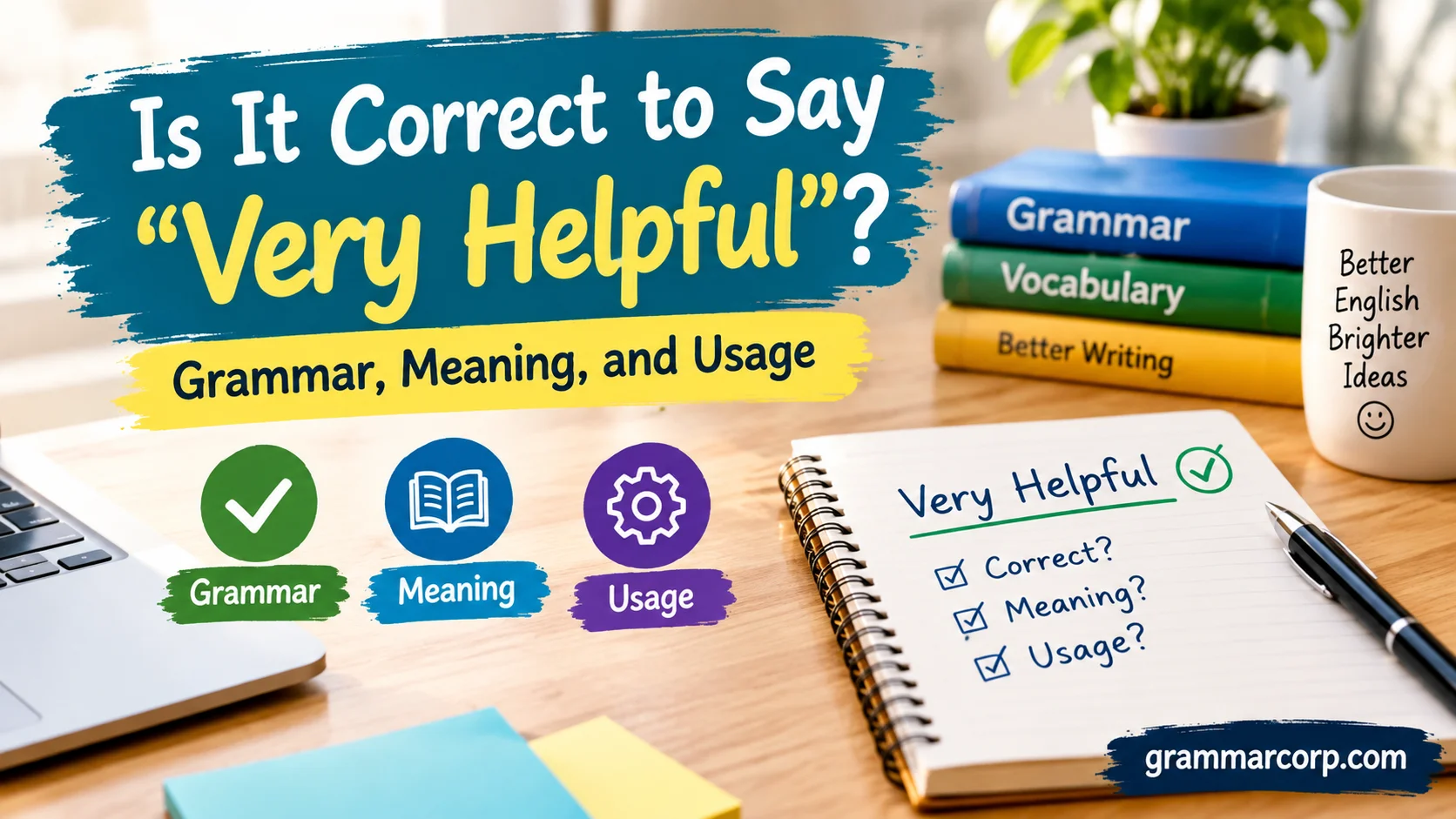
Is It Correct to Say “Very Helpful”? Grammar, Meaning, and Usage explains why this common phrase is grammatically correct and natural in everyday English.
The phrase very helpful follows standard English grammar rules because very is an adverb and intensifier, while helpful is an adjective. The adverb modifies the adjective, intensifying its meaning and expressing a high degree of usefulness, help, or support. This grammatical structure is an example of adverbial modification and adjective modification.
The expression provides a positive description of people, tools, instructions, resources, explanations, advice, and information that offer useful assistance. It is common in spoken English, written English, schoolwork, reviews, casual writing, and professional emails. For example, you might describe a teacher’s explanation, a colleague’s advice, or a helpful resource as very helpful. The phrase communicates a meaningful level of help clearly without requiring a complicated sentence.
However, context matters when choosing the most appropriate word. Although helpful is often enough, alternatives such as valuable, informative, useful, and effective can communicate meaning more precisely. Valuable advice emphasizes importance, informative explanations provide knowledge, and effective instructions focus on results. These alternative expressions improve clarity, emphasis, and writing style. The best word choice depends on the meaning, tone, audience, and linguistic context
Quick Answer:
Yes. “Very helpful” is grammatically correct and natural English.
In this phrase:
- Very is an adverb of degree.
- Helpful is an adjective.
- Very helpful is an adjective phrase.
- Very modifies the adjective helpful by making its meaning stronger.
For example:
Your explanation was very helpful.
Here helpful describes the explanation. Very tells us that the explanation provided a high degree of help.
You can use the phrase in both informal and formal communication.
Examples include:
- Your advice was very helpful.
- The instructions were very helpful.
- Your feedback was very helpful.
- The teacher was very helpful.
- This guide is very helpful for beginners.
There is nothing grammatically wrong with these sentences.
Comparison Overview
The easiest way to understand very helpful is to compare it with related expressions.
| Expression | Meaning | Strength |
| Helpful | Provides useful assistance | Neutral |
| Very helpful | Provides a high degree of assistance | Strong |
| Extremely helpful | Provides an exceptionally high degree of assistance | Very strong |
| Somewhat helpful | Provides some assistance but not a great deal | Mild |
| Not very helpful | Provides little useful assistance | Negative |
The important difference involves degree.
If you say, The guide was helpful, you make a general positive statement.
If you say, The guide was very helpful, you emphasize that the guide provided considerable assistance.
If you say, The guide was extremely helpful, you make the praise even stronger.
None of these constructions is automatically more grammatically correct than the others. The best choice depends on the strength of the meaning you want to express.
Main Differences Between “Very Helpful” and Related Expressions
The phrase very helpful often gets confused with similar expressions. Understanding their differences can help you choose the right wording.
“Helpful” vs. “Very Helpful”
Helpful describes something that provides assistance or makes a situation easier.
Very helpful expresses a stronger degree of usefulness.
Compare these sentences:
- The instructions were helpful.
- The instructions were very helpful.
The first sentence gives a neutral positive assessment.
The second sentence emphasizes the value of the instructions.
The difference isn’t about grammar. It is about intensity.
“Very Helpful” vs. “Extremely Helpful”
Both expressions are correct.
Very helpful indicates a high degree of usefulness.
Extremely helpful pushes that degree even further.
For example:
- The tutorial was very helpful.
- The tutorial was extremely helpful.
The second sentence communicates stronger enthusiasm.
Still, you shouldn’t automatically replace very with extremely. Stronger language can sound excessive if the situation doesn’t justify it.
“Very Helpful” vs. “Somewhat Helpful”
These expressions communicate almost opposite degrees.
Very helpful means something provided substantial assistance.
Somewhat helpful means it provided some assistance but its usefulness was limited.
For example:
- The feedback was very helpful.
- The feedback was somewhat helpful.
The first sentence expresses strong approval. The second gives a more limited assessment.
Why Is “Very Helpful” Grammatically Correct?
The grammar becomes simple when you separate the two words.
“Very” Is an Adverb
Very is an adverb that can modify adjectives and adverbs.
When it modifies an adjective, it usually expresses degree.
Consider:
- very good
- very useful
- very clear
- very difficult
- very important
- very helpful
In each example, very strengthens the adjective that follows it.
“Helpful” Is an Adjective
Helpful describes someone or something that gives assistance or makes a situation easier.
You can use it with nouns such as:
- person
- advice
- information
- explanation
- guide
- tool
- resource
- suggestion
- instructions
Examples:
- She is helpful.
- The information is helpful.
- The guide is helpful.
- His advice was helpful.
Adding very simply increases the degree.
- She is very helpful.
- The information is very helpful.
- The guide is very helpful.
- His advice was very helpful.
“Very Helpful” Forms an Adjective Phrase
The words very helpful work together as an adjective phrase.
The adjective helpful acts as the main word. Very modifies it.
For example:
The online guide was very helpful.
The phrase very helpful describes the online guide.
This structure is completely standard in English.
What Does “Very Helpful” Mean?
Very helpful means highly useful or highly effective at providing assistance.
The exact meaning depends on the context.
If you describe a person as very helpful, you usually mean that person provides substantial assistance.
The librarian was very helpful.
This could mean the librarian answered questions, found useful materials, or guided someone toward the right information.
If you describe information as very helpful, you mean it made understanding or completing something easier.
The information was very helpful.
If you describe a tool as very helpful, you mean the tool made a task easier or more manageable.
The calculator was very helpful during the lesson.
The phrase therefore has a broad meaning. It doesn’t identify one specific type of assistance.
How Do You Use “Very Helpful” in a Sentence?
You can use very helpful in several common sentence patterns.
Describing a Person
Use very helpful after a linking verb when you want to describe someone’s behavior or willingness to assist.
Examples:
- The teacher was very helpful.
- The receptionist was very helpful.
- My tutor has been very helpful.
- The staff member was very helpful.
The phrase describes the person’s helpful nature in a particular situation.
Describing Advice
Advice can be very helpful when it gives someone useful direction.
Examples:
- Your advice was very helpful.
- Her suggestions were very helpful.
- His feedback was very helpful.
- The recommendations were very helpful.
Describing Information
Information can also be very helpful when it improves someone’s understanding or helps them make a decision.
Examples:
- The information was very helpful.
- Those details were very helpful.
- The examples were very helpful.
- Your explanation was very helpful.
Describing Tools and Resources
You can describe a tool or resource as very helpful when it makes a task easier.
Examples:
- This checklist is very helpful.
- The tutorial was very helpful.
- The reference guide is very helpful.
- This website has been very helpful.
Common Sentence Patterns With “Very Helpful”
Understanding the common structures makes the phrase easier to use naturally.
Subject + Be + Very Helpful
This is one of the most common patterns.
The guide was very helpful.
Other examples:
- Your explanation is very helpful.
- The teacher was very helpful.
- These notes are very helpful.
Subject + Find + Object + Very Helpful
You can also use very helpful after find.
I found the explanation very helpful.
Here very helpful describes the object of found.
More examples:
- I found the examples very helpful.
- We found the instructions very helpful.
- She found the feedback very helpful.
Very Helpful + for + Noun
Use for when you want to identify who or what benefits.
The guide is very helpful for beginners.
Other examples:
- This book is very helpful for students.
- The checklist is very helpful for new employees.
- These exercises are very helpful for learners.
Very Helpful + in + -ing
You can also explain the specific activity where the assistance matters.
The examples were very helpful in understanding the concept.
Other examples:
- The instructions were very helpful in completing the task.
- Her feedback was very helpful in improving the report.
- The demonstration was very helpful in learning the process.
Is “Very Helpful” Formal or Informal?
Very helpful works in both formal and informal English.
You can use it in everyday conversations.
Thanks. That was very helpful.
You can also use it in professional communication.
Your feedback was very helpful.
The phrase doesn’t automatically make writing informal.
However, professional or academic writing sometimes benefits from greater precision. Instead of repeatedly using very helpful, you can select a word that identifies exactly why something helped.
Compare:
Your research was very helpful.
with:
Your research was valuable to the project.
The second sentence tells the reader more about the type of benefit.
That doesn’t make very helpful incorrect. It simply makes the alternative more specific.
Examples in Professional English
- Your feedback was very helpful.
- The additional information was very helpful.
- Your explanation was very helpful in clarifying the issue.
- The examples you provided were very helpful.
These sentences are natural in workplace communication.
“Very Helpful” in Everyday English
The phrase appears naturally in everyday conversations.
Someone might say:
Your directions were very helpful.
A student might say:
Your explanation was very helpful.
A customer might say:
The representative was very helpful.
A friend might say:
That suggestion was very helpful.
These examples show why the phrase remains useful. It lets you express appreciation or describe usefulness without sounding overly complicated.
Common Mistakes With “Very Helpful”
Although very helpful is correct, several related mistakes can cause confusion.
Mistake: Using “Very Helpful” as a Complete Sentence
The phrase very helpful doesn’t contain a subject or finite verb.
For example:
Very helpful.
In casual conversation, this can work as an elliptical response. The listener understands the missing meaning from context.
However, in formal writing, a complete sentence is usually better.
Instead write:
That was very helpful.
Or:
Your explanation was very helpful.
Mistake: Saying “Very Helping”
Very helping doesn’t normally express the same meaning as very helpful.
When you want to describe something that provides assistance, use helpful.
Correct:
The guide was very helpful.
Incorrect for this intended meaning:
The guide was very helping.
The words helpful and helping have different grammatical functions.
Helpful is an adjective.
Helping can function as a present participle or gerund depending on its use.
For example:
She is helping her brother.
Here helping forms part of the verb phrase.
It doesn’t mean the same thing as helpful.
Mistake: Confusing “Helpful” With “Helpfully”
These words have different jobs.
Helpful is an adjective.
The assistant was helpful.
Helpfully is an adverb.
The assistant helpfully explained the process.
The first sentence describes the assistant.
The second describes how the assistant performed the action.
Mistake: Adding “Very” Without Considering Meaning
Very adds emphasis.
That means you shouldn’t use it automatically every time you want to say something was useful.
Compare:
The article was helpful.
The article was very helpful.
The second sentence carries stronger praise.
If the article provided only limited assistance, helpful may be more accurate.
Good writing doesn’t simply use stronger words. It uses the right degree of emphasis.
“Very Helpful” vs. “Very Helpfully”
This distinction causes confusion because the words look similar.
Very Helpful
Helpful is an adjective.
It describes a person, thing, idea, resource, or information.
The teacher was very helpful.
The phrase describes the teacher.
Very Helpfully
Helpfully is an adverb.
It describes how someone performs an action.
The teacher helpfully explained the difficult section.
The word helpfully modifies the verb explained.
A useful test is to ask what the word describes.
| Expression | Word Type | What It Describes |
| Very helpful | Adjective phrase | A person or thing |
| Helpfully | Adverb | An action |
| Very helpfully | Adverb phrase | The manner of an action |
These expressions shouldn’t be treated as interchangeable.
Better Alternatives to “Very Helpful”
There is nothing wrong with very helpful. Still, alternatives can make your writing more precise.
Valuable
Use valuable when something provides significant benefit or worth.
Your feedback was valuable to the project.
Useful
Use useful when something has a practical purpose.
The checklist was useful during the inspection.
Informative
Use informative when something provides knowledge or important information.
The presentation was informative.
Effective
Use effective when something works well and produces the desired result.
The new method was effective.
Practical
Use practical when something can be applied easily to a real situation.
The advice was practical and easy to follow.
Supportive
Use supportive when someone provides encouragement or assistance.
Her teacher was supportive throughout the project.
Invaluable
Use invaluable when something has extremely high value.
His experience was invaluable to the team.
Be careful with these alternatives. They don’t all mean exactly the same thing.
For example, informative focuses on information. Effective focuses on results. Supportive often focuses on people and their assistance. Valuable emphasizes worth.
Comparison of Alternatives to “Very Helpful”
| Expression | Main Focus | Example |
| Very helpful | General assistance | Your explanation was very helpful. |
| Valuable | Significant worth | Your feedback was valuable. |
| Useful | Practical usefulness | This guide is useful. |
| Informative | Information or knowledge | The article was informative. |
| Effective | Successful results | The method was effective. |
| Practical | Real-world usefulness | Her advice was practical. |
| Supportive | Personal assistance | The teacher was supportive. |
| Invaluable | Extremely high value | His experience was invaluable. |
The best alternative depends on what you actually mean.
Examples of “Very Helpful” in Real Sentences
Here are natural examples across different situations.
For People
- The teacher was very helpful.
- The customer-service representative was very helpful.
- My tutor has been very helpful.
- The librarian was very helpful.
For Advice
- Your advice was very helpful.
- Her suggestions were very helpful.
- His recommendations were very helpful.
- The feedback was very helpful.
For Information
- The information was very helpful.
- Those details were very helpful.
- The examples were very helpful.
- Your explanation was very helpful.
For Resources
- The checklist was very helpful.
- The tutorial was very helpful.
- This guide is very helpful.
- The reference material was very helpful.
For Expressing Gratitude
- Thank you. That was very helpful.
- Your explanation was very helpful.
- I appreciate your advice. It was very helpful.
- Your feedback was very helpful.
Is “Very Helpful” Appropriate in Academic Writing?
Yes. Very helpful is grammatically acceptable in academic writing.
However, academic writing often values precision. You should therefore consider whether a more specific adjective explains the benefit better.
For example:
The study was very helpful.
This sentence is grammatically fine. Yet it doesn’t explain exactly how the study helped.
A more precise version could be:
The study provided valuable evidence for the analysis.
The second sentence communicates a clearer academic idea.
That doesn’t mean you must avoid very helpful in academic writing. Use it when it accurately communicates your meaning.
The same principle applies to professional writing.
Correct grammar doesn’t always equal maximum precision.
That’s an important distinction for strong writing.
Is “Very Helpful” Appropriate in Emails?
Yes.
The phrase works particularly well when you want to thank someone.
For example:
Your explanation was very helpful. Thank you for taking the time to clarify the issue.
Or:
The information you provided was very helpful. I appreciate your assistance.
These sentences sound polite and natural.
You can also use the shorter conversational form:
Thanks. That’s very helpful.
The appropriate version depends on the level of formality.
Read More : Wasn’t vs. Weren’t: How to Use Each One Correctly
Is “Very Helpful” Better Than “Helpful”?
Neither phrase is always better.
The choice depends on the degree of assistance.
Use helpful when you want a neutral positive description.
The instructions were helpful.
Use very helpful when you want to emphasize stronger usefulness.
The instructions were very helpful.
Think of very as a volume control. It turns up the intensity of the adjective without changing its basic category or meaning.
Quick Decision Guide
Choose helpful when:
- The assistance was useful but ordinary.
- You want a neutral tone.
- You don’t need strong emphasis.
Choose very helpful when:
- The assistance made a significant difference.
- You want to express stronger appreciation.
- You want to emphasize usefulness.
Choose a more specific alternative when:
- You want to explain exactly why something helped.
- You’re writing formal or technical content.
- The context calls for precise vocabulary.
Case Study: Choosing the Right Expression
Imagine a student receives feedback on an essay.
The teacher points out several grammar errors and explains how to fix them.
The student could write:
Your feedback was helpful.
This is correct and neutral.
The student could also write:
Your feedback was very helpful.
This expresses stronger appreciation.
If the feedback completely changed the student’s understanding of the assignment, the student might write:
Your feedback was invaluable.
Each sentence works. The difference lies in degree and precision.
This small example shows why vocabulary choices should reflect the actual situation.
A Simple Grammar Test for “Very Helpful”
When you’re unsure about the phrase, use this simple test.
Ask yourself:
Is “helpful” describing a person or thing?
If yes, it is probably functioning as an adjective.
Then ask:
Do I want to emphasize the degree of helpfulness?
If yes, very helpful is a natural choice.
For example:
The instructions were helpful.
The instructions provided assistance.
The instructions were very helpful.
The instructions provided a high degree of assistance.
The grammar remains straightforward in both sentences.
FAQs:
1. Is it grammatically correct to say “very helpful”?
Yes, very helpful is grammatically correct and natural English. “Very” is an adverb that modifies the adjective “helpful,” adding emphasis to show that something provides a high degree of assistance or support.
2. What does “very helpful” mean?
Very helpful means providing a great deal of help, support, or useful information. For example, “Your explanation was very helpful” means the explanation made something easier to understand.
3. Should I say “very helpful to me” or “very helpful for me”?
Both expressions are correct, but their meanings can differ slightly. Very helpful to me often emphasizes personal experience or the effect something has on you. Very helpful for me often emphasizes usefulness in a particular situation or for a specific purpose.
4. Is “very helpful” appropriate for professional emails?
Yes, very helpful is appropriate for professional emails, workplace communication, and formal or informal writing. For example, you can write, “Thank you for your detailed explanation. It was very helpful.” This sounds polite, clear, and appreciative.
5. What are some alternatives to “very helpful”?
Depending on the context, you can use valuable, useful, informative, effective, or beneficial. For example, “Your feedback was valuable” emphasizes importance, while “The instructions were effective” highlights how well they worked.
Conclusion:
“Very helpful” is a grammatically correct, natural, and widely used English expression. It combines the adverb “very” with the adjective “helpful” to emphasize the degree of assistance, support, or usefulness something provides. Whether you use it in everyday conversations, schoolwork, or professional emails, the phrase communicates appreciation clearly and politely.
You can also choose alternatives such as “valuable,” “informative,” or “effective” when you want to express a more specific meaning. Ultimately, understanding the context, audience, and intended message will help you choose the most appropriate expression.






1 thought on “Is It Correct to Say “Very Helpful”? Grammar, Meaning, and Usage”