It’s vs. Its: What’s the Difference? Rules and Examples helps you understand the important difference between its and it’s in English writing. If you have ever paused while writing because you were not sure whether to use it’s or its, you are not alone. The difference may look small, but it can change the meaning of a sentence. In English, both words sound exactly alike in normal speech, but they have completely different jobs. It is a contraction of “it is” or “it has,” while its is a possessive pronoun that shows possession.
The apostrophe creates much of the confusion because English usually uses an apostrophe to show possession, as in Sarah’s book or the dog’s collar, but its shows possession without one. The simple rule is an easy test: replace it’s with “it is” or “it has”; if the sentence still makes sense, it’s is the correct use. Otherwise, its is normally the right word. For examples, “The dog wagged its tail” shows possession, while “It’s a good day” uses the contraction. Experienced writers, students, bloggers, and business professionals can all make this common mistake in an email or professional communication, especially when autocorrect fails to catch it.
A tiny apostrophe can surprisingly change a sentence, so knowing this one rule helps you write with confidence, improve your grammar and usage, and avoid embarrassing mistakes. If you are trying to master its vs. it’s, remember the quick fix: it’s means “it is” or “it has,” while its means something belongs to it. This memory trick makes the difference easy to remember and helps you tell the two words apart. Whether someone simply wants better writing skills or is mastering English for school or work, this guide can explain the rules, practical examples, and contextual clues clearly
Quick Answer:
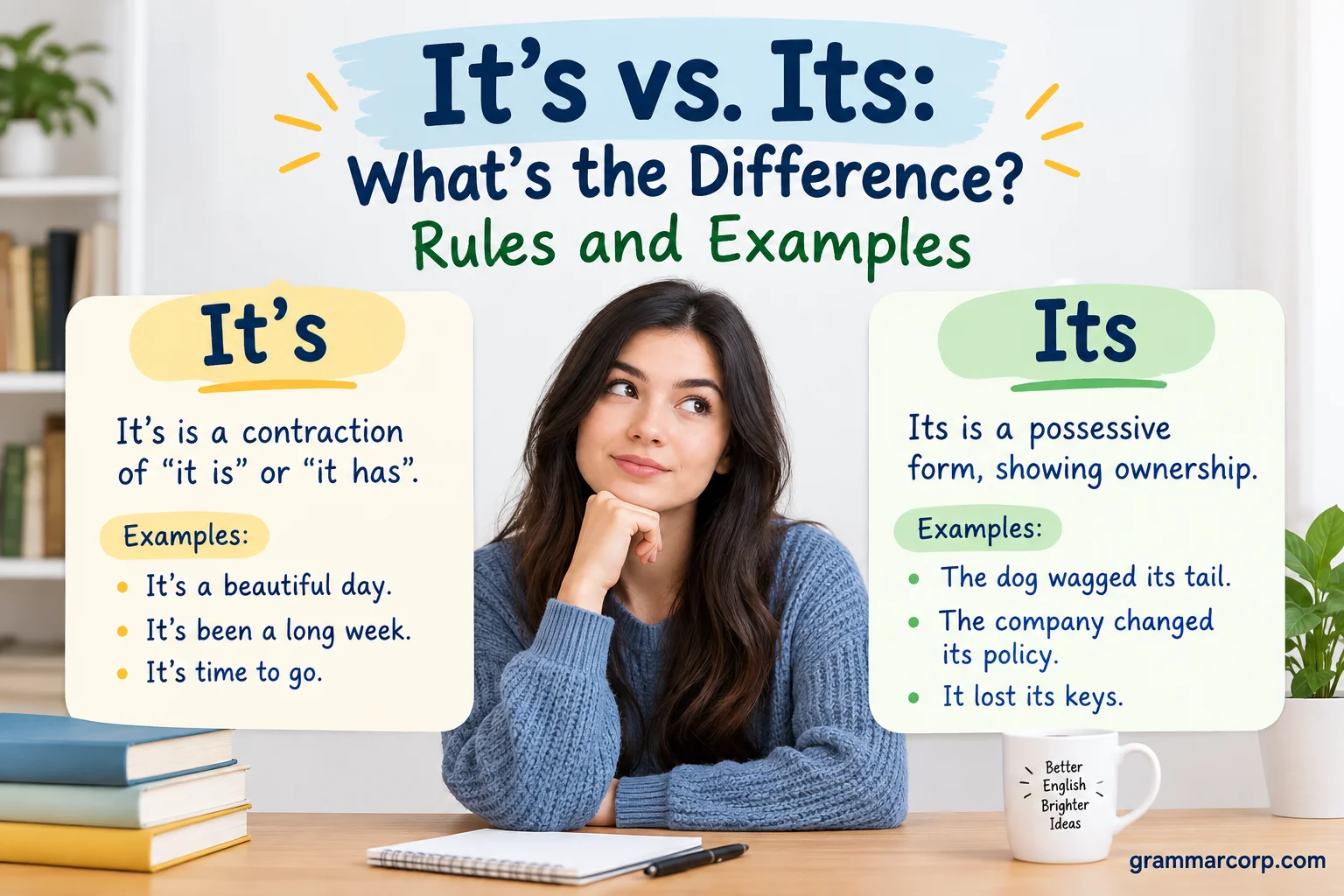
It’s is a contraction of it is or it has.
Its is the possessive form of it. It shows that something belongs to or relates to a person, animal, object, organization, or other thing referred to as it.
Here’s the easiest rule to remember:
It’s = it is or it has.
Its = belonging to it.
Consider these examples:
- It’s raining outside. → It is raining outside.
- It’s been a busy week. → It has been a busy week.
- The dog wagged its tail. → The tail belongs to the dog.
- The company changed its policy. → The policy belongs to or relates to the company.
If you can replace it’s with it is or it has, the apostrophe belongs there. If the word shows possession or association, use its.
Comparison Overview
The difference between it’s vs. its becomes much clearer when you compare their grammatical roles.
| Word | Meaning | Function | Example |
| It’s | It is | Contraction | It’s getting cold. |
| It’s | It has | Contraction | It’s been repaired. |
| Its | Belonging to it | Possessive determiner | The car lost its wheel cover. |
| Its | Associated with it | Possessive determiner | The company changed its name. |
The apostrophe in it’s doesn’t indicate possession. Instead, it marks missing letters from the words it is or it has.
For example:
- it is → it’s
- it has → it’s
The word its works differently. It doesn’t stand for two words. It functions as a possessive determiner.
A Simple Side-by-Side Example
Look at these two sentences:
- It’s a beautiful house.
- The house has its own garden.
In the first sentence, it’s means it is:
It is a beautiful house.
In the second sentence, its means the garden belongs to or is associated with the house.
That small apostrophe creates a major grammatical difference.
Main Differences Between It’s vs. Its
Understanding the grammatical difference makes the rule much easier to remember.
It’s Means “It Is”
The most common use of it’s occurs when it replaces it is.
Examples include:
- It’s too late to call.
- It’s a beautiful morning.
- It’s difficult to explain.
- It’s colder today.
- It’s important to check your work.
- It’s the best option available.
Try expanding each sentence.
It’s important to check your work becomes:
It is important to check your work.
The sentence still makes sense. Therefore, it’s is correct.
This substitution test works remarkably well because it focuses on the actual grammatical function instead of the appearance of the word.
It’s in Questions
You can also use it’s in questions.
Examples:
- Why is it so quiet?
- Is it ready?
- When is it going to start?
Notice that you generally won’t see it’s in every question simply because the word order can change.
For example:
- It’s ready.
- Is it ready?
The contraction disappears when the sentence becomes a question because it and is switch positions.
It’s With Descriptions
Writers frequently use it’s when describing a situation, object, place, event, or condition.
Examples:
- It’s beautiful here.
- It’s surprisingly expensive.
- It’s difficult to find.
- It’s already dark.
- It’s worth trying.
In each case, it’s can expand to it is.
It’s Means “It Has”
Many people learn that it’s means it is and then forget that it can also represent it has.
Examples:
- It’s been a long day.
- It’s already happened.
- It’s changed significantly.
- It’s become more popular.
- It’s taken several hours.
Take the sentence:
It’s been a long day.
Expand the contraction:
It has been a long day.
That works perfectly. Therefore, it’s is correct.
This use often appears with words such as been, become, changed, started, finished, and gone.
How to Recognize “It’s” as “It Has”
Look at what comes after it’s.
If the following word is a past participle, it’s may represent it has.
For example:
- It’s been difficult.
- It’s changed over time.
- It’s become a problem.
- It’s started already.
- It’s gone too far.
The context determines the exact meaning.
Its Shows Possession
Now consider its.
Its shows possession, ownership, connection, or association.
Examples:
- The dog shook its head.
- The company updated its website.
- The phone lost its signal.
- The tree dropped its leaves.
- The school changed its schedule.
- The computer needs its battery replaced.
In each example, its connects something to the thing represented by it.
The dog has a head.
The company has a website.
The phone has a signal.
The tree has leaves.
The school has a schedule.
The key idea isn’t always literal ownership. Its can express a broader relationship.
For example:
The book is famous for its detailed illustrations.
The illustrations don’t necessarily belong to the book in the same way a person owns a phone. They are features associated with the book.
Why Does “Its” Have No Apostrophe?
This is one of the biggest reasons people make the it’s vs. its mistake.
English commonly uses apostrophes for possession:
- the teacher’s desk
- the dog’s collar
- Maria’s phone
- the company’s website
So why isn’t it it’s?
Because its follows a different possessive pattern.
Compare these possessive forms:
| Personal Pronoun | Possessive Form |
| he | his |
| she | her / hers |
| they | their / theirs |
| we | our / ours |
| you | your / yours |
| it | its |
The possessive forms his, hers, theirs, ours, and yours don’t need apostrophes. Its follows the same general principle.
The apostrophe in it’s has a different job. It signals that letters have been removed from it is or it has.
Therefore:
- it’s → contraction
- its → possession
How to Tell Whether You Need “It’s” or “Its”
When you’re unsure, don’t rely on how the word sounds. Both words usually sound the same.
Instead, use a quick grammatical test.
Use the “It Is” Test
Replace it’s with it is.
If the sentence still makes sense, it’s is correct.
Example:
It’s going to rain.
Replace the contraction:
It is going to rain.
The sentence works. So it’s is correct.
Another example:
It’s difficult to understand.
Becomes:
It is difficult to understand.
Again, the sentence works.
When the Test Fails
Consider this sentence:
The bird cleaned it’s feathers.
Replace it’s with it is:
The bird cleaned it is feathers.
That doesn’t work.
The sentence needs a possessive word because the feathers belong to the bird.
Correct:
The bird cleaned its feathers.
Use the “It Has” Test
Sometimes it’s doesn’t mean it is. It means it has.
Consider:
It’s been raining all morning.
Replace it’s:
It has been raining all morning.
That works.
So it’s is correct.
Try another:
It’s changed since last year.
Becomes:
It has changed since last year.
Again, the sentence works.
Use the Possession Test
If the word means belonging to it or describes something associated with it, choose its.
For example:
The phone lost its connection.
The connection belongs to or relates to the phone.
You wouldn’t say:
The phone lost it is connection.
That makes no grammatical sense.
Therefore, its is correct.
A Three-Step Decision Rule
When you hesitate between it’s and its, follow these steps:
- Replace it’s with “it is.”
- If that doesn’t work, try “it has.”
- If neither works and the word shows possession, use its.
This simple method handles most everyday cases.
Common “It’s” vs. “Its” Mistakes
The same mistakes appear repeatedly in school assignments, emails, websites, social media posts, and professional documents.
Mistake: Using “It’s” to Show Possession
Incorrect:
The dog hurt it’s paw.
Correct:
The dog hurt its paw.
Why?
The paw belongs to the dog. The sentence doesn’t mean the dog hurt it is paw.
Mistake: Using “Its” for “It Is”
Incorrect:
Its going to be a busy day.
Correct:
It’s going to be a busy day.
Here, it’s means:
It is going to be a busy day.
The apostrophe marks the contraction.
Mistake: Writing “It’s” When You Mean “It Has”
Incorrect:
Its been three hours.
Correct:
It’s been three hours.
The expanded version is:
It has been three hours.
That makes it’s the correct choice.
Mistake: Assuming Apostrophes Always Show Possession
This mistake comes from learning a useful but incomplete rule.
Apostrophes can show possession:
- the girl’s book
- the dog’s bowl
- the teacher’s chair
However, apostrophes can also create contractions:
- cannot → can’t
- do not → don’t
- I am → I’m
- it is → it’s
So an apostrophe doesn’t automatically mean possession.
With it’s, the apostrophe signals a contraction.
“It’s” vs. “Its” Examples in Real Sentences
Seeing the words in different contexts can make the distinction much easier.
Everyday Examples
- It’s getting late.
- The cat is licking its paw.
- It’s too hot outside.
- The car needs its tires checked.
- It’s been a strange week.
- The phone lost its charge.
- It’s probably the right answer.
- The computer restarted its system.
Each word has a specific grammatical job.
Work and Business Examples
Business writing often contains possessive uses of its.
Examples:
- The company announced its new policy.
- The organization updated its guidelines.
- It’s important to meet the deadline.
- The brand changed its logo.
- It’s become a major competitor.
- The business expanded its services.
Notice how easily both forms can appear in the same paragraph.
For example:
It’s important for a company to understand its customers.
The first word means it is.
The second word shows possession or association.
School and Academic Examples
The same distinction appears in academic writing.
- It’s difficult to explain the result.
- The experiment produced its expected outcome.
- It’s clear that the evidence matters.
- The study has its own limitations.
- It’s been widely discussed.
- The theory has its origins in earlier research.
This distinction matters because grammatical mistakes can make otherwise strong writing look careless.
It’s vs. Its in Different Types of Writing
The basic rule never changes. However, the preferred style can change depending on the situation.
Academic Writing
Academic writing sometimes favors full forms instead of contractions.
For example:
- It is important to examine the evidence.
- It has become an important research topic.
A professor or style guide may prefer these forms over it’s.
However, its remains correct when you need to show possession:
- The study has its limitations.
- The theory has its origins in earlier research.
The difference isn’t about formal versus informal English. It comes down to grammar.
Professional Writing
In business communication, it’s and its both appear frequently.
For example:
It’s important that every department understands its responsibilities.
Here, it’s means it is while its indicates association.
Proofreaders should pay special attention to these words because spellcheckers may recognize both forms as correctly spelled words.
That means software might not identify the grammatical mistake.
Everyday Messages
Contractions such as it’s are extremely common in conversations and casual messages.
You might write:
- It’s fine.
- It’s okay.
- It’s almost ready.
- It’s been fun.
- It’s getting late.
Meanwhile, its appears whenever you describe possession or association:
- The dog found its toy.
- The phone lost its signal.
- The app changed its settings.
Website and Content Writing
Online content needs accurate grammar because readers notice repeated mistakes.
A sentence such as:
The product has it’s own advantages
looks incorrect because it’s cannot show possession.
The correct sentence is:
The product has its own advantages.
This is particularly important in headings, advertisements, product descriptions, and educational content. A tiny apostrophe can change the grammatical meaning of a sentence.
Tricky Cases You Should Know
Some sentences make the distinction less obvious.
“It’s Own” vs. “Its Own”
The correct expression is:
its own
Examples:
- The company has its own website.
- The machine has its own power source.
- The school has its own rules.
Why isn’t it it’s own?
Because its shows possession.
You can think of the phrase as meaning:
belonging to it individually or specifically
Therefore:
The company has its own website.
Not:
The company has it’s own website.
“It’s Been” vs. “Its Been”
The correct form is:
It’s been
because it means:
It has been
Examples:
- It’s been a long time.
- It’s been difficult.
- It’s been an interesting experience.
The form its been doesn’t work because its cannot mean it has.
“Its” Before a Noun
A useful clue is placement.
Its commonly appears immediately before a noun:
- its color
- its purpose
- its size
- its name
- its history
- its location
- its value
- its meaning
That pattern doesn’t guarantee that its is correct in every imaginable sentence. However, it provides a useful clue because possessive determiners normally introduce nouns.
Raed More : Disoriented or Disorientated: Which Is Correct?
Case Study: Why One Apostrophe Changes the Meaning
Consider these two sentences:
It’s losing its color.
At first glance, the difference looks tiny.
But the two words perform completely different jobs.
It’s means:
It is
So the sentence expands to:
It is losing its color.
The second its indicates that the color belongs to or describes the thing represented by it.
Now remove the apostrophe:
Its losing its color.
The first word no longer works because its cannot mean it is.
This example shows why proofreading should focus on meaning and grammar, not just spelling.
Both it’s and its are correctly spelled words. The challenge lies in choosing the one that matches the sentence.
Quick Reference: It’s vs. Its
Here’s the entire rule in one table.
| Question | Correct Word |
| Do you mean it is? | It’s |
| Do you mean it has? | It’s |
| Do you mean belonging to it? | Its |
| Are you showing a relationship to something? | Its |
| Does the sentence need a possessive determiner? | Its |
| Can you expand the word to it is? | It’s |
| Can you expand the word to it has? | It’s |
The Fastest Memory Trick
Remember this:
The apostrophe in “it’s” replaces letters.
- it is → it’s
- it has → it’s
Meanwhile:
Its has no apostrophe because it already functions as the possessive form.
Another useful memory phrase is:
Apostrophe? Think contraction. No apostrophe? Think possession.
This isn’t a universal rule for every English possessive construction. However, it works well for distinguishing it’s from its.
FAQs:
1. What is the difference between it’s and its?
It’s is a contraction of “it is” or “it has.” Its is a possessive pronoun used to show that something belongs to or is connected with something.
2. Does its ever need an apostrophe?
No. Its shows possession without an apostrophe. For example, “The company changed its policy.”
3. How can I remember when to use it’s?
Try replacing “it’s with “it is” or “it has.” If the sentence still makes sense, it’s is correct. If it does not, you probably need its.
4. Which is correct: “The dog wagged its tail” or “The dog wagged it’s tail”?
“The dog wagged its tail” is correct because its shows possession. The tail belongs to the dog.
5. Why are it and its commonly confused?
They have the same or nearly the same pronunciation in ordinary speech, but they have different grammatical functions. The apostrophe in it’s can also make the distinction confusing because apostrophes often indicate possession in other English words.
Conclusion:
Understanding it’s vs. its becomes much easier when you remember one simple rule: it’s means “it is” or “it has,” while its shows possession. The apostrophe does not indicate possession in its, so checking whether you can replace the word with “it is” or “it has” is a quick and reliable way to choose the correct form.
With regular practice, this small grammar distinction can become easy to use in everyday and professional writing.