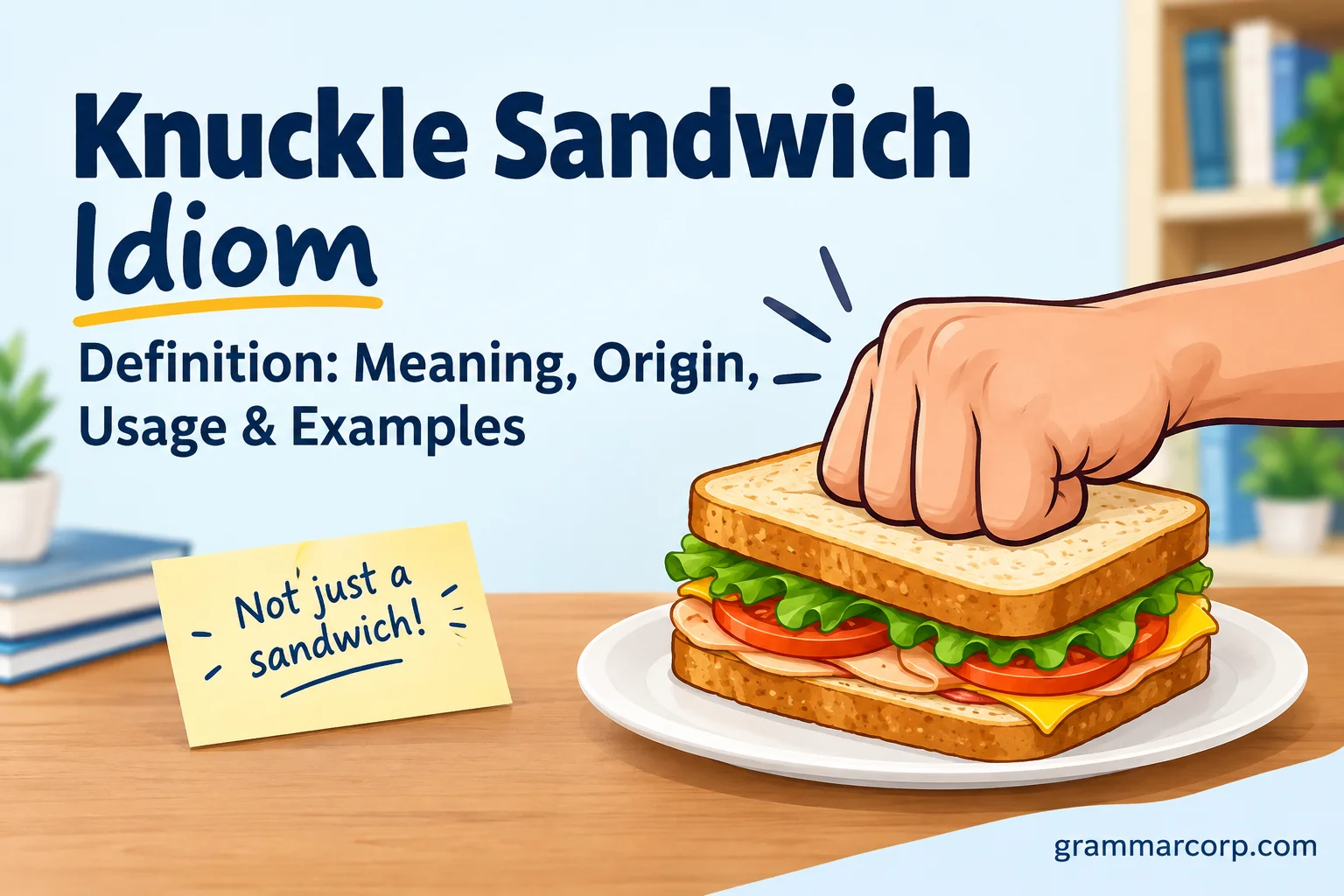
Knuckle Sandwich Idiom Definition: Meaning, Origin, Usage explains this colorful English idiom, its meaning, history, tone, and usage. The knuckle sandwich is an idiom whose definition, meaning, usage, and examples show how English expressions can turn a familiar word such as sandwich into a humorous metaphor. Although a sandwich may suggest something delicious connected with lunch, this phrase does not mean a real sandwich or anything from a diner menu.
Instead, it refers to a punch made with a closed fist, often aimed at the mouth. Major dictionaries describe the expression as slang or informal language, giving an ordinary food word a comic, memorable, and sometimes exaggerated quality. Its strange combination creates vivid imagery that grabs attention, while its origin is sometimes ascribed to American movies from the 1930s, including stories about tough street children, small-time gangsters, and cartoons; however, some experts trace the term to the early twentieth century, so the exact history remains uncertain. In modern English, the expression appears in pop culture, movies, TV shows, casual conversations, slang expressions, and figurative language. In everyday use, people might say, “Do you want a knuckle sandwich?” as a joking warning for someone to back off, although a genuine argument can make it sound like a real threat.
The tone depends on the context and situation: a fictional comedy scene may keep it playful, while a serious situation may suggest real violence. From my experience with English teaching, this idiomatic expression is useful for understanding how language uses metaphor, humor, and colorful wording to make a message more engaging. It is important to know that the phrase should be used carefully and in a light-hearted way, especially among friends, because it can sound harmless and funny while still suggesting a hit, fist, or threatening action. Its playful tone, rough aspects, and humor can help break the seriousness of a conversation, but it is not polite in every situation
Quick Answer:
Knuckle sandwich is an informal slang expression meaning a punch with a closed fist, traditionally understood as a punch in the mouth or face.
For example:
The phrase knuckle sandwich means a punch in the mouth with a clenched fist.
The expression normally appears in casual speech, fictional dialogue, comedy, and discussions about slang. It isn’t suitable for most formal writing.
The phrase also has an interesting history. Some modern dictionaries date its first recorded use to 1970–75, while historical research has identified an earlier printed occurrence from 1940.
That difference matters. It shows why a dictionary’s recorded-date field shouldn’t automatically be treated as the absolute first use of a word.
Comparison Overview
The easiest way to understand knuckle sandwich is to compare it with related expressions.
| Expression | Basic meaning | Typical tone | Formality |
| Knuckle sandwich | A punch | Humorous, threatening, or playful | Informal |
| Throw a punch | Attempt to hit someone | Neutral | Informal to neutral |
| Take a swing | Attempt to hit someone | Casual | Informal |
| Deck someone | Hit someone | Slang | Very informal |
| Cold-cock | Hit someone unexpectedly | Slang | Informal |
| Put up your dukes | Prepare to fight | Playful or old-fashioned | Informal |
| Give someone a sock | Hit someone | Old-fashioned slang | Informal |
The biggest difference is the food metaphor. Most related expressions directly describe hitting or fighting. Knuckle sandwich disguises the idea behind an absurd culinary image.
That contrast creates much of the phrase’s humor.
Main Differences Between Knuckle Sandwich Idiom Definition and Similar Expressions
The knuckle sandwich idiom definition is narrower than some general expressions for physical conflict.
For example, throwing a punch simply describes an attempt to hit someone. Knuckle sandwich specifically evokes a punch delivered with the fist. Major dictionaries associate it particularly with a punch in the mouth.
Knuckle Sandwich vs. Throw a Punch
Throwing a punch is straightforward. It describes an action without adding much attitude.
A knuckle sandwich carries more personality. It often sounds theatrical, humorous, or deliberately tough.
Compare these two sentences:
- He threatened to throw a punch.
- He threatened to serve a knuckle sandwich.
The first sounds direct. The second sounds like exaggerated slang.
Knuckle Sandwich vs. Take a Swing
Take a swing can mean attempting to hit someone. It can also have nonviolent meanings in modern English, such as trying something.
Knuckle sandwich doesn’t have that broader range.
Its idiomatic meaning stays closely connected to a punch.
Knuckle Sandwich vs. Deck Someone
Deck someone is slang for hitting someone hard enough to knock them down.
The expression has a more aggressive flavor. Knuckle sandwich often carries more comic imagery.
Neither expression belongs in formal academic prose unless the writer discusses slang itself.
Knuckle Sandwich vs. Put Up Your Dukes
Put up your dukes means to prepare to fight. It doesn’t describe the punch itself.
It also sounds notably old-fashioned today.
Knuckle sandwich can have an old-school flavor too. However, most English speakers can still understand its basic meaning without much explanation.
What Does Knuckle Sandwich Mean?
The simplest knuckle sandwich meaning is a punch delivered with a fist.
Oxford describes it as slang for a hard hit in the mouth made with a fist. Collins gives the American English meaning as a punch in the mouth with a clenched fist.
The expression therefore has two layers:
- Literal wording: A sandwich involving knuckles.
- Idiomatic meaning: A punch.
The first interpretation is deliberately misleading. The second carries the actual message.
Why Does Knuckle Mean a Fist?
A knuckle is a joint in the finger. The knuckles become prominent when someone closes the hand into a fist.
That physical connection explains why knuckle works in the expression. The word points toward the part of the hand associated with a closed fist.
The figurative phrase then turns that fist into a mock “sandwich.”
Why Does Sandwich Appear in the Expression?
The word sandwich creates the metaphor.
A sandwich normally involves something placed between other parts. In knuckle sandwich, the food word creates an intentionally absurd comparison between eating a sandwich and receiving a punch.
The humor comes from that mismatch.
Instead of saying something plain such as a punch, the speaker gives the action an imaginary menu item.
That makes the phrase vivid and memorable.
Is Knuckle Sandwich a Threat or a Joke?
It can be either.
The surrounding context determines how a listener interprets it.
A person might use the expression jokingly among friends. A character in a comedy might use it as exaggerated tough talk. A person involved in a real argument could use the same phrase as an actual threat.
The words themselves don’t guarantee the speaker’s intention.
When It Sounds Humorous
The phrase often sounds funny because the speaker presents a punch as if it were food.
For example:
- The cartoon character threatens to serve a knuckle sandwich.
- The comedian describes the phrase as an imaginary item on a ridiculous menu.
- A fictional tough character uses it to sound dramatically intimidating.
The humor comes from mock seriousness.
The speaker treats something unpleasant as though it were an ordinary meal.
When It Sounds Serious
Context can remove the humor.
If someone uses the phrase during a genuine confrontation, the listener may understand it as a threat rather than a joke.
That makes knuckle sandwich a good example of why idiom interpretation depends on more than dictionary definitions.
Tone, relationship, setting, and delivery all matter.
Where Did the Knuckle Sandwich Phrase Come From?
The history of knuckle sandwich requires some caution.
Several websites claim that the expression originated in the 1920s or 1930s. Those claims often connect it with boxing, street slang, vaudeville, or early American movies. However, the evidence doesn’t justify treating one of those theories as a proven origin.
Dictionary.com and Collins currently list the phrase as first recorded in 1970–75.
However, historical research has located an earlier printed example.
Word Histories reports an occurrence in the San Francisco Chronicle on August 19, 1940. The newspaper used knuckle sandwich in football-related slang for a punch.
That evidence pushes the documented history back several decades before the date shown by those dictionary entries.
The 1940 Newspaper Evidence
The 1940 example is especially useful because it provides a dated printed record rather than relying on a modern explanation of the phrase.
The newspaper described knuckle sandwich as part of football “culinary” slang. The context connected the expression with physical clashes during a football rivalry.
This example demonstrates an important point about word history:
The first date listed by a modern dictionary isn’t necessarily the earliest surviving use.
Dictionaries often depend on particular corpora, editorial research, or historical evidence available to their editors. Later discoveries can reveal older examples.
Was It Really Invented by Hollywood?
There’s no solid evidence that one Hollywood writer invented the expression.
Some accounts connect knuckle sandwich with early American films and tough-guy dialogue. That connection is plausible as part of the phrase’s cultural spread. It shouldn’t be presented as a proven invention story.
The safest conclusion is that the expression belongs to American colloquial slang and was already in written use by the early 1940s.
The Evolution of the Knuckle Sandwich Idiom
Language rarely develops in a perfectly documented straight line.
Slang can appear in spoken communities for years before anyone writes it down. A newspaper might then record the expression long after people began using it.
That makes the history of knuckle sandwich particularly interesting.
Early Usage
The surviving 1940 evidence shows the phrase functioning as slang connected with physical conflict.
A later British example appeared in the Daily Mirror in 1963. That use referred to punches in the stomach within a discussion of alleged bullying at a military training depot.
This demonstrates that the expression had crossed into British English by the 1960s.
Later Dictionary Recognition
Dictionary.com and Collins place their recorded date around 1970–75.
The differing dates don’t necessarily contradict the historical evidence. They reflect different editorial sources and dating methods.
Modern Usage
Today, knuckle sandwich remains recognizable. Its strongest association is still a punch.
Its tone has also become strongly influenced by comedy and fictional dialogue.
That gives the expression a somewhat old-school, theatrical quality in many modern contexts.
How Do You Use Knuckle Sandwich in a Sentence?
The phrase functions as a noun.
It commonly appears with verbs such as give, get, serve, or offer.
Examples include:
- He joked about serving a knuckle sandwich.
- The character threatened to give him a knuckle sandwich.
- The old movie used knuckle sandwich as comic slang.
- She asked what knuckle sandwich meant.
- The writer explained the knuckle sandwich idiom to the language students.
The expression usually appears in informal contexts.
Common Sentence Pattern: Give Someone a Knuckle Sandwich
One common structure is:
give + someone + a knuckle sandwich
This structure treats the idiom almost like an object being handed to someone.
That wording helps create the joke.
A punch isn’t literally something a person can serve or hand over. The metaphor pretends that it is.
Common Sentence Pattern: Want a Knuckle Sandwich?
Another familiar construction is:
Want a knuckle sandwich?
This form usually functions as a rhetorical threat or joke.
The speaker isn’t genuinely offering food.
Instead, the expression uses the question format to dramatize the implied action.
Common Sentence Pattern: Get a Knuckle Sandwich
The phrase can also appear with get.
For example:
- The fictional character warned that the bully might get a knuckle sandwich.
This construction focuses on the person receiving the implied punch.
Knuckle Sandwich Examples in Different Contexts
Understanding examples makes idioms easier to recognize.
Humorous Example
A cartoon character gets angry over a missing lunch and jokes about offering a knuckle sandwich.
The humor comes from combining food language with an exaggerated threat.
Fictional Example
A detective in a fictional crime story uses knuckle sandwich while trying to sound tough.
The expression helps establish the character’s old-fashioned slang style.
Language-Learning Example
A teacher explains that knuckle sandwich doesn’t describe food.
The student learns that English idioms often can’t be interpreted word by word.
Descriptive Example
A writer discussing American slang might describe knuckle sandwich as a colorful expression for a punch.
Here, the phrase isn’t being used as a threat. The writer is explaining vocabulary.
Case Study: Why Context Changes the Meaning
Imagine three speakers using exactly the same expression.
Speaker One: A Comedian
A comedian uses knuckle sandwich during an obviously exaggerated joke.
Likely interpretation: Humor.
Speaker Two: A Fictional Character
A character in a comedy uses the phrase while pretending to be a stereotypical tough guy.
Likely interpretation: Exaggerated intimidation.
Speaker Three: Someone During a Real Argument
A person uses the expression during a genuine dispute.
Likely interpretation: A threat.
The words haven’t changed.
The context has.
This small example illustrates a larger principle in linguistics: pragmatic meaning depends heavily on the situation in which language appears.
Why Is It Called a Knuckle Sandwich?
The phrase is essentially a metaphorical joke.
The knuckle represents the fist. The sandwich supplies the food imagery.
Together, they create an imaginary “sandwich” involving a fist.
The phrase therefore works through figurative language rather than literal description.
It also uses an element of hyperbole. Nobody is actually describing a normal meal. The strange comparison makes the expression more vivid.
The Humor Behind the Metaphor
Food and violence belong to very different semantic fields.
One suggests eating and everyday life. The other refers to physical conflict.
Putting those ideas together creates a comic collision.
That’s one reason the expression remains memorable decades after its earliest documented appearances.
Is Knuckle Sandwich Slang?
Yes.
Major dictionaries explicitly classify the expression as slang or informal.
That classification tells you something important about usage.
You wouldn’t normally write:
The researcher received a knuckle sandwich during the laboratory experiment.
That sentence would sound bizarre in formal academic writing unless the writer were discussing the phrase itself.
Instead, use the expression when the informal tone serves a purpose.
Appropriate Contexts
The phrase can work well in:
- Casual conversation
- Fictional dialogue
- Comedy
- Discussions of slang
- Informal storytelling
- Popular culture commentary
- Language-learning examples
Contexts to Avoid
It generally doesn’t belong in:
- Academic reports
- Formal business documents
- Scientific papers
- Legal writing
- Professional correspondence
- Serious news reporting unless quoting or analyzing informal language
Choosing the right register matters just as much as knowing the definition.
Is Knuckle Sandwich Offensive?
The phrase isn’t a profanity.
However, it refers to physical aggression. That means it can sound hostile depending on the situation.
A joking use doesn’t automatically make every situation harmless. Tone and circumstances still matter.
For language learners, the safest approach is simple:
Understand the expression before using it.
If the context is formal or uncertain, a neutral phrase such as punch or threatened to hit is clearer.
Is Knuckle Sandwich Still Used Today?
Yes.
The expression remains recognizable in contemporary English. Dictionary entries continue to list it as a current slang or informal expression.
However, its register has shifted toward the humorous and old-fashioned.
Modern speakers may encounter it in fictional dialogue, comedy, entertainment, or discussions of slang rather than everyday serious conversation.
The phrase has also developed cultural associations beyond its basic idiomatic meaning. Knuckle Sandwich can appear as a name for creative works, businesses, or products. Those uses don’t necessarily carry the dictionary meaning.
That distinction matters when interpreting the phrase outside a normal sentence.
How to Pronounce Knuckle Sandwich
The phrase is pronounced approximately:
NUK-uhl SAN-wich
Oxford lists pronunciations for both British and American English.
The word knuckle contains a silent k at the beginning.
That means you pronounce it like nuckle, not kuh-nuckle.
The spelling follows the normal English pattern found in other words beginning with kn-, such as knee and knife.
Grammar and Plural Form
Knuckle sandwich is a countable noun phrase.
The plural is:
knuckle sandwiches
For example:
- The film contains several references to knuckle sandwiches.
- The characters joke about knuckle sandwiches.
When writing about the expression itself, lowercase is normally appropriate:
knuckle sandwich
Capitalization may change when the phrase appears as part of a proper name or title.
Common Questions About the Knuckle Sandwich Idiom
Is knuckle sandwich an idiom?
Yes. It is an idiomatic slang expression because its intended meaning differs from the literal meaning of the individual words.
A literal reading suggests food. The idiomatic reading means a punch.
What does knuckle sandwich mean?
It means a punch with a closed fist, particularly a punch in the mouth. Oxford and Collins both give definitions centered on a punch delivered with the fist.
Is knuckle sandwich slang?
Yes. Major dictionaries label it as slang or informal.
Why is it called a knuckle sandwich?
The phrase combines knuckle, which evokes a fist, with sandwich, creating a humorous metaphor for a punch.
The exact historical path of the expression isn’t completely certain.
When was knuckle sandwich first used?
The answer depends on the evidence being discussed.
Dictionary.com and Collins list 1970–75 as the first recorded period in their entries. Historical research by Word Histories identifies a printed example from August 19, 1940, which predates that dictionary dating.
Therefore, it is safer to say that the phrase was certainly in documented American use by 1940, while the complete spoken history may be older.
Is knuckle sandwich an American expression?
The expression is generally regarded as American in origin. It later appeared in British English as well.
Can knuckle sandwich be used as a joke?
Yes.
Its unusual food metaphor makes it especially suitable for humorous or exaggerated dialogue.
Still, the surrounding situation determines whether the phrase sounds playful or threatening.
Is knuckle sandwich formal English?
No.
It’s better classified as slang or informal English.
Use a neutral expression when writing formal documents.
What is the plural of knuckle sandwich?
The plural is knuckle sandwiches.
The phrase follows the normal plural pattern for the noun sandwich.
What the Knuckle Sandwich Idiom Teaches About English
The phrase offers a useful lesson in how idioms work.
English speakers constantly combine familiar words to create meanings that aren’t obvious from the literal vocabulary.
Consider the structure:
knuckle + sandwich = punch
Nothing about that equation works literally.
Yet once you know the expression, the meaning becomes easy to recognize.
Idioms Depend on Shared Understanding
A listener understands knuckle sandwich because English-speaking communities have used the expression long enough for its figurative meaning to become established.
Without that shared convention, the phrase would sound nonsensical.
Humor Can Make Slang Memorable
The phrase doesn’t simply say punch.
Instead, it creates a bizarre image.
That unusual image gives the expression personality. It also helps explain why colorful slang often survives longer than bland alternatives.
Context Controls Interpretation
The same phrase can sound funny in one situation and threatening in another.
That makes knuckle sandwich a useful example of pragmatics, the study of how context influences meaning.
Key Facts About Knuckle Sandwich
| Fact | Detail |
| Phrase | Knuckle sandwich |
| Meaning | A punch with a closed fist |
| Typical target in dictionary definitions | The mouth |
| Word class | Noun |
| Register | Slang / informal |
| Plural | Knuckle sandwiches |
| Origin | American English |
| Documented historical evidence | At least as early as 1940 |
| Dictionary dating | 1970–75 in Dictionary.com and Collins |
| Main metaphor | A fist imagined as a sandwich |
| Common tone | Humorous, exaggerated, or threatening |
| Formal writing | Generally inappropriate unless discussing the expression |
The historical dating deserves special attention. The 1940 San Francisco Chronicle evidence provides a much earlier printed example than the 1970–75 date shown in some major dictionary entries.
FAQs:
1. What does “knuckle sandwich” mean?
“Knuckle sandwich” is an informal idiom that means a punch, usually suggesting a hit with a closed fist. It is often used jokingly or as an exaggerated warning.
2. Is “knuckle sandwich” a literal sandwich?
No. It is a figurative expression, not a type of food. The word “sandwich” is used humorously to create an unusual image of a fist or punch.
3. Where did the phrase “knuckle sandwich” come from?
The exact origin is uncertain. Some accounts connect the expression with American popular culture, movies, cartoons, and slang from the early twentieth century, while other sources suggest later popularization.
4. Is “knuckle sandwich” considered slang?
Yes. It is generally considered slang or informal English. You are more likely to hear it in casual conversations, jokes, movies, television shows, and other forms of popular culture than in formal writing.
5. Can “knuckle sandwich” be used as a joke?
Yes. It can be used humorously among friends or in fictional situations. However, because it refers to a punch, the phrase can also sound like a real threat, so the context and tone are important.
Conclusion:
The knuckle sandwich is a memorable English idiom that uses a familiar food word to describe a punch in a humorous and figurative way. Its unusual imagery helps explain why it appears in slang, casual speech, movies, cartoons, and popular culture.
Although its exact origin is uncertain, its meaning is generally clear from context. When used as a joke, it can sound playful and exaggerated, but in a serious situation it may be understood as a threat. Understanding the phrase therefore requires attention to the speaker, situation, tone, and context.











1 thought on “Knuckle Sandwich Idiom Definition: Meaning, Origin, Usage”