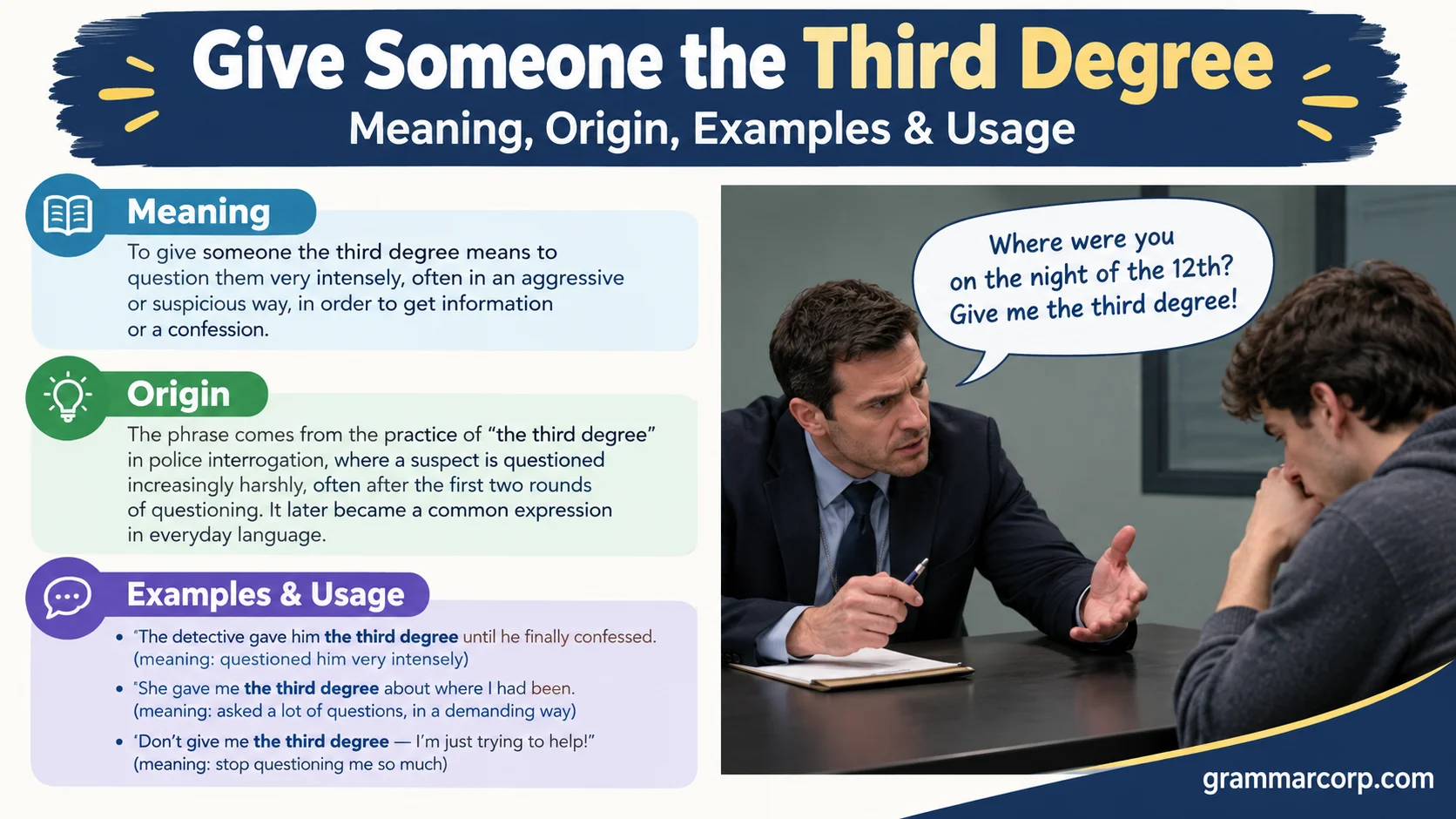
Give Someone the Third Degree: Meaning, Origin, Examples & Usage explains how this English idiom describes difficult questioning rather than real punishment in everyday use. The expression give someone the third degree may sound like a serious action, but its modern figurative meaning usually involves deep, intense, persistent, and sometimes harsh questioning. I have noticed how parents may start asking about plans for the weekend, making someone feel that a simple question has become an actual, almost cruel interrogation technique. People often joke about lots of questions and too much curiosity, although a persistent, thorough process can feel like torture.
The term dates to 1900, and its earlier meanings add to its long history. A third-degree burn was the most severe type, while a third-degree crime could refer to the least serious level in a particular legal system, and these meanings are still used today. In police settings, at home, or in other situations, the phrase applies to many scenarios. Parents, a friend, or a coworker may keep asking detailed questions about where you have been, what you have been doing, or why you came home late. They may seek an explanation for every step of a decision, every little detail, or a story told in full. An attempt to uncover information or obtain a confession can become a tough, sometimes exhausting process of being questioned. The idea is to get to the bottom of something important, whether talking to police, parents, friends, or someone in everyday life.
Thinking back, I can see why similar expressions seem close while having slightly different meanings. Sometimes the questioning is very detailed and intensely harshly delivered, but the phrase generally means discovering exactly what happened in a persistent, serious, and engaged manner. The original term is connected with interrogation, where investigators interrogate a suspect through intense questioning, persistent questioning, an inquiry, or an investigation to obtain answers, an answer, or a response. Historical interrogation technique could involve harsh, cruel treatment, rough treatment, or torture, creating the sense of pressure associated with the wording. The wording, tone, and context can make the expression sound humorously, intrusive, serious, excessive, or simply difficult to escape.
Quick Answer:
Give someone the third degree means to question someone very closely or intensely, usually by asking many detailed or persistent questions.
For example:
My friends gave me the third degree about where I had been.
This means the friends asked many questions and wanted detailed answers.
The phrase is generally informal. It can sound annoyed or critical when someone feels overwhelmed by questions. People also use it jokingly when the questioning isn’t actually serious.
Simple meaning: to question someone intensely.
Comparison Overview
The easiest way to understand someone to the third degree is to compare it with ordinary questioning and related expressions.
| Expression | Basic meaning | Tone | Typical use |
| Give someone the third degree | Question someone intensely | Informal, often negative | Everyday conversations |
| Ask someone questions | Seek information | Neutral | Almost any situation |
| Question someone closely | Ask detailed questions | Neutral to serious | General or formal contexts |
| Grill someone | Ask many difficult questions | Informal | Interviews, conversations |
| Interrogate someone | Question someone systematically | Serious/formal | Investigations |
| Cross-examine someone | Question someone rigorously | Formal | Legal contexts |
The important distinction is intensity. If someone asks you one or two ordinary questions, they probably aren’t giving you the third degree. The idiom suggests sustained questioning that feels more demanding than normal conversation.
Main Differences Between “Give Someone the Third Degree” and Similar Expressions
Although several English expressions describe intensive questioning, they aren’t interchangeable in every situation.
Give Someone the Third Degree vs. Grill Someone
Give someone the third degree and grill someone have very similar meanings.
Both can describe asking someone question after question. However, grill often emphasizes challenging or probing questions.
For example:
- My parents gave me the third degree about the party.
- The interviewer grilled the candidate about her experience.
The first sentence sounds like persistent questioning. The second suggests tougher questions designed to test the person’s knowledge or qualifications.
Give Someone the Third Degree vs. Interrogate Someone
Interrogate sounds more serious and formal.
You might say:
- The detective interrogated the suspect.
You generally wouldn’t use give someone the third degree in a formal police report. The idiom belongs more naturally in casual speech.
However, someone discussing the situation afterward might say:
- The detective practically gave him the third degree.
That version adds a conversational and somewhat dramatic tone.
Give Someone the Third Degree vs. Question Someone Closely
Question someone closely sounds more neutral.
If a teacher questions a student carefully about an assignment, you can describe the situation without implying annoyance.
By contrast, saying the teacher gave the student the third degree suggests that the questioning felt unusually intense.
That difference matters when you want your wording to sound objective.
Give Someone the Third Degree vs. Cross-Examine Someone
Cross-examine has a specific legal meaning. It refers to questioning a witness during a trial.
People sometimes use it figuratively in ordinary conversation:
My brother cross-examined me about the missing charger.
Still, give someone the third degree remains more natural when you’re simply describing relentless questioning in everyday life.
What Does “Give Someone the Third Degree” Mean?
The idiom means to question someone intensely, persistently, or in great detail.
The person asking the questions usually wants an explanation, information, or reassurance. The person answering may feel pressured because the questions keep coming.
Consider this short exchange:
A: Why were you late?
B: Traffic.
A: What happened? Which road did you take? When did you leave?
If this questioning continues, B might jokingly say:
Why are you giving me the third degree?
The phrase doesn’t necessarily mean the questions are hostile. It often communicates the speaker’s feeling that the questioning has become excessive.
What Does “Third Degree” Mean in This Idiom?
Here, third degree doesn’t mean the third level of a school qualification.
It functions as part of a fixed idiomatic expression. The phrase developed a figurative association with intense questioning.
That’s why you shouldn’t interpret the words literally.
Someone saying You’re giving me the third degree isn’t talking about an academic degree. They’re saying:
You’re questioning me very intensely.
The Main Ideas Behind the Expression
When someone gives another person the third degree, the situation often involves:
- Repeated questions
- Detailed follow-up questions
- Persistent requests for explanations
- Pressure to provide information
- Close scrutiny
- A feeling of being interrogated
The exact level of seriousness depends on context.
A friend might use it while laughing. A person facing unwanted questions might say it with genuine irritation.
Examples of “Give Someone the Third Degree”
Examples make this idiom much easier to recognize in real conversations.
Everyday Examples
My mom gave me the third degree when I got home later than expected.
She asked many questions about where the person had been and why they were late.
Don’t give me the third degree. I’ll explain everything.
The speaker feels that the other person is asking too many questions.
My friends gave me the third degree about my weekend plans.
The friends wanted lots of details.
Sarah gave Tom the third degree after he missed the meeting.
Sarah questioned Tom closely about what happened.
School Examples
A student might say:
The teacher gave me the third degree about my missing assignment.
This doesn’t necessarily mean the teacher acted unfairly. It simply emphasizes the student’s perception that the questioning felt intense.
Another example:
My classmates gave me the third degree when they noticed I had a new project.
The classmates asked many questions because they were curious.
Workplace Examples
The phrase also works in informal workplace conversations.
The manager gave me the third degree about the delayed report.
This suggests that the manager asked detailed questions about the delay.
You could also say:
The team lead gave us the third degree about the budget changes.
The wording suggests strong scrutiny rather than a casual discussion.
For formal business writing, however, a neutral alternative such as questioned us extensively may sound more professional.
Social Examples
Imagine that someone buys a gift for a friend. The friend immediately asks:
- Who is it for?
- Where did you get it?
- How much did it cost?
- When did you buy it?
The person might laugh and say:
You’re giving me the third degree!
Here, the expression sounds playful rather than hostile.
Is “Give Someone the Third Degree” Positive or Negative?
The expression usually carries a negative or critical tone because it suggests that someone has asked too many questions.
However, tone matters enormously.
When It Sounds Negative
The phrase can express irritation when someone doesn’t want to answer more questions.
For example:
I told you what happened. Stop giving me the third degree.
Here, the speaker clearly wants the questioning to stop.
When It Sounds Playful
Friends and family members often use the expression jokingly.
Wow, you’re giving me the third degree just because I bought a new backpack!
The speaker isn’t necessarily angry. They may simply be teasing the person for being curious.
When It Sounds Serious
In a tense situation, the phrase can suggest uncomfortable scrutiny.
The committee gave the employee the third degree about the missing records.
The wording makes the questioning sound demanding.
Quick Tone Guide
| Context | Likely tone |
| Friend asking about your plans | Playful or mildly annoyed |
| Parent asking about a late arrival | Annoyed or humorous |
| Manager questioning a mistake | Serious |
| Formal investigation | Informal description of serious questioning |
| Casual teasing | Playful |
The expression therefore isn’t automatically rude. Context, relationship, and tone of voice determine how it lands.
Where Did “Give Someone the Third Degree” Come From?
The origin of give someone the third degree has attracted several explanations over the years. The history is more complicated than simply saying that the phrase came from one specific type of interrogation.
One commonly discussed connection involves the third degree in Freemasonry.
In traditional Masonic terminology, the third degree is associated with becoming a Master Mason. Historical discussions of the idiom have connected the idea of the third degree with an intense examination or initiation process.
Another historical association involves the use of third degree in descriptions of severe questioning or examination. Over time, the expression developed its familiar figurative meaning of subjecting someone to persistent questioning.
The Freemasonry Connection
The Masonic explanation appears frequently in dictionaries and discussions of the phrase’s history. The basic idea is that the third degree represented an advanced and demanding stage of initiation.
That association may have helped reinforce the phrase’s sense of intense examination.
However, origin stories for idioms often become simplified as they pass from one source to another. It’s therefore better to describe this as a historical explanation associated with the expression rather than claim that every detail of the modern phrase has one indisputable origin.
Why the Phrase Became Figurative
English frequently turns serious or specialized language into everyday metaphor.
Consider how people use words such as:
- interrogate
- cross-examine
- grill
- probe
- press
These words can move from literal situations into ordinary conversation.
Give someone the third degree followed a similar path. Today, someone doesn’t need to face a formal investigation to receive the “third degree.” A curious friend can do it simply by asking too many questions.
How to Use “Give Someone the Third Degree” Correctly
The normal grammatical structure is:
give + person + the third degree
The person can change according to the sentence.
Common forms
- give me the third degree
- give him the third degree
- give her the third degree
- give them the third degree
- gave me the third degree
- giving someone the third degree
Examples:
My sister gave me the third degree.
Why are you giving him the third degree?
They gave us the third degree about the decision.
The expression remains grammatically stable while the pronoun or noun changes.
Common Tenses
You can use the idiom naturally in different tenses.
| Tense | Example |
| Present | They give me the third degree every time I travel. |
| Present progressive | They’re giving me the third degree right now. |
| Past | She gave me the third degree yesterday. |
| Future | My parents will give me the third degree if I’m late. |
| Present perfect | They’ve given me the third degree all morning. |
A Common Mistake
Don’t assume that third degree alone carries the full idiomatic meaning.
For example:
She gave me the third degree.
works because the phrase functions as a complete idiom.
But:
She gave me third degree.
doesn’t work in standard usage.
The article the belongs to the established expression.
When Should You Use “Give Someone the Third Degree”?
This idiom works best in informal conversations.
You can use it when someone asks many questions and you want to highlight how intense or persistent the questioning feels.
Good Situations for the Idiom
Use it when talking about:
- Family conversations
- Friends asking personal questions
- Casual workplace discussions
- Social situations
- Humorous conversations
- Fiction and dialogue
- Informal storytelling
For example:
My cousins gave me the third degree about my new hobby.
That sounds natural because the situation is conversational.
When to Choose a Different Expression
Avoid the idiom when you need precise formal language.
Instead of:
The committee gave the applicant the third degree.
a formal report might say:
The committee questioned the applicant extensively.
The second version sounds more objective and professional.
Synonyms for “Give Someone the Third Degree”
No synonym matches the idiom perfectly in every situation. The best choice depends on how serious or informal you want to sound.
Casual Synonyms
Grill someone
Means to question someone intensely.
The reporters grilled the coach after the game.
Pepper someone with questions
Suggests asking many questions quickly or repeatedly.
She peppered me with questions about the trip.
Bombard someone with questions
Emphasizes a large number of questions arriving rapidly.
The students bombarded the speaker with questions.
Press someone for answers
Focuses on persistent attempts to get information.
They kept pressing him for answers.
More Serious Alternatives
Interrogate someone
This is stronger and more formal.
Investigators interrogated the witness.
Question someone intensely
This gives the meaning directly without using an idiom.
Subject someone to intense questioning
This sounds formal and works well in reports or analytical writing.
Neutral Alternatives
- Question someone closely
- Ask someone detailed questions
- Seek more information
- Ask for clarification
- Press for details
These alternatives can avoid the negative implication found in give someone the third degree.
Antonyms and Opposite Ideas
English doesn’t have one perfect opposite for this idiom. However, several expressions communicate the opposite behavior.
These include:
- Leave someone alone
- Take someone’s word for it
- Trust someone’s explanation
- Avoid pressing for details
- Ask only a few questions
- Accept an explanation
For example:
Instead of giving her the third degree, I took her word for it.
This sentence creates a clear contrast between persistent questioning and trusting someone’s explanation.
Related Idioms About Questioning
Several English expressions sit close to give someone the third degree.
Put Someone on the Spot
This means placing someone in a situation where they must respond immediately or handle an uncomfortable question.
The unexpected question put me on the spot.
The focus is pressure in the moment, not necessarily a long series of questions.
Pepper Someone With Questions
This means asking someone many questions, often one after another.
The children peppered the scientist with questions.
This expression can sound more neutral than give someone the third degree.
Press Someone for Answers
This emphasizes persistence.
Reporters pressed the spokesperson for answers.
The person asking may continue because the original answer wasn’t sufficient.
Pump Someone for Information
This means trying to get information from someone, often through persistent questioning.
The reporter tried to pump the witness for information.
The expression can suggest that the person asking questions has a specific goal.
Cross-Examine Someone
This has a strong legal association.
The attorney cross-examined the witness.
Outside legal settings, people sometimes use it metaphorically to describe extremely detailed questioning.
Case Study: How Context Changes the Meaning
Consider the same basic situation in three different settings.
Scenario A: Family
A teenager arrives home later than expected.
A parent asks where they went, who they were with, and why they were late.
The teenager says:
You’re giving me the third degree!
Here, the phrase probably expresses annoyance mixed with familiarity.
Scenario B: Workplace
An employee makes an error in a financial report. A manager asks several detailed questions about how the mistake happened.
A coworker later says:
The manager gave him the third degree about that report.
Here, the idiom emphasizes intense scrutiny.
Scenario C: Friends
A friend notices someone carrying a wrapped gift.
The friend asks who it’s for and keeps guessing.
The person laughs:
Why are you giving me the third degree?
Here, the expression sounds playful.
The words remain the same. The social context changes the meaning people hear.
“Give Me the Third Degree” Meaning in Conversation
One of the most common versions is:
Why are you giving me the third degree?
This usually means:
Why are you asking me so many questions?
It can also imply:
Why do you need so many details?
or:
Why are you questioning me so intensely?
Another common phrase is:
Don’t give me the third degree.
That means the speaker wants the questioning to stop or become less intense.
Example
Don’t give me the third degree. I only went to the library.
The speaker isn’t necessarily accusing the other person of doing anything serious. They simply feel over-questioned.
“Get the Third Degree” vs. “Give Someone the Third Degree”
These expressions are related but focus on different sides of the interaction.
Give someone the third degree describes the person asking the questions.
My brother gave me the third degree.
Get the third degree describes the person receiving the questions.
I got the third degree from my brother.
The difference is small but useful.
| Expression | Focus |
| Give someone the third degree | The questioner |
| Get the third degree | The person being questioned |
Both can describe the same event from opposite perspectives.
Read More : Knuckle Sandwich Idiom Definition: Meaning, Origin, Usage
Is “Give Someone the Third Degree” Formal or Informal?
The expression is primarily informal.
You can use it naturally in conversations, casual messages, personal writing, and dialogue. It also appears in journalism and fiction when the writer wants a conversational tone.
For formal academic or professional writing, clearer alternatives usually work better.
Instead of:
The researchers gave participants the third degree.
you might write:
The researchers questioned participants extensively.
The second sentence communicates the idea without the idiomatic tone.
Why Do People Say “The Third Degree”?
Idioms often preserve older meanings long after ordinary speakers stop thinking about their original references.
That’s what makes the third degree interesting.
Today, most people using the phrase aren’t thinking about its historical associations. They simply recognize the expression as a familiar way to describe intense questioning.
This is common in English. Many idioms have become fixed expressions whose individual words don’t fully explain their modern meaning.
The important lesson is simple:
Learn the phrase as a unit rather than trying to interpret it word by word.
Quick Reference Table
| Question | Answer |
| What does give someone the third degree mean? | To question someone intensely or persistently. |
| Is it an idiom? | Yes. |
| Is it usually formal? | No. It’s mainly informal. |
| Is it always negative? | No. It can be playful or humorous. |
| Does third degree mean an academic degree here? | No. |
| What is a close synonym? | Grill someone. |
| What is a more formal alternative? | Question someone closely or extensively. |
| Can you say give me the third degree? | Yes. |
| Can you say get the third degree? | Yes. |
| Does context affect the tone? | Very much. |
Frequently Asked Questions
1. What does “give someone the third degree” mean?
“Give someone the third degree” means to question someone intensely or persistently, often by asking many detailed or personal questions. It is usually used figuratively in everyday English.
2. Is “give someone the third degree” a literal expression?
No. In modern everyday English, it is generally a figurative expression. It describes intense questioning and does not normally mean that someone is actually being punished.
3. Where did the expression “give someone the third degree” come from?
The expression is associated with the idea of intense interrogation. Its history is connected with earlier uses of “third degree” and the language of questioning, although the exact origin of the idiom is debated.
4. Can I use “give someone the third degree” in casual conversation?
Yes. It is commonly used in informal conversation, especially when someone asks many questions about your plans, actions, relationships, or decisions. It can also be used humorously.
5. What is an example of “give someone the third degree”?
You might say, “My parents gave me the third degree when I got home late.” This means they asked many questions about where you had been and why you were late.
Conclusion
“Give someone the third degree” is a common English idiom for intense, persistent, or excessive questioning. Although the wording has a serious historical background, its modern use is usually figurative and can even be humorous. Understanding its meaning, tone, and context makes it easier to use naturally in everyday English.











1 thought on “Give Someone the Third Degree: Meaning, Origin, Examples & Usage”