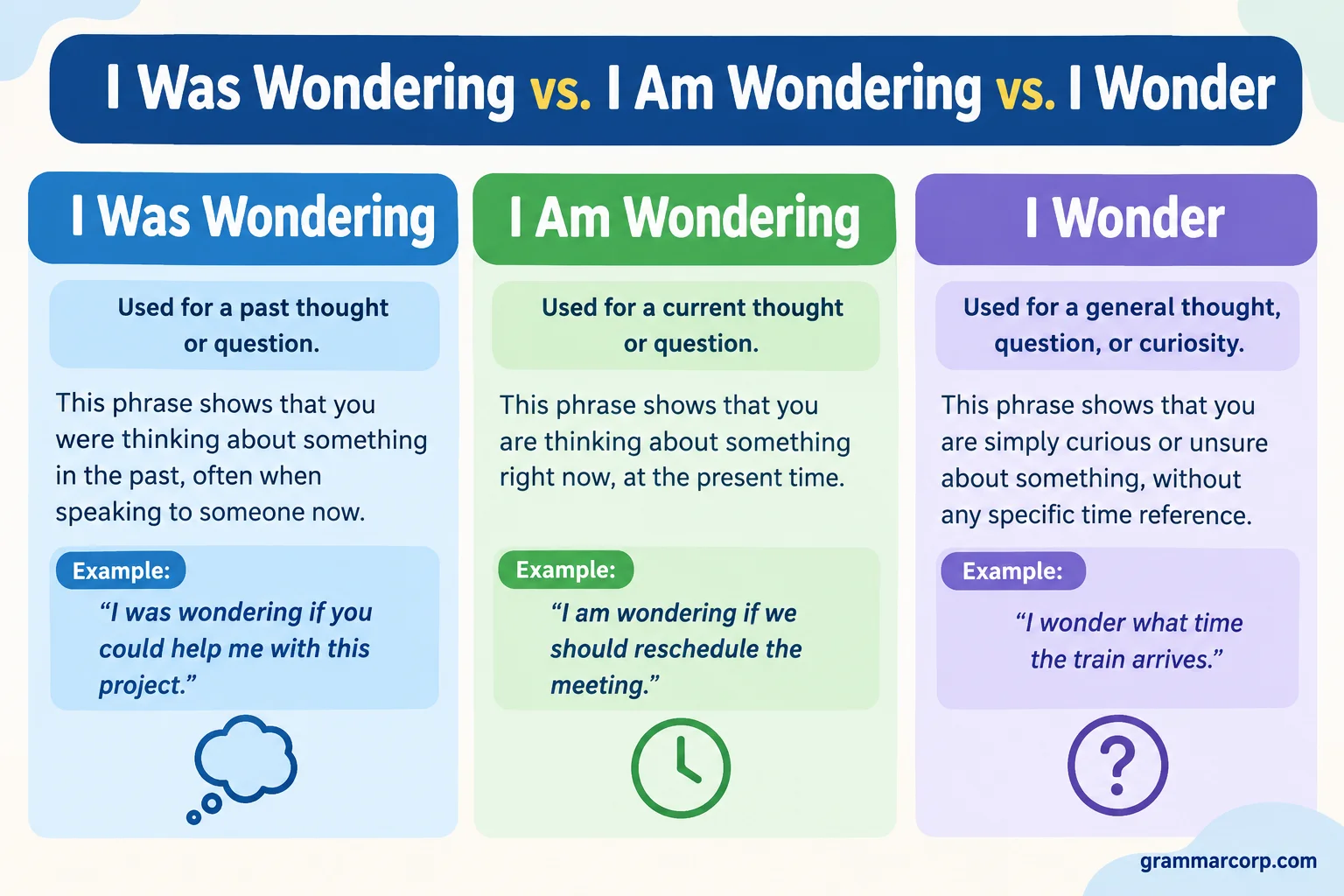
I Was Wondering vs. I Am Wondering vs. I Wonder shows how different expressions shape tone, meaning, politeness, and curiosity in English today.
The difference becomes clearer when we consider tone, politeness, and emotional meaning. I was wondering, I am wondering, and I wonder may look similar, but their subtle differences can affect the overall emotional feeling of a sentence. Your choice of words can shape perception and improve human connection because some phrases feel polite and gentle, while others sound immediate, direct, or thoughtful. In professional situations, especially professional emails, I was wondering usually sounds softer and more respectful, while I am wondering feels more current and emotionally present.
Meanwhile, I wonder often appears in stories, personal conversations, and moments of curiosity, when someone sounds curious, reflective, or interested in a deeper meaning. These expressions are more than a grammar lesson because they influence natural communication, emotional expression, and modern language use. I once sent an email with the wrong emotional sound because I ignored the softer wording of I was wondering. That moment taught me how important politeness, tone, and context are in writing and daily conversations.
Many common mistakes happen when people focus only on grammar and miss the hidden emotional signals inside these phrases. By noticing the practical ways people speak while chatting, casually talking, or reflecting quietly, you can understand how these forms influence communication in both personal and professional settings, making interactions more genuine and meaningful.
Quick Answer
I wonder usually expresses curiosity, uncertainty, or a thought about something you don’t know.
I am wondering uses the present progressive and usually emphasizes that you’re actively thinking about or considering something now.
I was wondering uses the past progressive. It can describe a genuine past thought, but English speakers also commonly use it to make a present request sound more indirect and polite.
Compare these examples:
- I wonder where Sarah is. → I’m curious about Sarah’s location.
- I am wondering where Sarah is. → I’m actively thinking about where Sarah might be.
- I was wondering if you could help me. → I’m making a polite request now.
The forms overlap in some situations. They aren’t three completely separate expressions with fixed meanings. Context determines the precise meaning and tone.
Comparison Overview
| Expression | Grammar | Main meaning | Common use | Typical tone |
| I wonder | Simple present | Curiosity or uncertainty | Thinking, speculating, indirect questions | Neutral |
| I am wondering | Present progressive | An ongoing thought or consideration | Decisions, current concerns, active thinking | Thoughtful |
| I was wondering | Past progressive | Past thought or softened present request | Polite requests, indirect inquiries, past reflection | Softer or more indirect |
Consider the difference in these three sentences:
I wonder if John is coming.
This simply tells us that the speaker is curious.
I am wondering if John is coming.
This puts more attention on the speaker’s current thought process.
I was wondering if John is coming.
This can refer to an earlier thought, but context may also make it sound like a softer way to raise the question.
One important point matters here: grammar doesn’t operate like a collection of rigid switches. A particular tense can contribute meaning beyond its basic time reference. English speakers often use past forms to create conversational distance or soften what they say.
Main Differences Between I Was Wondering vs. I Am Wondering vs. I Wonder
The biggest differences involve time, aspect, purpose, and tone.
I Wonder: Curiosity or Reflection
I wonder uses the simple present.
It often expresses a mental state rather than describing an activity that someone is visibly performing. You might use it when you’re curious about an answer, thinking aloud, or considering something uncertain.
For example:
- I wonder where they went.
- I wonder why the store closed early.
- I wonder whether she’ll accept the offer.
- I wonder what happened.
The expression doesn’t necessarily ask another person to answer you. Sometimes you’re simply expressing curiosity.
Imagine you’re walking past an empty restaurant and notice that its lights are off. You might say:
I wonder why it’s closed.
You’re not necessarily asking anyone nearby for information. You’re expressing a thought.
I Am Wondering: An Ongoing Thought
I am wondering uses the present progressive:
I + am + wondering
The progressive form can emphasize something that is happening or developing around the present moment.
For example:
I am wondering whether I should take the job.
Here, the speaker isn’t merely stating a general curiosity. They’re actively considering a decision.
Another example:
I am wondering what we should do next.
The speaker is currently thinking through a problem.
This doesn’t mean I am wondering is always better than I wonder. In many ordinary situations, I wonder sounds more natural when someone simply wants to express curiosity.
Compare:
- I wonder why he left.
- I am wondering why he left.
Both can be grammatical. The second version places more emphasis on the speaker’s current process of thinking.
I Was Wondering: Past Thought or Polite Request
I was wondering uses the past progressive:
I + was + wondering
Its literal meaning can refer to a thought that was happening in the past.
For example:
Yesterday, I was wondering why the library was closed.
That’s straightforward. The wondering happened yesterday.
However, English uses this structure in another extremely common way:
I was wondering if you could help me.
The request itself usually concerns the present, not the past.
That’s one of the most important points in the entire comparison.
The past form can create distance between the speaker and the request. Instead of saying:
Can you help me?
a speaker might say:
I was wondering if you could help me.
The second version feels less abrupt because it introduces the request indirectly.
Why Does “I Was Wondering” Sometimes Refer to the Present?
This is where many English learners get confused.
English doesn’t use past forms only to describe past events. Speakers can also use past forms for politeness, tentativeness, and social distance.
Consider:
I want to ask you something.
This is direct.
Now compare:
I wanted to ask you something.
Depending on context, the second sentence can still introduce a question that the speaker wants to ask right now.
The same general idea appears with I was wondering.
For example:
I was wondering if you could send me the document.
The speaker isn’t necessarily saying, “I wanted you to send it yesterday.”
Instead, the speaker is making a present request in a less forceful way.
Why the Softer Form Works
A direct request puts the listener immediately in a position where they must respond.
Can you check this for me?
An indirect version creates more conversational space:
I was wondering if you could check this for me.
The second sentence doesn’t demand an action directly. It presents the request as something the speaker has been considering.
That doesn’t mean I was always more polite. Tone also depends on the speaker’s voice, relationship with the listener, wording, and situation.
Still, this construction is a well-established feature of everyday English.
What Does “I Wonder” Mean?
I wonder expresses curiosity, uncertainty, or speculation.
It often introduces an indirect question.
For example:
- I wonder where Maria went.
- I wonder why the computer stopped working.
- I wonder if they know about the change.
- I wonder whether this is the right answer.
Notice that these sentences don’t follow normal direct-question word order.
Direct Questions vs. “I Wonder”
A direct question might be:
Where is Maria?
After I wonder, the word order changes:
I wonder where Maria is.
Not:
I wonder where is Maria.
Another example:
Direct question:
Why did he leave?
Indirect question:
I wonder why he left.
The same pattern appears with other question words.
| Direct question | With “I wonder” |
| Where is she? | I wonder where she is. |
| What does he want? | I wonder what he wants. |
| Why did they leave? | I wonder why they left. |
| When will it start? | I wonder when it will start. |
| How does this work? | I wonder how this works. |
This is an important grammar distinction because learners often carry the word order from the direct question into the indirect question.
What Does “I Am Wondering” Mean?
I am wondering emphasizes an active or ongoing mental process.
It often appears when someone is:
- Considering a decision
- Exploring possibilities
- Thinking through a problem
- Trying to understand something
- Describing a current uncertainty
For example:
I am wondering whether we should leave earlier.
The speaker is actively considering the choice.
Another example:
I’m wondering what caused the problem.
This can suggest that the speaker is currently trying to work out the cause.
“I Wonder” vs. “I Am Wondering”
The distinction becomes clearer when you place them in context.
I wonder what she thinks about the idea.
This sounds like a general expression of curiosity.
I’m wondering what she thinks about the idea.
This sounds more connected to the speaker’s current situation or thought process.
Neither sentence is automatically more correct. The intended emphasis decides which one works better.
What Does “I Was Wondering” Mean?
The literal meaning is simple: the speaker was thinking about something during a past period.
For example:
I was wondering why the lights were still on.
That describes a thought in progress at some point in the past.
But the expression has another major use:
I was wondering if you had a moment to talk.
Here, the speaker is generally asking for time now.
“I Was Wondering” for Polite Requests
You’ll often see the structure:
I was wondering if + subject + could/would + verb
Examples include:
- I was wondering if you could review this.
- I was wondering if you could explain that again.
- I was wondering if you would be available tomorrow.
- I was wondering if you could send the details.
The construction works particularly well when you want to make a request without sounding overly blunt.
However, don’t assume that longer always means more polite.
Compare:
I was just wondering if you might possibly be able to send me the file.
with:
I was wondering if you could send me the file.
The second sentence is clearer and more efficient.
“I Was Wondering” vs. “I Am Wondering” in Requests
These two forms can sometimes appear in similar sentences, but their tone can differ.
I Was Wondering If You Could…
This is a common polite-request pattern.
I was wondering if you could help me with this question.
It creates distance between the speaker and the request.
I Am Wondering If You Could…
This is grammatically possible, but it may sound more focused on the speaker’s current thought.
I’m wondering if you could help me understand this.
The sentence can work naturally. However, depending on the context, I was wondering if you could… may sound more conventional as a polite request.
I Wonder If You Could…
This can also introduce an indirect request:
I wonder if you could check this before Friday.
It sounds relatively indirect but can feel somewhat more formal, restrained, or context-dependent than the conversational I was wondering if you could…
“I Wonder” vs. “I Was Wondering”
These expressions can overlap, especially when introducing an indirect question.
Compare:
I wonder if the meeting is still happening.
This sounds like present curiosity.
I was wondering if the meeting is still happening.
Depending on context, this can sound like a softer inquiry directed toward another person.
For example:
I was wondering if the meeting is still happening. Do you know?
Here, the speaker clearly wants information from the listener.
Meanwhile:
I wonder if the meeting is still happening.
could simply be the speaker thinking aloud.
That’s a useful practical distinction:
“I wonder” often expresses the speaker’s curiosity. “I was wondering” can turn that curiosity into a softer conversational inquiry.
“I Wonder” vs. “I Am Wondering”
The choice here often comes down to whether you want to emphasize curiosity or ongoing consideration.
Use “I Wonder” for Curiosity
Examples:
- I wonder why the road is closed.
- I wonder where they bought that table.
- I wonder whether he’ll come.
- I wonder what happened to the old building.
Use “I Am Wondering” for Active Consideration
Examples:
- I’m wondering whether I should apply.
- I’m wondering what we should do next.
- I’m wondering if there’s another option.
- I’m wondering how we can solve this problem.
The distinction isn’t absolute. Native speakers can use the forms flexibly, especially in informal conversation.
Grammar Rules Behind the Three Expressions
Understanding the grammar makes the differences much easier to remember.
I Wonder = Simple Present
The structure is:
I + wonder
The simple present often describes states, habits, facts, or general situations.
With wonder, it commonly expresses a current state of curiosity:
I wonder what she means.
I Am Wondering = Present Progressive
The structure is:
I + am + wondering
The present progressive can describe something happening around the present time.
I am wondering what to do.
The speaker emphasizes an active thought or consideration.
I Was Wondering = Past Progressive
The structure is:
I + was + wondering
The past progressive normally describes an activity in progress at a past time.
I was wondering why the door was open.
But English also uses this form for indirectness:
I was wondering if you could help.
The grammatical form remains past progressive even though the request can concern the present.
“If” vs. “Whether” After “Wonder”
Both if and whether can introduce indirect questions in many contexts.
For example:
- I wonder if she is coming.
- I wonder whether she is coming.
Both are natural.
Whether can sound more formal and becomes especially useful when the sentence involves alternatives.
For example:
I’m wondering whether we should stay or leave.
You can also say:
I’m wondering whether or not we should stay.
The phrase whether or not explicitly presents both possibilities.
In everyday conversation, however, if often sounds perfectly natural:
I wonder if they’ll arrive soon.
Common Mistakes With “I Was Wondering,” “I Am Wondering,” and “I Wonder”
Mistake: Assuming “I Was Wondering” Always Means the Past
This is the biggest misconception.
I was wondering if you could help me can refer to a request you’re making right now.
The context determines whether the thought itself belongs to the past or whether the past form serves a polite, indirect function.
Mistake: Using Direct Question Word Order
Avoid:
I wonder where is he.
Use:
I wonder where he is.
After an indirect-question expression such as I wonder, use normal statement word order.
Mistake: Thinking “I Am Wondering” Is Incorrect
It isn’t.
I am wondering is grammatically correct.
The question is whether it fits the context naturally.
If you’re describing an active decision, it can work very well:
I’m wondering whether I should take the course.
Mistake: Assuming One Form Is Always More Polite
No single expression guarantees politeness.
I was wondering often softens a request, but the rest of the sentence matters too.
Compare:
I was wondering if you could help.
with an overly complicated version:
I was just wondering if you might possibly be able to help me.
The first sounds polite without unnecessary hesitation.
Mistake: Thinking “I Wonder” Always Requires an Answer
It doesn’t.
I wonder why the sky looks different today.
This can simply express curiosity.
The speaker doesn’t necessarily expect someone else to answer.
I Was Wondering vs. I Am Wondering vs. I Wonder: Real-Life Examples
The easiest way to understand the difference is to see the expressions in realistic situations.
Asking a Friend for Help
I was wondering if you could help me with this assignment.
This sounds like a polite request.
Thinking Through a Decision
I’m wondering whether I should take the earlier train.
The speaker is actively considering a choice.
Thinking Aloud
I wonder why the train is late.
The speaker expresses curiosity.
Asking About a Past Situation
I was wondering why the office was closed yesterday.
Here, was wondering has its straightforward past meaning.
Professional Communication
I was wondering if you could confirm the meeting time.
This is a useful way to make a professional request without sounding abrupt.
Academic Discussion
I wonder whether this explanation accounts for the difference.
This can express intellectual curiosity or introduce a point for discussion.
When a Direct Question Is Better
Indirect language isn’t always necessary.
Sometimes the clearest option is simply to ask.
Instead of:
I was wondering if you could possibly tell me when the meeting starts.
you can say:
What time does the meeting start?
Instead of:
I wonder if you could send the updated file.
you could say:
Could you send the updated file?
Clear communication often beats excessive softening.
The best choice depends on your relationship with the listener, the situation, and how much directness the conversation calls for.
Which One Should You Use?
Use this quick guide when you’re unsure.
Choose “I Wonder” When You Want to:
- Express curiosity
- Think aloud
- Speculate
- Introduce an indirect question
- Describe uncertainty
Example:
I wonder why they changed the schedule.
Choose “I Am Wondering” When You Want to:
- Emphasize an ongoing thought
- Describe active consideration
- Discuss a decision you’re currently making
- Explain what you’re trying to figure out
Example:
I’m wondering whether we should change our plans.
Choose “I Was Wondering” When You Want to:
- Make a polite request
- Ask something indirectly
- Soften an inquiry
- Describe genuine past thinking
Example:
I was wondering if you could check this for me.
Read More : Complaint vs Complain: Meaning, Difference, Grammar Rules
Everyday, Academic, and Professional Examples
The setting can influence which expression feels most natural.
| Situation | Natural example | Why it works |
| Casual curiosity | I wonder where Tom went. | Expresses curiosity |
| Current decision | I’m wondering whether to apply. | Highlights active consideration |
| Asking a friend | I was wondering if you could help. | Softens the request |
| Professional request | I was wondering if you could confirm this. | Polite and indirect |
| Academic discussion | I wonder whether this explains the result. | Introduces a question or possibility |
| Past reflection | I was wondering why the store was closed. | Refers to past thinking |
Practice: Choose the Right Expression
Try completing each sentence with I wonder, I am wondering, or I was wondering.
Situation: You are thinking about changing your plans.
I’m wondering whether I should change my plans.
The present progressive fits because the decision is currently under consideration.
Situation: You are curious about someone’s decision.
I wonder why she chose that option.
The simple present expresses curiosity.
Situation: You want to ask someone for assistance.
I was wondering if you could help me.
The past progressive creates a softer, indirect request.
Situation: You are talking about a thought you had yesterday.
Yesterday, I was wondering why the store closed early.
Here, the past progressive has its literal past-time meaning.
Situation: You’re thinking aloud about the weather.
I wonder whether it will rain.
This expresses uncertainty or curiosity.
Situation: You’re currently deciding which course to take.
I’m wondering which course would be better for me.
The progressive highlights the active decision-making process.
Situation: You politely ask a colleague to check something.
I was wondering if you could check these figures.
The expression makes the request less direct.
Situation: You want to know whether someone has arrived.
I wonder if they’ve arrived yet.
This naturally expresses present curiosity.
FAQs:
1. What does “I was wondering” mean?
“I was wondering” is commonly used to introduce a polite request or question. It often sounds softer and more respectful than a direct question.
2. When should I use “I am wondering”?
Use “I am wondering” when you want to emphasize that you are currently thinking about something or have an active question in your mind.
3. What does “I wonder” express?
“I wonder” usually expresses curiosity, uncertainty, general interest, or reflection. It is natural when you are thinking about something without necessarily asking another person directly.
4. Is “I was wondering” more polite than “I am wondering”?
Often, yes. “I was wondering” can make a request sound less direct and more considerate, especially in professional conversations and emails.
5. Are “I was wondering,” “I am wondering,” and “I wonder” interchangeable?
Not always. Although they can express similar ideas, they differ in tone, emphasis, and context. Choosing the right form makes your communication clearer and more natural.
Conclusion:
Understanding the difference between I was wondering, I am wondering, and I wonder can make your English sound more natural and appropriate.
Use I was wondering for softer and more polite requests, I am wondering for an active thought in the present, and I wonder for curiosity or reflection. Paying attention to context, tone, and politeness will help you choose the expression that best fits each situation.














1 thought on “I Was Wondering vs. I Am Wondering vs. I Wonder”