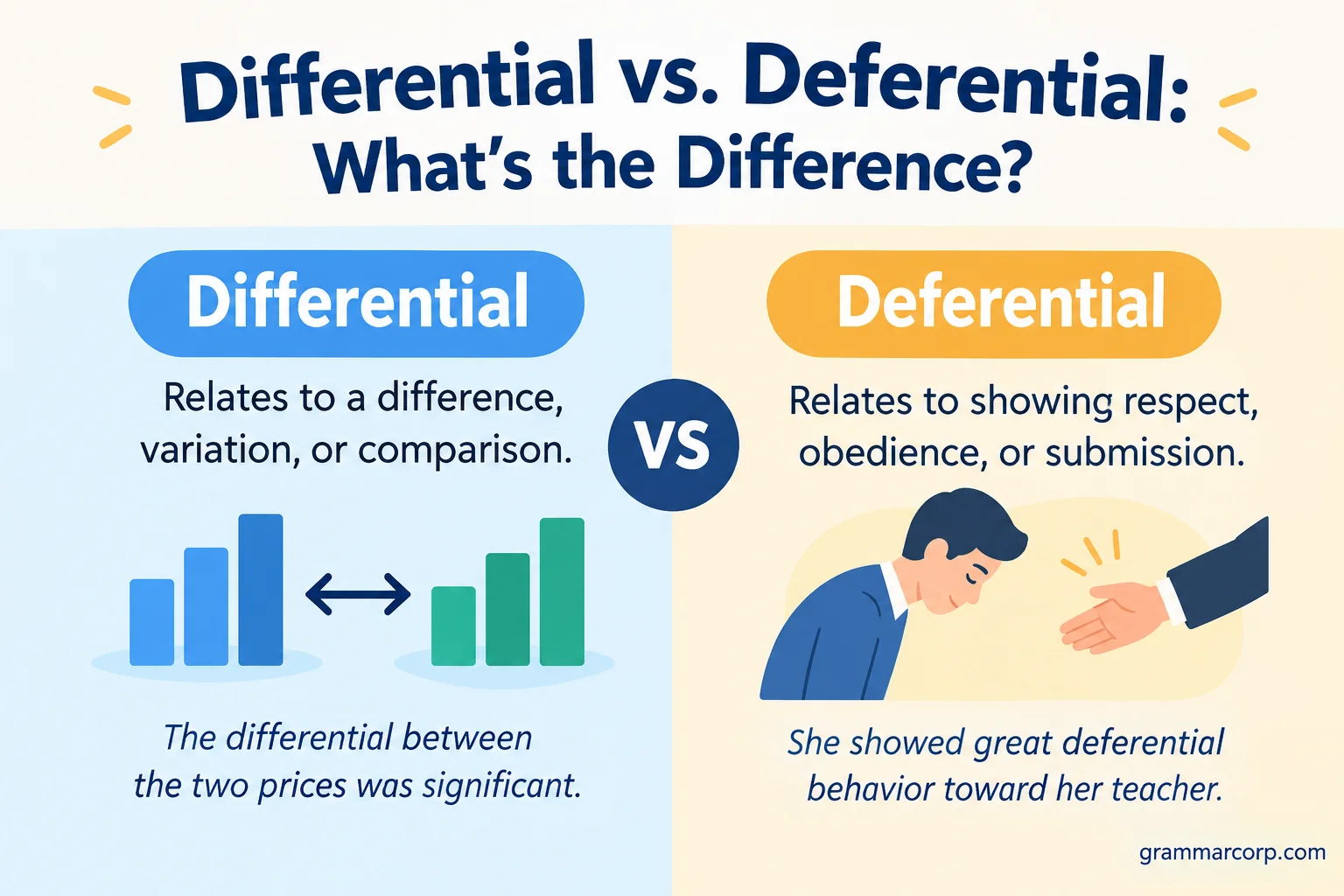
Differential vs. Deferential: What’s the Difference? These adjectives sound similar, but their meanings differ in everyday English and formal use. The difference between differential and deferential can seem confusing because they look and sound similar, but their meanings are completely different. This word-choice question often affects learners and native speakers, especially when spelling, pronunciation, and context are unclear. In plain English, differential relates to a difference, distinction, or variation, while deferential describes respect, politeness, submission, or deference toward another person, particularly someone with authority, experience, age, or status.
In professional communication and interpersonal communication, a deferential tone can improve communication clarity, communication skills, and the ability to communicate effectively. In conversations, spoken English, and written English, attention to context, contextual meaning, and contextual usage supports clear understanding, comprehension, and better expression. Common phrases, sentence examples, and simple examples also help students distinguish these words instead of depending only on how they sound.
By contrast, differential commonly appears in technical fields and technical contexts, including engineering, mechanics, mathematics, physics, and calculus. It can describe measurable differences, a quantifiable difference, variation, comparisons, and measurements, including run differentials and point differentials in sports and science. In technical writing, numbers, calculations, precision, and semantic precision require careful observation. I often notice that students struggle with these terms because they seem somewhat similar and are occasionally confused even when the basic definitions are known. Careful reading, writing, listening, and speaking practice makes the exact difference easier to learn and use correctly in everyday English and academic communication. These practical usage tips, rules, and memory tricks help learners know when to use each word confidently and avoid the wrong choice that can change a sentence or cause misunderstandings.
Quick Answer:
Differential means relating to a difference or representing a difference between things.
Deferential means showing respect or politeness toward someone, often because of that person’s authority, experience, age, or position.
The easiest way to remember them is:
Differential = difference
Deferential = deference and respect
For example:
- The company has a significant salary differential between entry-level and senior positions.
- The junior lawyer was deferential toward the judge.
Cambridge Dictionary defines differential as an adjective meaning “based on a difference.” It also uses the noun differential for an amount of difference between things being compared.
Cambridge defines deferential as meaning polite and respectful. Its related noun, deference, refers to respect or politeness shown toward another person.
So if you’re asking differential vs. deferential, think about the subject first:
- Is the sentence about a difference or gap? Use a differential.
- Is it about respectful behavior? Use deferential.
Comparison Overview
| Feature | Differential | Deferential |
| Basic meaning | Related to a difference | Showing respect |
| Main idea | Difference or variation | Respect or politeness |
| Common part of speech | Noun and adjective | Adjective |
| Related word | Difference | Deference |
| Common context | Pay, prices, mathematics, mechanics, comparisons | Authority, seniority, experience, social relationships |
| Example | There is a large pay differential. | She was deferential toward her supervisor. |
| Easy memory word | Different | Deference |
The two words share a similar ending, but that similarity doesn’t make them interchangeable.
Differential describes a relationship involving difference. Deferential describes an attitude or manner involving respect.
That distinction remains true even when both words appear in formal writing.
What Does Differential Mean?
Differential has several meanings depending on the context. Its central idea is a difference between things that can be compared.
As an adjective, differential means based on or relating to a difference. Cambridge gives examples involving salary structures and pay.
As a noun, differential can mean the amount of difference between two things.
For example:
- The company introduced a differential salary structure.
- The price differential between the two products is substantial.
- Researchers examined the differential effects of the policy.
- The team finished with a positive goal differential.
- The mechanic repaired the vehicle’s differential.
Notice how each example centers on a difference or a specialized system involving differences.
Differential as an Adjective
When differential works as an adjective, it usually modifies another noun.
Common combinations include:
- differential treatment
- differential pricing
- differential pay
- differential impact
- differential effects
- differential diagnosis
- differential equation
- differential pressure
The exact meaning depends on the noun that follows it.
For example, differential pay refers to a difference in compensation under particular circumstances. A workplace might offer additional pay for a night shift.
Differential diagnosis has a specialized medical meaning. It involves considering multiple possible conditions that could explain a patient’s symptoms. Cambridge defines it as a judgment made by choosing among two or more possible conditions with similar symptoms.
Differential as a Noun
As a noun, differential often identifies the gap between two amounts.
For example:
- The price differential between the models is $500.
- The wage differential widened over several years.
- The pay differential between the two positions is significant.
Cambridge specifically defines this noun sense as an amount of difference between things being compared.
The word also has specialized technical meanings.
In automobiles, a differential is part of the drivetrain that allows wheels on the same axle to rotate at different speeds when necessary. Cambridge lists this as a specialized gear-related noun meaning.
So don’t assume differential always means a simple numerical difference. The surrounding context determines the intended meaning.
What Does Deferential Mean?
Deferential describes a person, attitude, behavior, or manner that shows respect toward someone else.
It often appears when one person recognizes another person’s authority, experience, knowledge, age, or social position.
Cambridge defines deferential as polite and showing respect.
Consider these examples:
- The student was deferential toward the professor.
- The attorney remained deferential when addressing the judge.
- The employee took a deferential tone with the senior executive.
- He was respectful but not overly deferential.
- Her deferential manner reflected her respect for the experienced mentor.
In each example, the word describes how someone behaves toward another person.
Deferential and Deference
The easiest way to understand deferentiality is to connect it with deference.
Deference is a noun. It refers to respect or polite behavior shown toward another person. Cambridge notes that this respect can relate to someone’s experience, knowledge, age, or power.
Deferential is the adjective.
Think of the relationship like this:
- Deference = the respect itself
- Deferential = showing that respect
For example:
- She showed deference toward the senior scientist.
- She was deferential toward the senior scientist.
The first sentence uses the noun. The second uses the adjective.
Is Deferential Always Positive?
Not necessarily.
A deferential attitude can simply mean respectful and polite. However, the word can sometimes suggest that someone gives another person unusually strong respect because of status or authority.
Context determines the tone.
Compare these sentences:
The intern was deferential toward the experienced researcher.
This sounds fairly neutral or positive.
The employee was excessively deferential to the manager.
Here, excessively changes the impression. The sentence may suggest that the employee shows too much submission or gives the manager more authority than necessary.
That distinction matters because deferential can describe healthy respect or a more submissive attitude depending on context.
Main Differences Between Differential vs. Deferential
The main difference between differential vs. deferential comes down to two completely separate ideas.
Differential Is About Difference
Differential focuses on how things differ.
You might compare:
- Two prices
- Two salaries
- Two groups
- Two outcomes
- Two levels
- Two effects
- Two measurements
For example:
The company found a significant differential in operating costs.
The word points to a measurable or identifiable difference.
Deferential Is About Respect
Deferential focuses on how one person behaves toward another.
You might describe someone’s behavior toward:
- A teacher
- A judge
- A supervisor
- An elder
- A respected expert
- A senior colleague
- An authority figure
For example:
The student remained deferential when speaking with the professor.
The word describes the student’s respectful manner.
Differential vs. Deferential at a Glance
| Question | Correct Word |
| Are you describing a difference? | Differential |
| Are you describing respectful behavior? | Deferential |
| Are you comparing two prices? | Differential |
| Are you describing someone’s attitude toward a judge? | Deferential |
| Are you talking about salary differences? | Differential |
| Are you talking about respect for authority? | Deferential |
| Is the related word “difference”? | Differential |
| Is the related word “deference”? | Deferential |
Differential vs. Deferential in Sentences
Seeing the words in context makes the difference much clearer.
Examples of Differential
- The two plans have a considerable price differential.
- The company introduced a differential pay system for overnight workers.
- Researchers measured the differential effects of the two treatments.
- The teams ended the season with a small point differential.
- The contract creates a differential salary structure based on experience.
- The study examined the differential impact of the policy on different groups.
- The mechanic explained how the vehicle’s differential works.
Each sentence concerns a difference, variation, comparison, or specialized technical concept.
Examples of Deferential
- The student was deferential toward her teacher.
- The attorney adopted a deferential tone when addressing the judge.
- The young researcher remained deferential toward her experienced mentor.
- The employee was polite without becoming overly deferential.
- He spoke in a deferential manner during the formal meeting.
- The assistant remained deferential to the director’s experience.
- The athlete was respectful and deferential when discussing the veteran coach.
Here, the word describes respectful behavior or attitude.
Common Mistakes With Differential and Deferential
Because the words look similar, writers sometimes swap them accidentally.
Mistake: Using Deferential for a Difference
Incorrect:
There is a large deferential between the two salaries.
Correct:
There is a large differential between the two salaries.
The sentence describes a gap between amounts. Therefore, the differential is correct.
Mistake: Using Differential for Respect
Incorrect:
The student was different toward the professor.
Correct:
The student was deferential toward the professor.
The sentence describes respectful behavior. Therefore, deferential is the correct choice.
Mistake: Confusing Deferential With Different
Another common problem occurs because differential resembles different.
Although the words are related, differential has a more specific role. It often describes a difference between measurable, comparable, or distinguishable things.
For ordinary situations, you may simply need different.
For example:
The two plans are different.
You don’t normally need:
The two plans are differential.
However, in technical, academic, business, or specialized contexts, differential can be appropriate.
Mini Case Studies: Differential vs. Deferential in Real Contexts
Workplace Example
Imagine a company pays employees different rates for different shifts.
A manager might say:
The company has a night-shift pay differential.
Here, differential works because the phrase describes a difference in compensation.
Now imagine an employee speaking respectfully to the company’s chief executive.
You could write:
The employee was deferential toward the chief executive.
The first word describes a difference in pay. The second describes respectful behavior.
Classroom Example
A teacher compares test results between two groups.
The analysis revealed a noticeable performance differential between the groups.
Later, a student discusses the findings with the teacher.
The student remained deferential while listening to the teacher’s explanation.
Again, the words have entirely different jobs.
Professional Example
Consider a courtroom.
An attorney might compare two legal outcomes and discuss the differential between them.
When addressing the judge, however, the attorney may adopt a deferential tone.
The distinction is simple:
Differential describes the comparison. Deferential describes the conduct.
How to Remember Differential vs. Deferential
You don’t need a complicated mnemonic.
Just connect each word to its closest familiar word.
Differential → Difference
Look at the beginning:
DIFFERential
It starts with differ, which connects directly with different and difference.
When the sentence involves a gap, variation, or comparison, think:
Differential = difference.
Deferential → Deference
Now look at:
DEFERential
This connects with deference.
When the sentence involves respectful behavior toward another person, think:
Deferential = deference.
This is the most useful memory trick because it works in actual writing.
The Two-Question Test
Before choosing the word, ask:
Question one: Am I describing a difference between things?
If yes, choose differential.
Question two: Am I describing respect toward someone?
If yes, choose deferential.
For example:
The differential between the two salaries is $10,000.
Difference? Yes. Use differential.
The assistant was deferential toward the senior manager.
Respect? Yes. Use deferential.
Differential vs. Deferential Pronunciation
Pronunciation can also contribute to the confusion.
Cambridge gives the US pronunciation of differential as approximately:
/ˌdɪf.əˈren.ʃəl/
The word begins with a sound similar to different.
Deferential is pronounced approximately:
/ˌdef.əˈren.tʃəl/
The beginning sounds like defer rather than differ.
The middle and ending portions sound similar. The first part provides a useful clue.
Try saying them slowly:
- DIF-fer-en-tial
- DEF-er-en-tial
The first points toward difference. The second points toward deference.
Read More : I Was Wondering vs. I Am Wondering vs. I Wonder
Words Related to Differential
Knowing related vocabulary can help you recognize the word more quickly.
Common related terms include:
- different
- difference
- differentiate
- differentiation
- differentially
Cambridge defines differentiate as showing or finding the difference between things being compared.
Differentiation similarly refers to the act or process of identifying or creating differences between things.
For example:
The brand uses product differentiation to stand out from competitors.
The shared idea remains difference.
Words Related to Deferential
The most important related word is deference.
Other useful words include:
- deference
- respect
- respectful
- politeness
- courtesy
- reverence, depending on context
The relationship between deference and deferentiality is especially useful.
Compare:
She showed deference toward the senior professor.
and:
She was deferential toward the senior professor.
Both sentences express the same general idea. The first uses a noun. The second uses an adjective.
When Should You Use a Differential?
Use differential when the sentence concerns a difference, gap, variation, or specialized technical meaning.
It commonly appears in:
Business
- price differential
- wage differential
- pay differential
- cost differential
Science and Mathematics
- differential equation
- differential analysis
- differential measurement
Medicine
- differential diagnosis
Sports
- point differential
- goal differential
Engineering and Mechanics
- mechanical differential
- vehicle differential
This wide range explains why differential appears frequently in technical and professional writing.
When Should You Use Deferential?
Use deferential when you want to describe someone who behaves respectfully toward another person.
It commonly appears in situations involving:
- Authority
- Seniority
- Experience
- Age
- Expertise
- Social position
- Professional hierarchy
For example:
The junior employee was deferential toward the department head.
The word doesn’t mean the employee and manager were different.
It means the employee treated the manager with respect.
Differential vs. Deferential: A Simple Editing Checklist
Before publishing or submitting your writing, use this checklist.
Choose Differential If:
- You’re comparing two things.
- You’re describing a gap between amounts.
- You’re discussing different effects.
- You’re describing differences between groups.
- You’re using a technical term such as differential equation.
- You’re discussing a mechanical differential.
Choose Deferential If:
- You’re describing respectful behavior.
- Someone recognizes another person’s authority.
- Someone behaves respectfully toward an expert.
- Someone shows respect because of age or experience.
- You’re describing a polite or respectful tone.
If neither meaning fits, consider whether different, respectful, polite, or another simpler word would work better.
FAQs:
1. What is the difference between differential and deferential?
Differential refers to a difference, variation, or distinction between things. Deferential describes someone who shows respect, politeness, or deference toward another person.
2. When should I use a differential?
Use differential when discussing differences, especially in technical contexts such as mathematics, engineering, mechanics, science, sports, or measurements. For example, a point differential shows the difference between points scored.
3. When should I use deferential?
Use deferential when describing respectful behavior toward someone, particularly a person with authority, experience, age, or status. For example, an employee may use a deferential tone when speaking to a manager.
4. Are differential and deferential pronounced the same way?
No. Although they look and sound somewhat similar, their pronunciation and meanings are different. Paying attention to the middle sounds can help learners distinguish them.
5. What is an easy way to remember differential and deferential?
Connect differential with different and deferential with deference. If you mean a difference or variation, choose a differential. If you mean respectful behavior, choose deferential.
Conclusion:
The difference between differential and deferential becomes easier once you connect each word with its meaning. Differential concerns differences, variations, and measurements, while deferential describes respect and polite behavior toward another person.
Understanding their context, grammar, and common usage can help you choose the right word confidently in everyday, academic, and professional English.














1 thought on “Differential vs. Deferential: What’s the Difference?”