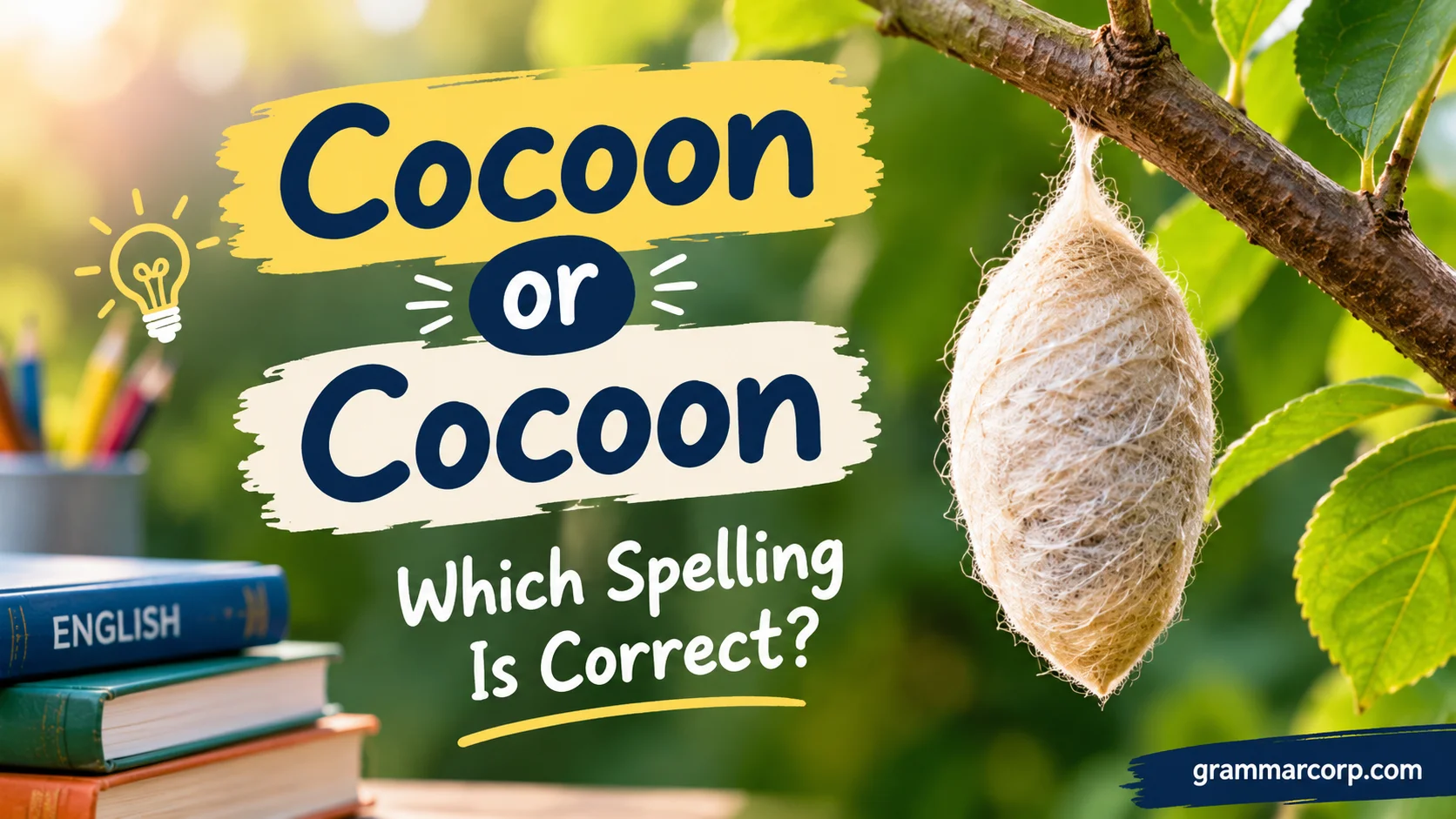
Cocoon or Cocoon: Which Spelling Is Correct? can be confusing when a little vowel changes the spelling, sound, and meaning of familiar words. When you have typed a question about spelling, the correct choice can seem like a little vowel problem because the words look almost identical and sound similar. This can create confusion about what they mean and which word you normally need. In English writing, Cocoon is the proper spelling when you are talking about the protective covering made by certain insects during development. The word has established figurative meanings connected with protection, comfort, and isolation. It refers to a silky case or protective enclosure surrounding a caterpillar before it becomes a butterfly, linking it with biology, nature, metamorphosis, and transformation.
The distinction becomes clearer through semantics and context. Cocoon works as a noun and verb form, meaning to envelop or protect someone or something, adding another meaning in everyday language usage. Cacoon is also a real dictionary word, although it is less common in everyday use. Merriam-Webster defines it as a West Indian snuffbox bean associated with a tropical American plant, Fevillea cordifolia, while Collins records it for the large bean of a tropical climber.
From my experience reviewing spelling mistakes, this small difference often matters because it affects clarity, accuracy, and credibility. People may confuse the two in school essays, online posts, or blogs, especially after seeing both spellings in a search box. Their pronunciation and similar appearance can make the difference easy to overlook, but cocoon remains the standard English spelling for the insect term. Cacoon is not a random collection of letters; it has specialized botanical contexts involving tropical plants and seeds. It is therefore not an alternative spelling of the insect term.
Quick Answer:
cocoons is the correct spelling when you mean the protective covering associated with certain insects during the pupal stage.
For example:
- The moth emerged from its cocoons .
- The caterpillar built cocoons before transforming.
- The insect remained inside its cocoons .
cocoons is also a real English word. It refers to certain tropical plants or their large bean-like seeds. Merriam-Webster records cocoons with meanings connected to a West Indian snuffbox bean and a tropical American plant.
The easiest rule to remember
Insect covering = cocoons s .
Tropical plant or bean = cocoons s .
If you’re writing about butterflies, moths, caterpillars, or insect development, cocoons s is almost certainly the word you’re looking for.
Comparison Overview
The quickest way to understand cocoons s vs. cocoons s is to put the two words side by side.
| Feature | cocoons s | cocoons s |
| Main meaning | Protective covering made by certain insects | A tropical plant or large bean/seed |
| Part of speech | Noun and verb | Noun |
| Common everyday word | Yes | No |
| Biological usage | Insect development | Botanical context |
| Figurative meaning | Yes | Not commonly used figuratively |
| Common spelling confusion | Often confused with cocoons s | Often mistaken for cocoons s |
| Pronunciation | /kəˈkuːn/ | Often listed with a similar final sound |
| Plural | cocoons s s | cocoons s s |
Cambridge defines cocoons s as a covering made from soft threads that protects particular insects during the pupal stage. It also lists a figurative meaning for a safe or quiet place.
Merriam-Webster gives cocoons s a separate definition. It identifies the word with a West Indian snuffbox bean and a tropical American plant.
The difference is therefore more than one letter.
Main Differences Between cocoons s or cocoons s
cocoons s refers to an insect covering
When people use the word cocoons s in everyday English, they usually mean the protective covering associated with an insect’s development.
Certain insect larvae produce a cocoons s from silk or other materials. The structure provides protection while the insect undergoes an important developmental stage. Cambridge specifically describes a cocoons s as a covering that surrounds and protects particular insects during the pupa stage.
For example:
- The moth remained inside its cocoons s .
- A silk-producing larva creates a cocoons s .
- Researchers studied the insect’s cocoons s before emergence.
The word also appears in biology, nature writing, children’s books, documentaries, and ordinary conversation.
cocoons s refers to something completely different
cocoons s doesn’t describe the usual insect covering.
Merriam-Webster defines the noun as a West Indian snuffbox bean. It also gives a second sense for a tropical American plant, Fevillea cordifolia, in the cucumber family.
Collins records another botanical use, describing cocoons s as the large bean of a tropical climber, Entada scandens.
Plant-name references also record cocoons s as an English common name associated with species in the genus Entada. Kew’s Plants of the World Online lists cocoons s among the vernacular names for Entada gigas.
This explains why cocoons s shouldn’t simply be dismissed as a nonexistent word.
cocoons s has a figurative meaning
English speakers don’t use cocoons s only for insects.
The word can describe a protected, quiet, or enclosed environment. Cambridge gives the example of a safe place described as a cocoons s .
You might write:
- The room became a quiet cocoons s during the storm.
- She created a warm cocoons s of blankets.
- The small apartment felt like a comfortable cocoons s .
This figurative meaning comes naturally from the physical idea of something surrounding and protecting another thing.
cocoons s can also work as a verb
cocoons s can function as a verb.
In this form, it means to protect or enclose someone or something. Cambridge lists the verb as meaning to protect someone or something from pain or an unpleasant situation.
Examples include:
- The thick walls cocoons s ed the room from the noise.
- The child was cocoons s ed from the harsh weather.
- The blankets cocoons s ed the baby in warmth.
The related forms include:
- cocoons s
- cocoons s s
- cocoons s ed
- cocoons s ing
So, unlike cocoons s , cocoons have a useful noun-and-verb role in modern English.
What Does cocoons Mean?
cocoons s as a biological term
In biology, a cocoons s is a protective covering produced by certain insects.
The structure can surround the insect while it develops toward its adult form. Cambridge describes it specifically as a covering made from soft, smooth threads that surrounds and protects particular insects during the pupa stage.
The word often appears when discussing moths and other insects that create such coverings.
A simple example is:
The caterpillar disappeared into its cocoons s .
That sentence uses cocoons s in its literal biological sense.
cocoons s and the pupa stage
It’s useful to understand one scientific distinction here.
A cocoons s is a covering or structure. A pupa is a developmental stage.
They aren’t automatically the same thing.
Some insects have a pupal stage without producing a traditional silk cocoons s . Butterflies, for example, are commonly associated with chrysalises, which are their pupal forms rather than silk cocoons s s.
This is why saying that every insect develops inside a cocoons s would be too broad.
A more accurate statement is:
Certain insects produce cocoons s s around their developing pupal stage.
That wording keeps the biology precise.
cocoons s as a figurative noun
The physical idea of a protective covering naturally led to a broader meaning.
A cocoons s can describe anything that surrounds someone with comfort, safety, or isolation.
For example:
- Her bedroom became a peaceful cocoons s after a busy day.
- The cabin provided a warm cocoons s during the winter.
- The quiet library felt like a cocoons s away from the noisy street.
Cambridge explicitly records this figurative sense as a safe, quiet place.
This use is common because the metaphor is easy to understand. A physical cocoons s protects an insect. A figurative cocoons s can protect a person from noise, stress, or unwanted distractions.
What Does cocoons s Mean?
cocoons s is a real word
One of the most important facts in the cocoons s or cocoons s debate is that cocoons s is not simply an invented spelling.
Merriam-Webster has a dictionary entry for cocoons s . It records the word as a noun and gives botanical meanings connected with tropical plants and beans.
Collins also has a separate entry for the word.
So, if someone says cocoons s isn’t a word, that statement is too broad.
The better explanation is:
cocoons s is a real but uncommon word that normally has nothing to do with an insect’s cocoons s .
cocoons s and tropical plants
The word has been associated with plants in the genus Entada.
The exact botanical history can be complicated because common names don’t always map neatly onto one scientific species. The University of Melbourne’s plant-name database, for example, lists cocoons s as an English name for Entada gigas and cocoons s Vine for Entada rheedei. It also notes that vernacular plant names can be unsettled because of taxonomic confusion.
That is why a general definition such as a tropical plant or its large bean-like seed is more useful for ordinary language questions than pretending every historical use refers to one exact species.
Why cocoons s is rarely seen
Most English speakers encounter cocoons s s far more often than cocoons s .
The difference comes down to subject matter.
People regularly talk about:
- butterflies
- moths
- caterpillars
- insect life cycles
- transformation
- silk
- protective coverings
Those topics naturally use cocoons s .
By contrast, cocoons s belongs mostly to specialized botanical, historical, or regional contexts.
As a result, a person who writes cocoons s while describing an insect is usually dealing with a spelling confusion rather than intentionally using the botanical word.
cocoons s vs. cocoons s : Why Are They Confused?
The two spellings create an obvious visual trap.
Only the vowel after the first c changes.
That makes the error easy to understand.
Pronunciation adds to the confusion
Cambridge gives the pronunciation of cocoons s as /kəˈkuːn/ in both British and American English.
The first syllable uses a reduced vowel sound. That sound isn’t strongly tied to the written letter o in the mind of every listener.
Someone hearing the word may therefore mentally reconstruct the spelling incorrectly.
This is a common pattern in English. Pronunciation doesn’t always give you a reliable map of spelling.
The visual pattern creates a false shortcut
Once someone sees cocoons s , the spelling can look plausible.
After all:
- ca + coon
- co + coon
Both forms look like they could belong to English.
But only one is normally appropriate for the insect-related meaning.
That’s why context is more useful than simply trying to memorize the appearance of the word.
How to Use cocoons s in a Sentence
The easiest way to understand the correct spelling is to see it in context.
Examples of cocoons s as a noun
- The caterpillar disappeared inside its cocoons s .
- The moth eventually emerged from the cocoons s .
- Scientists observed the insect while it remained inside its cocoons s .
- The delicate cocoons s hung from a branch.
- The larva formed a protective cocoons s before the next stage of development.
Each example refers to a protective structure associated with insect development.
Examples of cocoons s as a figurative noun
- The quiet room became a cocoons s from the busy world outside.
- The blankets created a warm cocoons s on the cold evening.
- Music gave her a peaceful cocoons s of sound.
- The small cabin felt like a comfortable cocoons s in the mountains.
Here, the word doesn’t refer to an actual insect structure.
Instead, it describes something that provides protection, comfort, or enclosure.
Examples of cocoons s as a verb
- Thick curtains cocoons s ed the room in darkness.
- The blanket cocoons s ed him against the cold.
- The quiet environment cocoons s ed the family from the noise outside.
- The walls cocoons s ed the studio from the busy street.
Cambridge records this verb usage as meaning to protect someone or something from pain or an unpleasant situation.
Common Mistakes With cocoons s and cocoons s
Mistake: Writing cocoons s when you mean cocoons s
This is the most common issue behind the search cocoons s or cocoons s .
Incorrect for the insect meaning:
- The butterfly came out of its cocoons s .
Correct:
- The butterfly came out of its cocoons s .
The second sentence uses the standard word for the insect-related meaning.
Mistake: Saying cocoons s isn’t a word
This mistake goes in the opposite direction.
cocoons s is a dictionary word.
Merriam-Webster lists it. Collins lists it. Botanical references also document related common-name usage.
The important point is that its meaning differs from cocoons s .
So the accurate correction isn’t:
cocoons s s are always wrong.
Instead:
cocoons s is wrong when you mean an insect’s cocoons s .
That’s a much more precise explanation.
Mistake: Treating cocoons s and chrysalis as exact synonyms
Another common misunderstanding involves cocoons s and chrysalis.
A chrysalis refers to the pupal form of a butterfly. A cocoons s refers to a protective covering produced by certain insects.
The terms can appear in discussions of insect metamorphosis, but they don’t mean exactly the same thing.
A simple comparison helps:
| Term | What it describes |
| cocoons s | A protective covering produced by certain insects |
| Chrysalis | The pupal form of a butterfly |
| Pupa | A developmental stage between larva and adult in insects with complete metamorphosis |
This distinction matters when writing educational or scientific content.
Mistake: Assuming every caterpillar makes a cocoons s
Not every caterpillar makes the same type of protective structure.
Some species form cocoons s s. Others pupate in different ways.
Therefore, cocoons s shouldn’t be treated as a universal term for every insect’s pupal stage.
How to Remember the Correct Spelling
A simple memory trick can eliminate most confusion.
Think about the meaning first
If you’re describing:
- a moth’s protective covering
- a silk-producing insect
- an insect developing inside a protective covering
- a figurative safe enclosure
use cocoons s .
If you’re discussing a tropical plant or a particular large bean or seed called cocoons s , then cocoons s may be the correct word.
Use this quick test
Ask yourself:
Am I talking about an insect’s protective covering?
If the answer is yes, write:
cocoons s
If you’re discussing the botanical term, check whether cocoons s is the intended plant or seed name.
This approach works better than simply memorizing two spellings because it connects the spelling to the meaning.
Read More : Formerly vs Formally: What’s the Difference?
cocoons s or cocoons s in Search and Everyday Writing
People often search cocoons s or cocoons s because they want a quick spelling check.
In ordinary writing, the practical answer is straightforward.
If you’re writing about an insect, choose cocoons s .
That applies to:
- school assignments
- blog posts
- essays
- emails
- social media captions
- nature articles
- educational content
- science explanations
For example:
Correct: The moth emerged from its cocoons s .
Incorrect for this meaning: The moth emerged from its cocoons s .
But if you’re writing about the botanical term itself, cocoons s can be correct.
This distinction is especially useful for editors and writers because it prevents an oversimplified spelling correction from changing a legitimate word into a supposed error.
A Simple cocoons s vs. cocoons s Case Study
Consider two sentences:
Sentence A:
The caterpillar built a cocoons s before becoming an adult moth.
Sentence B:
The trader described the tropical cocoons s bean.
Both spellings can be correct.
The surrounding subject tells you which word belongs.
In Sentence A, the subject is insect development. Therefore, cocoons s is correct.
In Sentence B, the subject is a tropical plant product. Therefore, cocoons s can be correct when that specific botanical term is intended.
This is the key lesson:
Spelling alone doesn’t tell the whole story. Meaning determines the right word.
FAQs:
1. Is “cocoon” the correct spelling?
Yes. Cocoon is the standard English spelling when referring to the protective covering associated with an insect’s development.
2. Is “cacoon” a misspelling of “cocoon”?
Not always. Cacoon is a real dictionary word used in specialized botanical contexts, including references to a tropical plant or bean.
3. What does “cocoon” mean?
A cocoon is a protective covering made by certain insects during development. It can also be used figuratively for a state of protection, comfort, or isolation.
4. What is the difference between a cocoon and a chrysalis?
A cocoon is generally a protective covering, often made of silk, around an insect during development. A chrysalis specifically refers to the pupal stage of a butterfly or moth.
5. How can I remember the spelling “cocoon”?
A simple memory trick is to associate cocoon with the insect’s protective covering. When discussing insects, cocoon is the spelling you normally need.
Conclusion:
Cocoon is the standard spelling for the protective covering associated with insect development, while cacoon has a separate botanical meaning.
Although the two words look similar, their meanings and contexts are different. Knowing this distinction can help you avoid spelling mistakes and use the right word with greater clarity and accuracy.