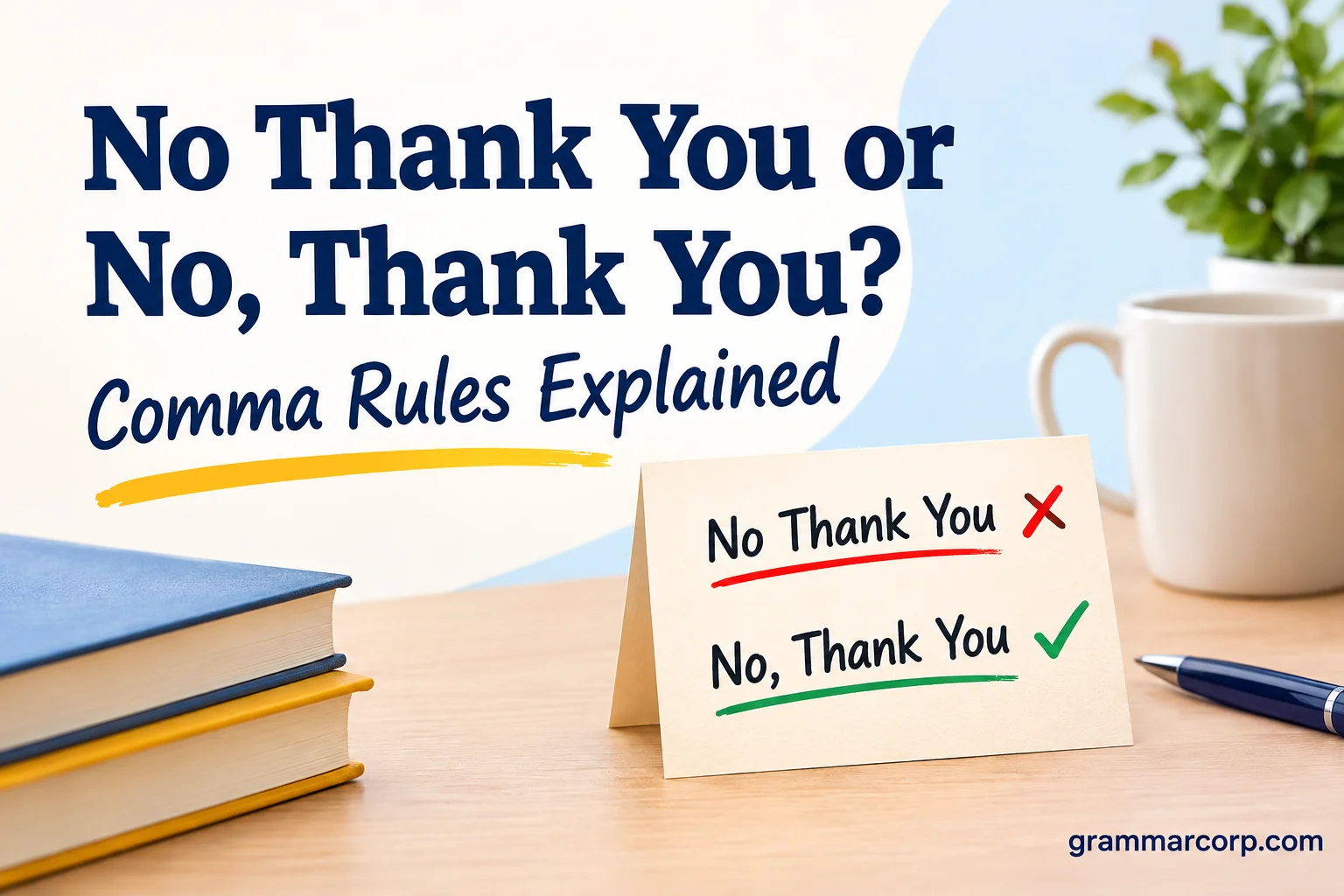
No Thank You or No, Thank You? Comma Rules Explained shows how a tiny comma can clarify a polite refusal in everyday English communication today. A quick thank-you note can leave you paused, with your pen or fingers hovering over the keyboard, wondering about that pesky comma. This little squiggle may look minor, but it can have a big punch in a message that is received. In English, commas help break up thoughts, provide clarity to sentences, and reduce confusion. In my own everyday communication, I have noticed that punctuation can become a common source of punctuation perplexity when a punctuation choice seems simple.
The standard answer for a polite refusal is No, thank you. The comma usage creates a short pause between no and thank you, particularly when you are directly addressing someone. For example, if someone offers you more coffee, an invitation, a suggestion, a request, or a slice of cake, you can reply, “No, thank you.” This is a polite refusal when you decline politely while showing gratitude for the offer. The same pattern works when you are politely declining something you do not want or do not need. Adding a comma gives emphasis and makes the intended meaning clear. The function, form, and context therefore matter when choosing the correct punctuation.
When I explore this question, I find that understanding the right way to use these words is more useful than memorizing a rule without considering the context. A helpful guide should explain the distinction between the usual form, related constructions, and their different uses. No, thanks is another natural option, while No. Thank you. uses two separate sentences and gives each thought its own space. The choice depends on how the words serve the sentence and what the writer wants to express. A tiny mark can change how a sentence is read, although the basic truth remains simple. Mastering commas may seem daunting, but the nitty-gritty becomes easier when you consider the words, phrase, sentence, grammatical function, and meaning together.
Quick Answer:
If you’re politely saying no to something, write:
No, thank you.
The comma separates no, which gives the answer, from thank you, which adds politeness.
For example:
- Would you like some tea? No, thank you.
- Can I help you with that? No, thank you.
- Would you like another serving? No, thank you.
- Do you want to come with us? No, thank you.
By contrast, no thank you can be correct when thank you functions as a noun phrase rather than a polite response.
For example:
- No thank you is necessary.
- There was no thank you in the speech.
So the simplest rule is:
Use “No, thank you” when you’re refusing something politely. Use “no thank you” without a comma when the phrase functions grammatically as a noun phrase.
Comparison Overview
The difference becomes much easier when you compare the forms side by side.
| Form | Main use | Example |
| No, thank you. | Polite refusal | No, thank you. I already ate. |
| No, thanks. | Casual polite refusal | No, thanks. I’m fine. |
| No thank you | Thank you functions as a noun phrase | No thank you is necessary. |
| No. Thank you. | Two separate sentences | No. Thank you for asking. |
| No, thank you, Alex. | Refusal plus direct address | No, thank you, Alex. |
The key isn’t simply whether you hear a pause after no.
Instead, ask what the words are doing in the sentence.
If no stands alone as the answer and thank you is an added expression of politeness, use the comma.
If no directly modifies the noun-like expression thank you, don’t use the comma.
That small distinction explains most examples you’ll encounter.
Main Differences Between No Thank You and No, Thank You
The two forms contain the same three words. Their grammatical structures differ.
No, Thank You
No, thank you, no works as an independent response. It rejects or declines something.
Then thank you for your courtesy.
Consider this exchange:
Would you like another cookie?
No, thank you.
The word no provides the actual answer. The following thank you isn’t the object of no. It’s a separate polite expression.
The comma helps mark that separation.
No Thank You
In no thank you, the words can form a noun phrase.
Here, thank you refers to an expression of gratitude. The word no modifies that expression.
For example:
No thank you is necessary.
This means that an expression of thanks isn’t necessary.
You could mentally expand it as:
No expression of thanks is necessary.
That isn’t the same construction as No, thank you.
Why the Difference Matters
The punctuation isn’t just decoration.
Compare these two sentences:
- No, thank you.
- No thank you is necessary.
In the first, you’re politely declining something.
In the second, you’re talking about whether a thank you is necessary.
The same words perform different grammatical jobs.
Why Does “No, Thank You” Have a Comma?
The comma in No, thank you reflects the structure of the response.
English often separates a short answer from an accompanying expression such as thank you, please, or a person’s name.
Imagine someone offers you dessert.
Would you like some pie?
You could simply say:
No.
You could also soften the response:
No, thank you.
The word no still carries the refusal. Thank you for acknowledging the offer politely.
This makes the comma useful because it prevents readers from interpreting no thank you as one grammatical unit.
The Same Pattern Appears in Other Responses
The structure isn’t unique to thank you.
You can see similar punctuation in:
- Yes, please.
- No, thanks.
- Yes, thank you.
- No, sir.
- Yes, ma’am.
In each case, the first word gives the basic response while the following expression adds information or politeness.
The Comma Doesn’t Mean You Must Pause Dramatically
One common misunderstanding is that commas exist only where speakers pause.
That’s too simplistic.
A comma can signal grammatical relationships that aren’t always obvious from speech.
In No, thank you, the comma separates two parts of a conversational response. You might barely pause when saying it aloud. The punctuation still helps readers understand the construction.
Good punctuation shows readers how words relate to one another.
That’s more useful than thinking of commas as nothing more than written breathing marks.
When Is “No Thank You” Correct Without a Comma?
This is where the answer gets more interesting.
Although No, thank you is the standard form for a polite refusal, no thank you can be grammatically correct in another structure.
The important question is whether thank you is being used as an expression or as a noun phrase.
“Thank You” Can Act Like a Noun
English allows certain expressions to function as nouns.
For example:
Thank you was all she said.
Here, thank you isn’t being used to thank someone directly. It refers to the words or expression itself.
The same idea appears in:
No thank you was required.
The sentence means that no expression of thanks was required.
You can see the distinction more clearly by replacing thank you with expression of thanks:
No expression of thanks was required.
That substitution shows why there isn’t a comma.
Examples of the Noun-Phrase Construction
Consider these sentences:
- No thank you is necessary.
- There was no thank you in his response.
- She gave no thank you for the assistance.
- The letter contained no thank you.
In each example, thank you refers to an expression of gratitude.
It’s not a person politely responding to an offer.
Compare the Two Meanings
Look at these examples:
No, thank you.
Meaning: No, I politely decline.
No thank you is necessary.
Meaning: No expression of thanks is necessary.
The comma changes the relationship between the words.
That’s why it’s better to learn the underlying grammar than memorize a rigid rule saying that one version is always right.
“No, Thank You” vs. “No Thank You” in Everyday Writing
Everyday writing creates another layer of confusion because people often leave out punctuation in texts, messages, signs, and informal online conversations.
Someone might type:
No thank you
when declining an offer.
Most readers will understand the intended meaning immediately.
That doesn’t necessarily make it the best choice for polished writing.
In edited prose, professional correspondence, school assignments, formal communication, and other contexts where standard punctuation matters, No, thank you is the clearer choice for a polite refusal.
Why Informal Writing Sometimes Drops the Comma
Digital communication often removes punctuation for speed or tone.
You might see:
- no thanks
- no thank you
- nope thanks
- no, thank you
Texting doesn’t always follow formal punctuation conventions.
That doesn’t mean all versions have equal grammatical status.
If you’re writing something where correctness matters, use the standard construction.
Formality and Tone
No, thank you is neutral and broadly appropriate.
No, thanks feels more conversational.
For example:
Would you like a cup of coffee?
No, thank you.
This works almost anywhere.
No, thanks.
This sounds natural in casual conversation with friends, classmates, coworkers, or acquaintances.
Neither expression is inherently rude. Context and delivery matter more than the small difference in wording.
Is “No, Thanks” Correct?
Yes.
No, thanks is a standard way to politely decline something.
The comma separates no from thanks in much the same way it does in No, thank you.
Examples include:
- No, thanks. I’ve already eaten.
- No, thanks. I brought my own.
- No, thanks. I’m okay.
- No, thanks. Maybe another time.
The expression is usually shorter and more conversational than No, thank you.
“Thanks” vs. “Thank You”
The difference is mostly one of register.
| Expression | Typical tone |
| No, thank you. | Neutral, polite |
| No, thanks. | Casual, friendly |
| No. Thank you. | More separated or emphatic |
The choice should match the situation.
For formal writing, No, thank you is often the safest option.
For casual conversation, No, thanks sounds perfectly natural.
Should You Write “No, Thank You” or “No. Thank You”?
Both can be grammatically possible. They don’t communicate exactly the same structure.
No, Thank You
No, thank you.
This is one sentence containing a refusal followed by a polite expression.
It’s the normal choice when declining an offer.
No. Thank You.
No. Thank you.
Here, you’ve created two sentences.
The first sentence gives the refusal.
The second expresses thanks.
That separation can create a more deliberate or emphatic effect.
For example:
No. Thank you for asking.
Here, the writer clearly wants no to stand alone before moving to the separate statement.
However, if your intended meaning is simply a polite refusal, No, thank you is usually smoother.
Compare the Rhythm
No, thank you.
The ideas belong together.
No. Thank you.
The ideas are separated.
That difference can affect tone, especially in dialogue.
So don’t automatically replace every comma with a period. Choose punctuation based on the intended structure.
How to Punctuate “No, Thank You” in Longer Sentences
Short responses are easy. Longer sentences create more opportunities for punctuation mistakes.
Consider:
No, thank you. I’ve already eaten.
This is straightforward. The first sentence gives the response. The second explains it.
You can also connect the ideas with a conjunction:
No, thank you, but I appreciate the offer.
Here, but connects the refusal with another clause.
Direct Address
If you’re speaking directly to a named person, the person’s name is set off with a comma.
For example:
No, thank you, Sarah.
The first comma separates no from thank you.
The second comma separates the name because Sarah is being directly addressed.
Compare:
No, thank you, Sarah.
with:
No, thank you. Sarah already ate.
In the second example, Sarah isn’t direct address. She’s the subject of another sentence.
Avoiding Comma Splices
A common mistake is joining complete thoughts with commas alone.
For example:
No, thank you, I already ate.
This construction can be awkward because it combines a conversational response with another complete clause using only commas.
Better choices include:
No, thank you. I already ate.
Or:
No, thank you, but I already ate.
Or:
No, thank you; I already ate.
For ordinary writing, the first two options usually read most naturally.
Common Mistakes With “No, Thank You”
Understanding the rule becomes easier when you see what commonly goes wrong.
Mistake: Writing “No Thank You” for Every Refusal
You may see No thank you frequently online.
That doesn’t mean it’s the preferred punctuation for a standard polite refusal.
Use:
No, thank you.
when no is the response and thank you is an added courtesy.
Mistake: Writing “No, Thank, You”
The comma belongs between no and thank you.
It doesn’t split the words thank and you.
Incorrect:
No, thank, you.
Correct:
No, thank you.
The phrase thank you functions together as the expression of gratitude.
Mistake: Assuming “No Thank You” Is Always Wrong
This goes too far in the opposite direction.
As shown earlier, no thank you can be grammatically valid when thank you functions as a noun phrase.
For example:
No thank you is necessary.
The absence of a comma isn’t an error there.
Mistake: Adding a Comma Everywhere
More commas don’t automatically make writing clearer.
For example:
No, thank, you, I don’t need it.
The punctuation interrupts the expression instead of clarifying its structure.
Good punctuation should reveal the sentence’s organization.
Mistake: Treating Every Spoken Pause as a Comma
People pause for many reasons while speaking.
They may hesitate, emphasize a word, change direction, or simply think.
Written punctuation follows grammatical structure rather than every tiny pause in speech.
That’s why learning the construction itself is more reliable than trying to transcribe spoken rhythm.
Practical Examples of “No, Thank You”
Context makes the rule easy to apply.
Declining Food
Would you like some more cake?
No, thank you. I’m full.
Here, no is the answer. Thank you expresses politeness.
Declining an Offer
Can I carry that for you?
No, thank you. I’ve got it.
Again, the comma is appropriate.
Declining an Invitation
Would you like to come with us?
No, thank you. I have other plans.
The phrase remains a polite refusal.
Declining a Suggestion
Would you like to try this one instead?
No, thank you. This one works for me.
The same punctuation pattern applies.
Using the Noun-Phrase Form
No thank you is necessary.
Now the meaning changes.
The sentence isn’t someone declining an offer. It’s saying that an expression of gratitude isn’t required.
That distinction is the heart of the entire rule.
A Simple Way to Remember the Rule
Here’s an easy test.
Ask yourself:
Am I saying no and then thanking someone?
If yes, write:
No, thank you.
If you’re talking about a thank you as a thing or expression, the comma may not belong.
For example:
No thank you is necessary.
You can replace thank you with expression of thanks:
No expression of thanks is necessary.
If that replacement works naturally, you’re probably dealing with the noun-like construction.
This simple test handles most everyday cases without requiring a complicated grammar lesson.
Read More : The Latter Two: Meaning, Usage, Examples, Common Mistakes
Quick Reference: Which Version Should You Use?
| What you mean | Recommended form | Example |
| Politely declining an offer | No, thank you. | No, thank you. I don’t need anything. |
| Casual polite refusal | No, thanks. | No, thanks. I’m good. |
| Referring to an expression of gratitude | no thank you | No thank you is necessary. |
| Separating the refusal into its own sentence | No. Thank you. | No. Thank you for understanding. |
| Addressing someone by name | No, thank you, Alex. | No, thank you, Alex. |
| Giving a refusal and explanation | No, thank you, but… | No, thank you, but I have to leave. |
The safest everyday rule remains simple:
If you’re saying no and then politely thanking someone, use “No, thank you.”
Why Context Matters More Than the Three Words Alone
Grammar becomes much clearer when you stop looking at punctuation in isolation.
The words no thank you don’t have one permanent grammatical function.
Context determines how readers should interpret them.
Consider:
No, thank you.
Someone has probably offered something.
Now consider:
No thank you was included in the letter.
Here, thank you is the thing being discussed.
The vocabulary barely changes. The grammatical relationship does.
This is common throughout English.
Words can shift roles depending on how they’re used. That’s one reason punctuation questions sometimes resist simple rules.
A Useful Editing Trick
When you’re unsure, temporarily expand the sentence.
Suppose you wrote:
No thank you is necessary.
Ask what you mean.
If you mean:
No expression of thanks is necessary.
then the unpunctuated version makes sense.
But if you mean:
No, I politely decline.
then you’re dealing with the conversational response:
No, thank you.
This substitution test is quick and surprisingly effective.
Case Study: One Phrase, Two Different Meanings
Consider a restaurant conversation.
A server asks:
Would you like dessert?
You answer:
No, thank you.
The phrase performs two functions:
- No declines the offer.
- Thank you acknowledges the offer politely.
Now imagine a sentence in a writing guide:
No thank you is necessary after every small favor.
Here, the writer is discussing the expression thank you itself.
The two constructions look similar. Their meanings are completely different.
That’s why a blanket rule such as always use a comma isn’t accurate.
The better rule is functional:
Comma when “no” is a standalone refusal followed by “thank you.” No comma when “thank you” functions as the noun-like thing being modified or discussed.
FAQs:
1. Is “No, thank you” grammatically correct?
Yes. No, thank you is the standard form when you politely decline an offer, invitation, suggestion, or request while addressing someone directly.
2. Should there be a comma in “No thank you”?
In a normal polite refusal, the comma is usually preferred: No, thank you. The comma represents the natural pause between the refusal and the expression of gratitude.
3. Is “No thank you” always incorrect?
No. No thank you can be correct in certain grammatical contexts. The appropriate form depends on the meaning and sentence structure.
4. Can I write “No, thanks” instead?
Yes. No, thanks is a natural and informal way to politely decline something. The comma separates no from the direct expression of thanks.
5. What does “No. Thank you.” mean?
No. Thank you. separates the refusal and thanks into two sentences. It can be used when the writer wants to give each statement more emphasis or independence.
Conclusion:
When politely declining an offer, No, thank you is generally the clearest and most conventional choice. The comma marks a brief pause and separates the refusal from the expression of gratitude.
Although No thank you, No, thanks, and No. Thank you. can also appear in English, their use depends on context, meaning, and sentence structure. Understanding these small punctuation differences can make everyday writing clearer and more natural.










1 thought on “No Thank You or No, Thank You? Comma Rules Explained”