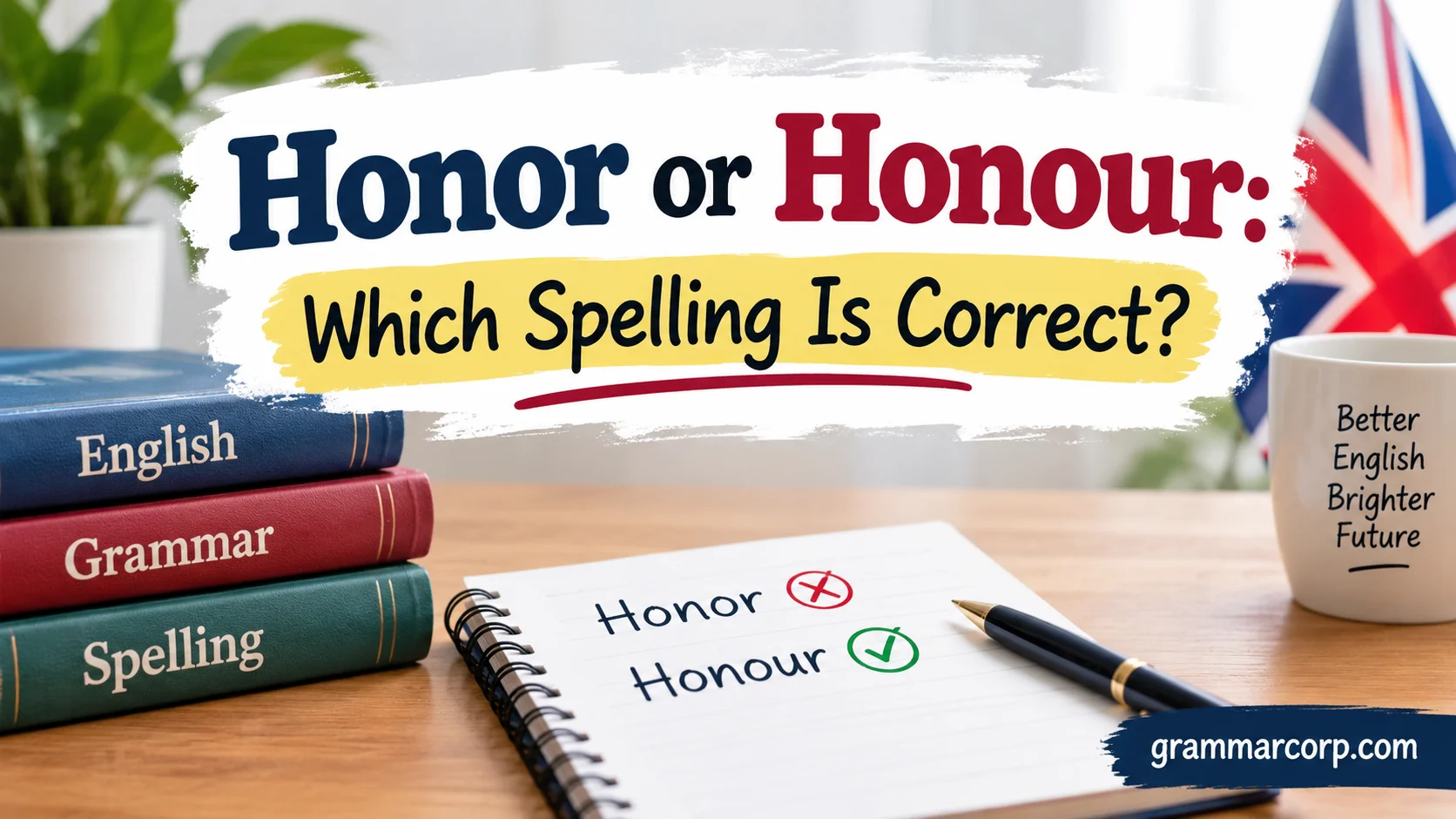
Honor or Honour: Which Spelling Is Correct? Both forms are correct, but American English uses honor, while British English uses honour in standard writing.
Students, English learners, and other language learners may feel confused because these words look almost the same. The main spelling difference is the extra letter u in honour. These regional preferences are part of English spelling conventions, and the English language contains many spelling variations.
Cambridge Dictionary identifies honor as the US spelling and honour as the UK form. Knowing this distinction helps you choose the correct spelling for your audience when reading books and texts, completing a US school assignment, or preparing British English writing.
The core meaning and definitions remain the same in both forms. Honor and honour can mean high respect, esteem, or respect for someone or something. They can also describe something that brings credit or distinction, or relate to a person’s integrity, principles, code of conduct, and moral principles. Their grammatical uses and grammatical functions are the same. For example, receiving an award can be an honor in American writing and an honour in British writing
Quick Answer:
Honor and honour mean the same thing.
- Honor is the standard American English spelling.
- Honour is the standard British English spelling.
- The words have the same basic meanings.
- Their pronunciation is essentially the same.
- Their grammatical uses are the same.
- Related forms also change spelling, such as honored/honoured and honoring/honouring.
- Canadian English generally prefers honour, although Canadian spelling has some variation between British and American conventions.
So, if you’re writing in American English, choose honor. If you’re following British English conventions, choose honour.
Neither version is simply a misspelling of the other.
Comparison Overview
The easiest way to understand honor vs. honour is to compare them side by side.
| Feature | Honor | Honour |
| Main variety | American English | British English |
| Meaning | Same | Same |
| Pronunciation | Essentially the same | Essentially the same |
| Noun | Yes | Yes |
| Verb | Yes | Yes |
| Past form | honored | honoured |
| -ing form | honoring | honouring |
| Common phrase | in honor of | in honour of |
| Example | It was an honor to meet you. | It was an honour to meet you. |
Cambridge and Oxford both treat the two spellings as regional variants rather than separate words with different meanings.
The simplest rule to remember
Think of the spelling this way:
US English → honor
UK English → honour
That same pattern appears in several other familiar words.
| American English | British English |
| honor | honour |
| color | colour |
| favor | favour |
| labor | labour |
| behavior | behaviour |
The Canadian government’s Language Portal identifies honour among the British spellings ending in -our and notes that Canadian spelling can draw from both British and American conventions.
Main Differences Between Honor and Honour
The biggest difference between honor and honour is spelling. However, understanding how the word works in real sentences makes the distinction much easier.
Honor and honour have the same meaning
Both words can describe respect, admiration, dignity, moral character, recognition, or a privilege.
For example:
- It was an honor to meet the author.
- It was an honour to meet the author.
The meaning doesn’t change.
Likewise:
- The award was a great honor.
- The award was a great honour.
Again, the meaning remains the same. Only the regional spelling changes.
Oxford defines honor as great respect for someone and also describes it as something that gives a person pride or pleasure because others show respect. Oxford identifies honour as the British English form.
Honor and honour can both be nouns
As a noun, the word can refer to respect or recognition.
Consider these examples:
- Winning the award was a great honor.
- Winning the award was a great honour.
- She was treated with honor.
- She was treated with honour.
The spelling depends on the English variety you’re using.
Honor and honour can also be verbs
The word can also function as a verb meaning to show respect or to fulfill a promise, agreement, or obligation.
American English:
The organization will honor the winner.
British English:
The organization will honour the winner.
The same difference appears when the word means fulfilling an agreement:
- The company agreed to honor the contract.
- The company agreed to honour the contract.
Cambridge lists this verb meaning as doing what you promised or agreed to do.
What Does Honor or Honour Mean?
The word has several related meanings. Its exact meaning depends on the sentence.
Respect and admiration
One of the most common meanings is deep respect for someone or something.
For example:
- The ceremony was held to honor the firefighters.
- The ceremony was held to honour the firefighters.
Here, the verb means to publicly show respect.
Cambridge describes honor as a quality connected with respect, pride, and honesty.
A privilege
The word can also describe something that makes you feel proud because someone has shown you respect.
For example:
- It was an honor to receive the invitation.
- It was an honour to receive the invitation.
This is why people often say:
It is an honor to meet you.
In British English, the same sentence becomes:
It is an honour to meet you.
Recognition or an award
An honor or honour can also mean a reward, title, or distinction given to someone because of an achievement.
For example:
- She received an honor for her community service.
- She received an honour for her community service.
Cambridge includes awards, prizes, and titles among the meanings of honour.
Moral character
The word can also refer to someone’s sense of honesty, dignity, and ethical behavior.
For example:
- He was known as a man of honor.
- He was known as a man of honour.
In this sense, the word describes a personal quality rather than an award.
Keeping a promise or agreement
As a verb, honor/honour can mean doing what you promised.
For example:
- The business agreed to honor the original price.
- The business agreed to honour the original price.
The meaning here is closer to fulfill, respect, or keep an agreement.
When to Use Honor in American English
Use honor when you’re writing in standard American English.
This applies to school assignments, American websites, business documents, articles, emails, and other writing aimed primarily at a US audience.
Common American English expressions
You’ll often see honor in phrases such as:
- in honor of
- guest of honor
- an honor
- honor someone
- honor a promise
- honor an agreement
- honor a commitment
- badge of honor
- maid of honor
- military honors
For example:
The event was held in honor of the retiring teacher.
The British version would use honour instead.
American spelling in related forms
The same spelling pattern continues with related words.
| American English | Meaning |
| honor | respect or recognition |
| honored | showed respect or received recognition |
| honoring | showing respect |
| honorable | deserving respect |
| dishonor | loss or violation of honor |
Oxford lists honored as the American past form and honoring as the American -ing form.
When to Use Honour in British English
Use honour when you’re following standard British English spelling.
You’ll commonly encounter it in British publications, educational materials, formal documents, and writing aimed at readers who expect British spelling.
Common British English expressions
Examples include:
- in honour of
- guest of honour
- an honour
- honour someone
- honour a promise
- honour an agreement
- honour a commitment
- badge of honour
- military honours
For example:
The ceremony was held in honour of the local volunteers.
The American version would use in honor of.
British spelling in related forms
British English normally carries the extra u into several related forms.
| British English | American English |
| honour | honor |
| honoured | honored |
| honouring | honoring |
| honourable | honorable |
| dishonour | dishonor |
Cambridge’s British dictionary uses honour as the UK form and honor as the US equivalent.
Honor or Honour in Different English-Speaking Countries
It’s tempting to divide English into only American and British varieties. Real-world spelling can be more complicated.
United States
American English uses honor.
Examples include:
- honor
- honored
- honoring
- honorable
United Kingdom
British English uses honour.
Examples include:
- honour
- honoured
- honouring
- honourable
Canada
Canadian English deserves special attention because it doesn’t always fit neatly into a single American-or-British box.
Canada’s Language Portal states that honour is the preferred spelling for the noun and verb in Canada. It also explains that Canadian spelling has historically drawn from both British and American conventions.
So if you’re writing specifically for Canadian readers, honour is generally the safer choice for this word.
Australia and other varieties
Other English-speaking regions may generally follow British-style spelling conventions, although individual publications, organizations, and style guides can establish their own preferences.
The important lesson is simple: don’t assume geography always gives you an absolute rule for every English word.
When you’re writing professionally, check the relevant style guide if one exists.
Honor vs. Honour and Their Related Forms
The spelling difference doesn’t stop with the basic word.
It affects several common derivatives.
Honored vs. honoured
American English:
She was honored for her work.
British English:
She was honoured for her work.
Both sentences mean exactly the same thing.
Honoring vs. honouring
American English:
The city is honoring its former mayor.
British English:
The city is honouring its former mayor.
The extra u remains in the British form.
Honorable vs. honourable
American English:
He was known as an honorable person.
British English:
He was known as an honourable person.
Again, the meaning doesn’t change.
Dishonor vs. dishonour
American English:
The decision brought dishonor to the organization.
British English:
The decision brought dishonour to the organization.
This follows the same general spelling pattern.
Words That Do Not Simply Add the U
One common mistake is assuming every related word must change from honor to honour.
That’s not always true.
The word honorary, for example, is normally spelled honorary in both American and British usage.
The Canadian Language Portal specifically notes that honorary is the preferred form and that honourary, although encountered as a variant, isn’t the preferred spelling.
This gives you an important practical rule:
Don’t add a u automatically just because a related word contains honor.
Always check the established spelling of the individual word.
Honor or Honour in Formal Writing
Choosing the right spelling matters most when you’re writing something formal.
A spelling difference that looks tiny can reveal which English convention you’re following.
School assignments
If your teacher or school expects American English, use honor.
If the assignment follows British English, use honour.
The key isn’t choosing the spelling that looks more familiar. It’s following the required variety consistently.
Business writing
Businesses often maintain style guides that specify American, British, or another English convention.
If the company’s style guide says to use American English, write:
honor
If it specifies British English, write:
honour
Websites and blogs
Website owners should consider their primary audience.
A US-focused website will usually benefit from consistent American spelling. A UK-focused publication will normally use British spelling.
This isn’t about one spelling being better for search engines. It’s about writing naturally for the audience you serve.
Academic writing
Academic institutions may have specific style requirements.
Before submitting an essay or research paper, check whether your institution expects:
- American English
- British English
- Canadian English
- A particular academic style guide
Once you’ve chosen the appropriate convention, apply it consistently.
Case Study: Why Consistency Matters
Imagine an article written for a US audience.
The writer begins with:
It was an honor to receive the award.
Later, the same article says:
The ceremony was held in honour of local teachers.
Neither spelling is individually wrong. The problem is inconsistency.
The article has switched between American and British spelling without a reason.
A cleaner American English version would say:
It was an honor to receive the award.
The ceremony was held in honor of local teachers.
A British English version would use honour in both places.
This small example shows why choosing a spelling system matters more than memorizing which version is supposedly correct.
Read More : From My End or From My Side: Which Is Correct?
Common Mistakes With Honor and Honour
Mistake: Thinking one spelling is always correct
There isn’t a universal winner.
Honor is correct in American English.
Honour is correct in British English.
Mistake: Mixing spelling conventions
Switching between American and British spellings can make otherwise polished writing look inconsistent.
Choose one variety and stick with it.
Mistake: Changing the pronunciation
The spelling difference doesn’t create a completely different word or meaning.
Cambridge provides US and UK pronunciations for the two forms while identifying them as regional spellings.
Mistake: Writing honorary
The preferred spelling is honorary, not honorary, including in Canadian English.
Mistake: Assuming the words have different meanings
They don’t.
If you write honor in American English or honour in British English, you’re expressing the same basic idea.
Honor or Honour: Examples in Sentences
Seeing the words in context makes the distinction easier to remember.
| American English | British English |
| It was an honor to meet her. | It was an honour to meet her. |
| He was honored for his service. | He was honoured for his service. |
| The event was held in honor of the founder. | The event was held in honour of the founder. |
| She honored her promise. | She honoured her promise. |
| He is an honorable man. | He is an honourable man. |
| They are honoring the winners. | They are honouring the winners. |
Notice something important: the sentence structure and meaning remain essentially unchanged.
Only the spelling convention changes.
Why Does British English Spell It Honour?
The -our spelling belongs to a broader British spelling pattern.
Words such as colour, favour, labour, and honour retain the u.
American English generally removed the u from this group:
- color
- favor
- labor
- honor
This isn’t a random difference created separately for every word. It forms part of a wider distinction between British and American spelling systems.
Canada’s Language Portal identifies -our/-or as one of the major areas where British and American English spelling can differ.
Is Honor or Honour More Correct?
Neither is universally more correct.
The better question is:
Which English variety are you using?
If you’re writing American English, honor is correct.
The same principle applies to many other spelling differences.
For example, an American writer may use color, while a British writer may use colour. Neither writer has made a spelling mistake simply because they chose a different regional convention.
How to Choose Between Honor and Honour
Use this quick decision guide:
- Writing for a US audience? Use honor.
- Writing for a UK audience? Use honour.
- Writing for a Canadian audience? Honour is generally preferred.
- Following a school or workplace style guide? Follow its requirements.
- Writing for an international audience? Pick one consistent English variety.
- Editing an existing document? Match the spelling convention already established in the document unless the style guide says otherwise.
The most useful habit is to think about audience first.
Don’t ask, “Which spelling looks right?”
Ask, “Which English convention does this piece of writing follow?”
That question usually gives you the answer immediately.
FAQs:
1. Is it honor or honour?
Both spellings are correct. Honor is standard in American English, while honour is standard in British English.
2. What is the difference between honor and honour?
The only spelling difference is the letter u. Both words have the same meaning, including respect, esteem, credit, or distinction.
3. Is honor American or British English?
Honor is the standard American English spelling. It is commonly used in American books, school assignments, newspapers, and professional writing.
4. Is honour the correct spelling in British English?
Yes, honour is the standard British English spelling. It is also used in other varieties that follow British spelling conventions, such as many forms of Australian and Canadian English, although usage can vary by context.
5. Should I use honor or honour in formal writing?
Choose the spelling that matches your audience and the required style guide. Use honor for American English documents and honour for British English documents. Most importantly, remain consistent throughout your writing.
Conclusion:
Both honor and honour are correct spellings of the same word. The difference comes from regional spelling conventions, not meaning or grammatical usage. American English generally uses honor, while British English uses honour.
When writing an essay, preparing a professional document, or publishing an article, consider your audience and follow the appropriate spelling style. Consistency will help make your writing clear, accurate, and professional.













1 thought on “Honor or Honour: Which Spelling Is Correct?”