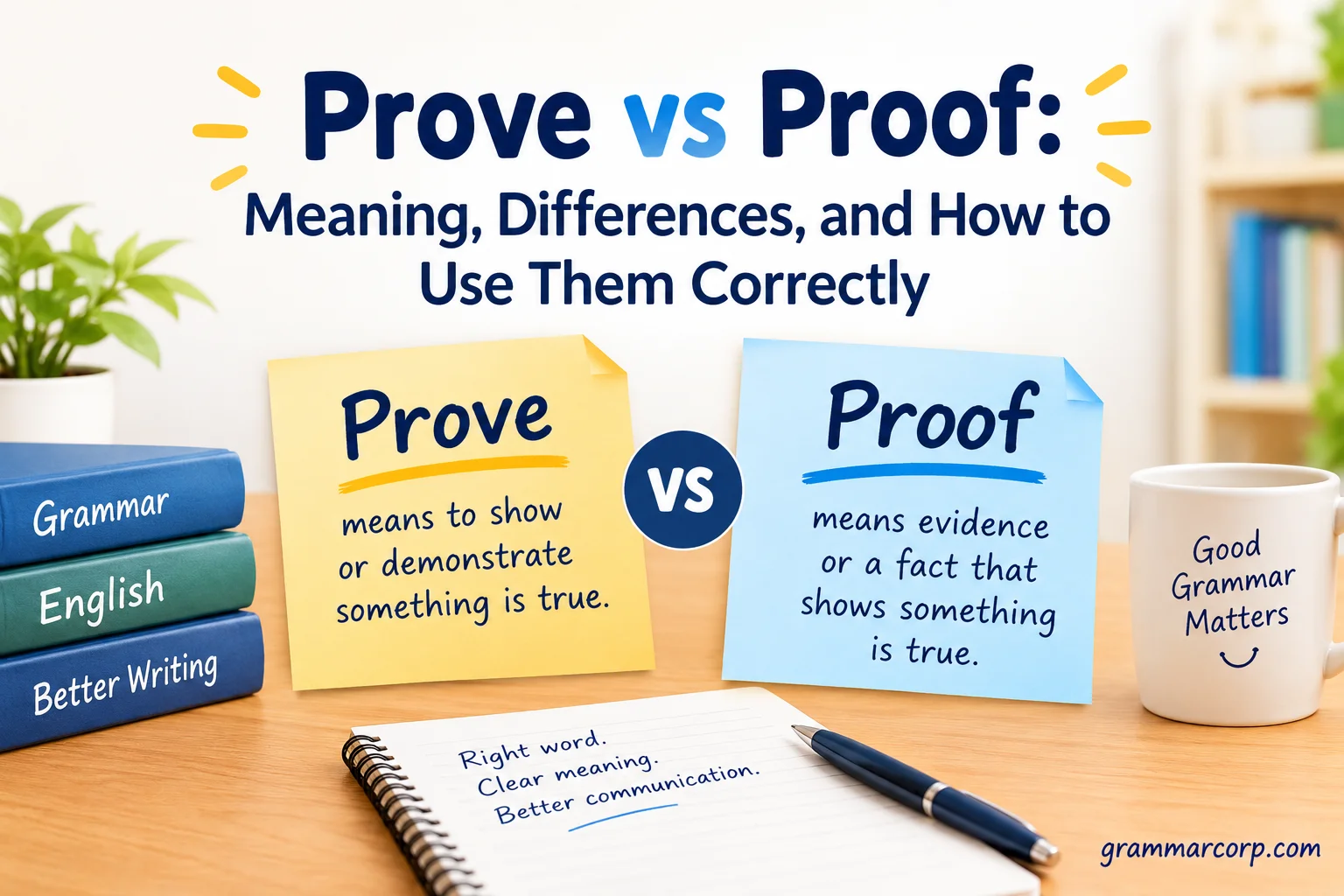
Prove vs Proof: Meaning, Differences, and How to Use helps learners understand why closely related words have different grammar roles. The core idea of prove is demonstrating that something is true through evidence, facts, or a demonstration that establishes the truth. Proof, however, refers to the evidence or information that confirms something is true. You can prove a claim or provide proof of a claim, but you should not swap the words. Choosing the wrong word can make a sentence sound unnatural or incorrect. In my experience, this simple distinction helps students use English more accurately in both writing and speaking.
The prove vs proof distinction is useful in an essay, when explaining an argument, or while completing a legal form. It also appears in everyday communication, school assignments, business writing, legal discussions, and casual conversations. The prove meaning focuses on the action of showing something is true, whereas the proof meaning focuses on what supports or confirms that truth. English is a language that borrows words from many sources, so similar terms can sometimes be used differently. This is especially helpful for learners, a student, a writer, or an English learner who wants to communicate ideas more clearly.
There is also a useful pronunciation connection. In today’s lesson, practice the F and V sounds because they are different sounds. Pay attention to your mouth position, blow air for the F sound, and use your voice for the V sound. Repeat the words to strengthen your communication skills. Words such as belief and believe can provide additional practice with these sounds. The difference between prove and proof becomes easier to remember when you connect the action of proving with the evidence called proof, rather than mixing the two words.
Quick Answer:
Prove is primarily a verb. It means to demonstrate or establish that something is true, correct, or valid.
Proof is primarily a noun. It means evidence, information, or a demonstration that shows something is true or correct.
| Word | Part of Speech | Meaning | Example |
| Prove | Verb | To demonstrate something is true | The experiment proved the theory. |
| Proof | Noun | Evidence that something is true | The experiment provided proof of the theory. |
A simple way to remember the difference is:
Prove = demonstrate. Proof = evidence.
So, if you’re talking about doing the demonstrating, use prove. If you’re talking about the evidence used to demonstrate something, use proof.
Comparison Overview
The words prove and proof are closely connected but have different grammatical functions.
Prove tells you what someone or something does. It normally acts as a verb.
Proof names something. It normally acts as a noun.
Consider these two sentences:
- The documents prove that he owned the property.
- The documents are proof that he owned the property.
The basic idea remains similar in both sentences. The grammatical structure changes.
In the first sentence, prove describes what the documents do. In the second sentence, proof identifies what the documents represent.
Prove vs Proof at a Glance
| Feature | Prove | Proof |
| Main grammatical role | Verb | Noun |
| Basic meaning | Demonstrate or establish truth | Evidence or demonstration |
| Describes an action? | Yes | No |
| Common structure | Prove something | Proof of something |
| Example | They proved their claim. | They gave proof of their claim. |
| Related forms | Proved, proven, proving | Proofs |
The distinction becomes especially clear when you replace each word with a simpler synonym.
If demonstrate fits, you probably need prove.
If evidence fits, you probably need proof.
For example:
- The test results prove the product works.
- The test results provide proof that the product works.
Both sentences communicate a similar idea. However, prove performs the action while proof names the evidence.
Main Differences Between Prove and Proof
The most important difference between prove and proof comes down to part of speech.
Prove Is a Verb
A verb expresses an action, process, state, or occurrence. Prove describes the act of showing that something is true, correct, effective, or valid.
You can prove:
- A fact
- A claim
- A theory
- A point
- An argument
- Someone’s identity
- A mathematical statement
- The effectiveness of something
Examples:
- The evidence proved his claim.
- She wants to prove that the calculation is correct.
- The experiment proved the method was effective.
- He couldn’t prove his accusation.
- The results prove that the machine works.
Notice how prove connects an action to something being established.
Proof Is a Noun
A noun names a person, place, thing, idea, quality, or concept. Proof names the evidence or demonstration that establishes something as true or valid.
Common examples include:
- Proof of identity
- Proof of purchase
- Proof of payment
- Proof of ownership
- Proof of age
- Proof of address
- Proof of concept
- Proof of eligibility
Examples:
- Please provide proof of purchase.
- The photograph became proof of his claim.
- They had no proof of ownership.
- The researchers found proof that the process worked.
Here, proof doesn’t describe the action of demonstrating something. It identifies the evidence.
The Easiest Memory Trick
Think of the relationship this way:
You prove something with proof.
For example:
- You prove your identity.
- You provide proof of your identity.
You prove a claim.
You provide proof of a claim.
You prove that something happened.
You provide proof that something happened.
This pattern works in many everyday situations.
What Does Prove Mean?
Prove means to demonstrate or establish that something is true, correct, genuine, effective, or valid.
It can describe a logical argument, scientific experiment, legal matter, personal claim, or everyday situation.
For example:
The experiment proved that the new method worked.
Here, proved tells us what the experiment did. It established the effectiveness of the method.
Common Uses of Prove
The verb prove appears in several useful sentence patterns.
Prove + Noun
You can place a noun directly after prove when the noun represents something being established.
Examples:
- Prove your identity.
- Prove your claim.
- Prove your point.
- Prove the theory.
- Prove the statement.
- Prove the accusation.
In these examples, prove describes an action performed by a person or piece of evidence.
Prove + That-Clause
Another common structure uses that followed by a clause.
Examples:
- The results proved that the treatment worked.
- She proved that the calculation was correct.
- The documents proved that the agreement existed.
- The investigation proved that the report was inaccurate.
This structure is particularly useful when you need to explain exactly what was established.
Prove + Adjective or Complement
Prove can also mean that something turns out to have a particular quality or result.
Examples:
- The advice proved useful.
- The decision proved difficult.
- The new system proved effective.
- The journey proved challenging.
Here, prove doesn’t necessarily mean someone deliberately demonstrated something. It can mean that later experience showed something to be true.
Prove in Different Tenses
Because prove is a verb, it can change according to tense and construction.
| Form | Example |
| Present | The evidence proves the claim. |
| Base form | They need to prove the claim. |
| Past | The evidence proved the claim. |
| Present participle | They are proving the claim. |
| Past participle | The results have proved/proven useful. |
Both proved and proven occur as past participles. Usage varies by context and variety of English. Proven is especially common before adjectives, as in a proven method or has proven effective, while proved remains completely standard.
What Does Proof Mean?
Proof is a noun referring to evidence or a demonstration that establishes something as true, correct, or valid.
The word often appears when someone needs to establish a fact through evidence.
For example:
The receipt is proof of purchase.
The receipt doesn’t prove something because the sentence needs a noun after is. Instead, the receipt is identified as proof.
Common Expressions With Proof
Some combinations appear frequently in everyday and professional English.
Proof of Identity
Proof of identity means documentation or other accepted evidence used to establish who someone is.
For example:
- The bank requested proof of identity.
- You may need proof of identity to complete the application.
Proof of Purchase
Proof of purchase shows that someone bought a particular product or service.
Examples include:
- A receipt
- An order confirmation
- An invoice
- Another accepted transaction record
Example:
The store requested proof of purchase before processing the return.
Proof of Payment
Proof of payment provides evidence that money was paid.
For example:
Please send proof of payment with your application.
Proof of Ownership
Proof of ownership establishes that someone legally or officially owns something.
This phrase can appear in property, vehicle, insurance, business, and other contexts.
Proof of Concept
In technology and business, proof of concept has a specific meaning. It refers to evidence that an idea or proposed system can work in practice.
For example:
The team built a prototype as a proof of concept.
This doesn’t necessarily mean the final product is ready. It means the team has demonstrated that the central idea is feasible.
Proof Can Have Other Meanings
Although evidence is one of the most common meanings, proof has other established uses.
In printing and publishing, a proof can refer to a version produced for checking before final publication.
For example:
The designer reviewed the proof before the brochure went to print.
The word can also appear in expressions describing resistance or protection, such as waterproof or fireproof. In those compounds, proof contributes the idea of resistance to a particular substance or condition.
Prove vs Proof in Sentences
Seeing the words side by side makes the difference much easier to understand.
Examples Using Prove
- The evidence proved his statement was accurate.
- She worked hard to prove her argument.
- The experiment proved the method was reliable.
- The documents prove that the transaction occurred.
- The results proved useful during the investigation.
- He couldn’t prove that the accusation was true.
In every case, prove functions as a verb.
Examples Using Proof
- The documents provide proof of the transaction.
- The receipt is proof of purchase.
- They found proof that the system had failed.
- The photograph served as proof of the event.
- The researchers presented proof for their argument.
- She had enough proof to support her claim.
In these examples, proof functions as a noun.
Direct Sentence Comparison
Compare these pairs:
The documents proved his ownership.
The documents were proof of his ownership.
The meaning is similar, but the grammar differs.
In the first sentence, proved is the verb. It tells us what the documents did.
In the second sentence, proof is a noun. It tells us what the documents were.
Another example:
The test proved that the product was safe.
The test provided proof that the product was safe.
The first sentence focuses on the action of establishing the fact. The second focuses on the evidence produced by the test.
Common Mistakes With Prove and Proof
Because these words belong to the same word family, learners sometimes use one where the other belongs.
Using Proof Instead of Prove
A common mistake occurs when someone needs a verb but uses the noun proof.
Incorrect:
The evidence proof that he was correct.
Correct:
The evidence proves that he was correct.
Why? Because the sentence needs a verb after evidence. Proof is a noun, while proves is the required verb.
Using Prove Instead of Proof
The opposite mistake happens when a noun is required.
Incorrect:
The receipt is prove of purchase.
Correct:
The receipt is proof of purchase.
After is, the sentence needs a noun that identifies what the receipt represents. Proof fits that role.
Confusing Proof of With Prove
This is one of the most useful distinctions to remember.
Proof of is a noun phrase.
Prove is a verb.
Compare:
- We need proof of identity.
- We need to prove our identity.
Both sentences concern the same general idea. However, the first asks for evidence while the second describes an action.
Confusing Proof With Proven
Proof and proven aren’t interchangeable.
Compare:
- The results provide proof of the theory.
- The method has been proven effective.
The first sentence uses proof as a noun.
The second uses proven as a past participle of prove.
Adding Unnecessary Words
Sometimes writers create awkward structures by trying to combine the two forms.
For example:
The evidence proved proof of the claim.
This is generally awkward because proved already functions as the verb and proof unnecessarily repeats the same basic idea.
Better alternatives include:
The evidence proved the claim.
Or:
The evidence provided proof of the claim.
The best choice depends on what you want to emphasize.
Prove, Proof, Proven, and Proved: What’s the Difference?
The word family becomes easier to understand when you compare its main forms.
| Word | Function | Example |
| Prove | Base-form verb | They need to prove the claim. |
| Proved | Past tense/past participle | They proved the claim. |
| Proven | Past participle | The method has proven effective. |
| Proof | Noun | They provided proof of the claim. |
| Proving | Present participle/gerund | They are proving the claim. |
Proved vs Proven
Both proved and proven are legitimate forms of prove.
Proved works naturally as the simple past:
The experiment proved the theory.
It can also function as a past participle:
The theory has been proved correct.
Proven is also widely used as a past participle:
The theory has been proven correct.
You will often see proven before an adjective:
- A proven method
- A proven strategy
- A proven solution
- A proven approach
The important point is that proof is different. It isn’t another form of the verb prove.
Read More : Dialog vs. Dialogue: What’s the Difference and Which Should You Use?
How to Remember the Difference Between Prove and Proof
You don’t need a complicated grammar rule to remember prove vs proof.
Use this simple pair:
Prove = action
Proof = evidence
Imagine a courtroom argument. Someone makes a claim. The person then presents documents or other evidence. The act of establishing the claim is to prove it. The documents themselves can serve as proof.
Use the Demonstrate Test
Replace the word with demonstrate.
If the sentence still works, prove may be the right choice.
- The experiment proved the theory.
- The experiment demonstrated the theory.
Now try evidence:
- The experiment provided proof of the theory.
- The experiment provided evidence of the theory.
This substitution test isn’t perfect for every context. However, it works well for everyday grammar decisions.
Use the Sentence Pattern Test
Watch for these patterns:
prove + object
prove the claim
proof + of
proof of the claim
proof + that
proof that the claim is correct
These patterns provide a useful shortcut when you’re unsure.
Prove vs Proof in Academic Writing
Academic writing uses both words frequently, especially when discussing arguments, research, and evidence.
However, academic writers should choose the word carefully.
For example:
The results prove that the hypothesis is correct.
Depending on the research context, this statement may be stronger than the evidence actually supports. Scientific writing often distinguishes between supporting a hypothesis and definitively proving it.
A more cautious sentence might be:
The results provide evidence supporting the hypothesis.
This distinction isn’t simply about grammar. It also involves the strength of the claim.
Prove in Mathematics
In mathematics, prove has a particularly precise role.
A mathematical proof is a logical demonstration showing that a statement follows from accepted definitions, axioms, and previously established results.
For example:
The student must prove the theorem.
The resulting logical argument can be called a proof.
So the same word relationship remains:
- You prove a theorem.
- You write a proof of the theorem.
This provides one of the clearest examples of the difference between the two words.
Prove vs Proof in Everyday English
You don’t need to be discussing mathematics or science to use these words.
They appear in ordinary situations all the time.
When You Need to Establish Something
Use prove:
- Can you prove that you paid?
- She wants to prove her identity.
- He tried to prove his point.
- The records prove that the payment was made.
When You Need Evidence
Use proof:
- Do you have proof of payment?
- Please provide proof of identity.
- The message was proof that the appointment had been confirmed.
- The receipt provides proof of purchase.
The distinction is remarkably consistent: prove describes the act; proof describes the evidence.
A Practical Case Study: Prove vs Proof
Imagine that a customer returns a product to a store.
The store asks the customer to show a receipt.
The customer needs to provide proof of purchase.
That’s the noun proof because the receipt serves as evidence.
Now imagine the customer says:
I can prove that I bought this product.
That’s the verb prove because the customer is describing an action: demonstrating the purchase.
The two sentences describe the same situation from different grammatical angles:
- I need proof of purchase.
- I can prove that I bought it.
This pattern applies far beyond shopping.
You can prove your identity with proof of identity.
You can prove payment with proof of payment.
Once you recognize this relationship, choosing the correct word becomes much easier.
Common Phrases With Prove and Proof
Common Phrases With Prove
- Prove a point
- Prove a claim
- Prove a theory
- Prove an argument
- Prove someone wrong
- Prove something correct
- Prove that something happened
- Prove the effectiveness of something
- Prove your identity
- Prove your ability
Common Phrases With Proof
- Proof of identity
- Proof of purchase
- Proof of payment
- Proof of ownership
- Proof of address
- Proof of age
- Proof of concept
- Proof of eligibility
- Proof of evidence
- Proof that something happened
Some phrases vary according to context. Proof of is particularly common when the following noun identifies what the evidence establishes.
Prove vs Proof: Quick Reference Table
| Question | Prove | Proof |
| What is it? | Verb | Noun |
| What does it mean? | Demonstrate or establish | Evidence or demonstration |
| Can it describe an action? | Yes | No |
| Common pattern | Prove something | Proof of something |
| Example | They proved their claim. | They provided proof of their claim. |
| Related form | Proved/proven | Proofs |
Remember These Examples
- Prove the claim.
- Provide proof of the claim.
- Prove your identity.
- Provide proof of your identity.
- The evidence proves the statement.
- The evidence is proof of the statement.
- The experiment proved effective.
- The experiment provided proof of the method’s effectiveness.
FAQs:
1. What is the difference between prove and proof?
Prove is mainly a verb meaning to show that something is true. Proof is mainly a noun meaning evidence that shows or confirms something is true.
2. Can I use prove and proof interchangeably?
No. Although proof and proof are closely related, they have different grammatical roles. For example, you can prove a claim, but you provide proof of a claim.
3. What does prove mean?
Prove means to demonstrate or establish that something is true, usually through facts, evidence, or reasoning.
4. What does proof mean?
Proof means evidence, information, or a demonstration that confirms something is true or correct.
5. How can I remember the difference between prove and proof?
A simple way is to remember that prove describes the action of showing something is true, while proof is the evidence used to support that truth.
Conclusion:
Understanding prove vs proof becomes easier when you remember their grammatical roles. Prove is a verb that describes the action of demonstrating something is true, while proof is a noun that refers to the evidence supporting that truth.
Using each word correctly can make your writing, speaking, and everyday English clearer, more natural, and more professional.











1 thought on “Prove vs Proof: Meaning, Differences, and How to Use”