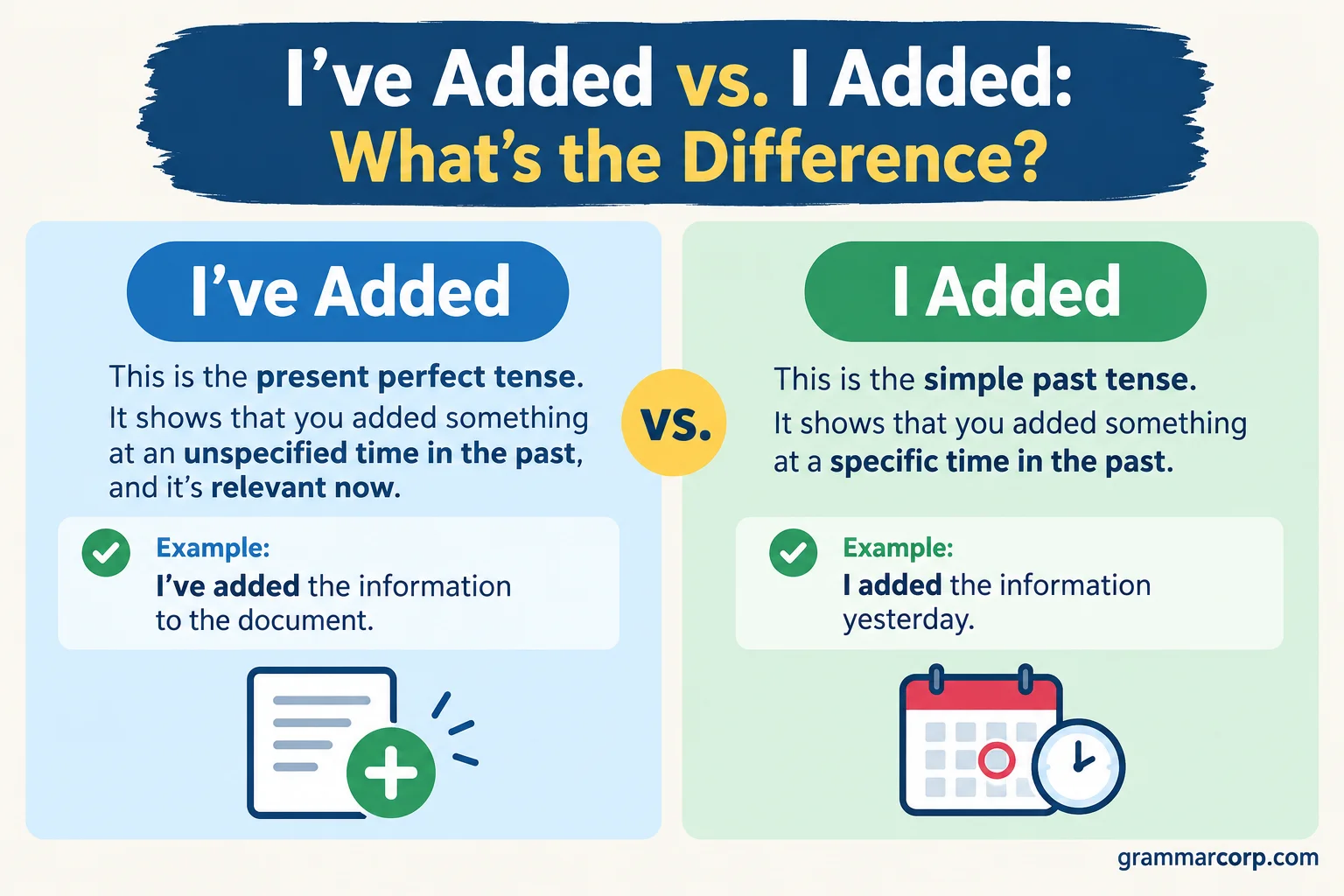
In I’ve Added vs. I Added: What’s the Difference?, I’ve added a past action to now, while I added reports of a finished past event. I’ve added the present perfect tense and emphasizes a present connection, current result, or present relevance. For example, “I’ve added the file to the folder” suggests that the file is now included or available. In contrast, I added uses the simple past and usually refers to a completed action, finished action, or past event, especially when a specific time is mentioned. “I added the file yesterday” clearly places the action in the past.
In everyday spoken English, written communication, emails, workplace messages, academic writing, and blog posts, choosing the correct tense makes your writing clearer. Native speakers, including speakers of American English, naturally use both forms depending on the time connection they want to express.
Use the present perfect when the past action still has a meaningful connection with the present, such as “I’ve added your name to the list.” Use the simple past when you are describing something completed at a definite past time, such as “I added your name yesterday.” Understanding this distinction also helps you avoid common mistakes and choose between I’ve added, I added, have added, put, and included based on the intended focus, tone, and context.
Quick Answer:
I’ve added the present perfect form of add. It usually emphasizes that something was added and that the action has a present connection or result.
I added is the simple past form of add. It focuses on an action that happened and finished in the past.
A simple way to remember the distinction is:
I’ve added = look at the result now.
I added = look back at the past action.
For example:
- I’ve added your name to the list. → Your name is now on the list.
- I added your name to the list yesterday. → The sentence focuses on when the action happened.
Neither form is automatically more correct or more professional. Context determines which one sounds natural.
Comparison Overview
The easiest way to understand I’ve added vs. I added is to compare their grammatical structure and purpose.
| Feature | I’ve added | I added |
| Full form | I have added | I added |
| Tense | Present perfect | Simple past |
| Main focus | Present result or relevance | Completed past action |
| Specific finished time | Usually avoided | Common |
| Example | I’ve added the details. | I added the details yesterday. |
| Common purpose | Giving an update | Describing what happened |
| Current result emphasized | Yes | Not necessarily |
| Can stand alone? | Yes | Yes |
Consider a workplace situation. Someone asks whether you included three missing details in a report.
You might say:
I’ve added the missing details.
The important information is that the details are now included.
If someone asks what you did yesterday, you could say:
I added the missing details yesterday.
Here, the action belongs to a specific past event.
This difference between present relevance and past time explains most everyday uses of these two forms.
Main Differences Between I’ve Added vs. I Added
The biggest difference between I’ve added vs. I added isn’t the action itself. It is the speaker’s view of the action.
I’ve Added Connects the Past to the Present
I’ve added uses the present perfect:
I + have + added
The word added is the past participle of add. The auxiliary verb have creates the present perfect construction.
For example:
- I’ve added the new paragraph.
- I’ve added your suggestions.
- I’ve added the meeting to my calendar.
- I’ve added the attachment.
- I’ve added the new items to the list.
These sentences don’t tell us exactly when the action happened. Instead, they tell us that the action has occurred and that the result matters now.
If you tell someone, I’ve added the attachment, you’re usually communicating that the attachment should now be available or included.
I Added Places the Action in the Past
I added the simple past.
The structure is straightforward:
I added
For example:
- I added the attachment yesterday.
- I added the information after lunch.
- I added the new section last week.
- I added your name during the meeting.
- I added those numbers before the presentation.
These sentences place the action in the past. The speaker isn’t simply reporting the current result. The speaker is talking about when or how something happened.
The Difference Is Often About Perspective
Imagine that you put a document into a shared folder.
If your coworker asks, Is the document in the folder?, you could answer:
I’ve added it.
The current status matters.
If your coworker asks, What did you do yesterday afternoon?, you could answer:
I added the document to the shared folder.
The past event matters.
The physical action may be exactly the same. What changes is the time perspective.
What Does “I’ve Added” Mean?
I’ve added means I have added.
It describes an action that began and finished in the past or happened recently while maintaining a connection to the present.
The present perfect doesn’t necessarily mean that the action happened moments ago. It can refer to an action at an unspecified time before now.
For example:
I’ve added several examples to the article.
This tells the reader that the examples are now part of the article. The exact moment of addition isn’t important.
Common Uses of “I’ve Added”
You can use I’ve added when:
- You want to report a recent update.
- The current result matters.
- The exact time isn’t important.
- You want to tell someone that something is now included.
- You are describing something that has happened during an unfinished period.
For example:
I’ve added your suggestions to the document.
The natural implication is that the document now contains those suggestions.
Another example:
I’ve added the new address to my contacts.
The important point is the current state of your contacts. The listener doesn’t need to know the exact minute when you entered the address.
“I’ve Added” With Already, Just, and Recently
The present perfect often works naturally with words such as already, just, and recently.
Examples include:
- I’ve already added the information.
- I’ve just added the final paragraph.
- I’ve recently added several new examples.
- I’ve already added your name.
- I’ve just added the updated version.
These words help reinforce the connection between a past action and the present situation.
However, the present perfect isn’t required every time you use words such as recently. Context still determines the most natural tense.
What Does “I Added” Mean?
I added is the simple past form of add.
It tells us that the action happened in the past.
For example:
I added the information yesterday.
The word yesterday clearly places the action in a finished past period.
Other examples include:
- I added the information last night.
- I added the image two hours ago.
- I added the names after the meeting.
- I added the figures last week.
- I added the final section before the deadline.
The simple past works particularly well when the sentence answers a question such as:
- What happened?
- What did you do?
- When did you add it?
- What did you change yesterday?
- What happened during the meeting?
Why “I’ve Added It Yesterday” Is Usually Incorrect
One of the most common mistakes involving I’ve added vs. I added occurs when someone combines the present perfect with a definite finished past time.
For example:
I’ve added it yesterday.
In standard English, this is normally incorrect.
The problem comes from the relationship between the tense and the time expression.
Yesterday identifies a finished period in the past. The simple past normally handles this situation:
I added it yesterday.
The present perfect connects an unspecified past action to the present. A finished-time expression such as yesterday instead places the action at a definite point in completed past time.
Compare:
- ❌ I’ve added it yesterday.
- ✅ I added it yesterday.
- ✅ I’ve added it already.
- ✅ I’ve added it recently.
The distinction becomes much easier when you ask yourself whether you’re identifying a finished past time.
When Should You Use “I’ve Added”?
Use I’ve added when the current result matters more than the exact time.
When Reporting an Update
Suppose someone asked you to update a document.
You can say:
I’ve added the missing information.
This works because you’re reporting the document’s current condition.
When Confirming a Task
If someone asks whether you completed a requested change, you might say:
I’ve added the changes you requested.
The emphasis falls on the completed task and its current result.
When the Exact Time Doesn’t Matter
Consider:
I’ve added three new examples.
The sentence doesn’t tell us exactly when you added them. That’s fine because the time isn’t relevant.
You could use this sentence when discussing the current version of an article, report, presentation, or document.
When the Action Happened During an Unfinished Period
The present perfect can also describe something that happened during a period that continues up to now.
For example:
I’ve added five new sections this week.
If the week is still in progress, I’ve added can naturally describe what has happened so far.
By contrast:
I added five new sections last week.
Here, last week refers to a completed period. The simple past fits naturally.
When Should You Use “I Added”?
Use I added when you want to describe a completed action in the past.
When You Mention a Finished Time
Examples:
- I added it yesterday.
- I added it last Monday.
- I added the details this morning.
- I added the image two hours ago.
- I added the names during yesterday’s meeting.
The simple past is the natural choice because the time is clearly located in the past.
When Telling a Story or Explaining Events
The simple past also works well when you’re describing a sequence of past actions.
For example:
I opened the document, checked the figures, and added the missing information.
The sentence describes a series of completed events.
The focus isn’t on the current result. Instead, the speaker is explaining what happened.
When Answering a Past-Tense Question
Question and answer pairs often make the distinction clear.
What did you add to the report?
I added two new examples and a short conclusion.
The question uses the simple past because it asks about a past action. The answer naturally follows that frame.
I’ve Added vs. I Added in Different Contexts
The choice becomes easier when you look at common real-world situations.
In Emails
When sending someone an updated document, you might write:
I’ve added the information you requested.
This sounds natural because you’re communicating the current status of the document.
If you’re explaining when you made the change, use the simple past:
I added the information yesterday afternoon.
Both can be correct in the same email:
I’ve added the requested information. I added it yesterday afternoon after reviewing the report.
The first sentence highlights the current result. The second supplies past-time information.
In Workplace Messages
Suppose your manager asks whether you included a new item in a spreadsheet.
I’ve added it to the spreadsheet.
This directly confirms the current status.
If a colleague asks what you worked on earlier:
I added the new item to the spreadsheet this morning.
Now the focus is on the past work.
In Everyday Conversation
Imagine someone asks:
Did you add milk to the shopping list?
You might respond:
I’ve added it.
The result matters because the person wants to know whether the item is now on the list.
If someone asks:
What did you add to the list this morning?
You might answer:
I added milk and bread.
The question asks about a past action, so the simple past fits naturally.
In Documents and Files
Both forms appear frequently when discussing digital work.
I’ve added the new section to the document.
This means the section is now there.
I added the new section before the meeting.
This tells the reader when the work happened.
The distinction becomes especially useful in professional communication because it helps you communicate whether you’re giving a status update or describing past work.
Can “I’ve Added” and “I Added” Both Be Correct?
Yes.
This is one of the most important points to understand about I’ve added vs. I added.
Grammar doesn’t require one form in every situation. Both can be completely correct when the surrounding context supports them.
Consider:
I’ve added the photo.
This sounds like a status update. The photo is now included.
Now consider:
I added the photo during the meeting.
This tells us when the action happened.
You could even combine the ideas:
I’ve added the photo. I added it after we discussed the layout.
The first sentence gives the current result. The second explains the past event.
Example: Updating a Report
Imagine you’re working on a report.
Someone asks:
Have you added the sales figures?
A natural response is:
Yes, I’ve added them.
Now imagine someone asks:
When did you add the sales figures?
A natural response is:
I added them this morning.
Notice how the question influences the answer.
| Question | Natural answer |
| Have you added the figures? | I’ve added them. |
| When did you add the figures? | I added them this morning. |
| Did you add them yesterday? | Yes, I added them yesterday. |
| Are the figures in the report now? | Yes, I’ve added them. |
This pattern gives you a practical way to choose the correct tense.
Common Mistakes With “I’ve Added” and “I Added”
Understanding the rule is useful. Avoiding common errors makes your writing much stronger.
Mistake: Using “I’ve Added” With “Yesterday”
Incorrect in standard English:
I’ve added the information yesterday.
Better:
I added the information yesterday.
The word yesterday identifies a completed past time.
Mistake: Thinking “I Added” Means the Result Doesn’t Matter
That’s not necessarily true.
Consider:
I added your name to the list yesterday.
The list may still contain the name today. The sentence simply chooses to focus on when the action occurred.
The simple past doesn’t automatically mean that the result disappeared or became irrelevant.
Mistake: Thinking “I’ve Added” Always Means “Just Now”
It doesn’t.
I’ve added several new examples to the article.
This could refer to something you did recently or at an unspecified time before now. The sentence doesn’t necessarily mean you finished the action a few seconds ago.
Mistake: Confusing “Added” With “Add”
After have, you need the past participle:
- Correct: I’ve added
- Incorrect: I’ve add
The verb add has the same form for its simple past and past participle:
add → added → added
That’s why the construction can look deceptively simple.
A Practical Test for Choosing the Right Form
When you’re unsure whether to use I’ve added or I added, ask yourself three questions.
Are You Talking About a Finished Past Time?
If yes, the simple past will usually work.
I added it yesterday.
I added it last week.
I added it after the meeting.
Are You Reporting a Current Result?
If yes, the present perfect may be the better choice.
I’ve added it.
I’ve added the missing information.
I’ve added your name to the list.
Does the Exact Time Matter?
If the exact time isn’t important, I’ve added may sound more natural.
If the time is important and clearly finished, I added is usually the better choice.
Read More : In Fact Comma Usage: Rules, Examples, and Common Mistakes
I’ve Added vs. I Added: Side-by-Side Examples
Here are several pairs that show how the meaning changes with context.
| I’ve added | I added |
| I’ve added the attachment. | I added the attachment yesterday. |
| I’ve added your name. | I added your name this morning. |
| I’ve added the final section. | I added the final section before lunch. |
| I’ve added the new figures. | I added the new figures last night. |
| I’ve added your comments. | I added your comments after the meeting. |
| I’ve added the address. | I added the address earlier today. |
| I’ve added three examples. | I added three examples during the revision. |
| I’ve added the updated schedule. | I added the updated schedule on Monday. |
The left column emphasizes the current result or relevance.
The right column emphasizes the completed past action.
Special Case: “This Morning,” “Today,” and Other Time Expressions
Some time expressions require more attention because their relationship with the present can vary by context.
This Morning
If it’s still morning, the present perfect can be possible:
I’ve added the information this morning.
However, many speakers may prefer the simple past depending on regional variety and context:
I added the information this morning.
If the morning has clearly ended, the simple past becomes especially natural.
Today
Because today can describe a period that is still continuing, both tenses may appear depending on the meaning and variety of English.
For example:
I’ve added three new items today.
This emphasizes what has happened so far today.
I added three new items today.
This can also be natural when the speaker is simply reporting a completed action that happened today.
The important difference is that today doesn’t automatically force one tense in every variety of English.
This Week
If the week is still in progress:
I’ve added several new examples this week.
If you’re talking about a completed week:
I added several new examples last week.
This illustrates a broader rule: present perfect often works with unfinished time periods, while simple past works naturally with completed periods.
Case Study: Choosing the Right Tense in a Work Email
Imagine that a colleague asks you to update a report.
You make the changes and send a message.
A useful status update would be:
I’ve added the missing figures and updated the conclusion.
Why does this work?
The purpose of the message is to tell your colleague that the requested changes are now complete.
Now imagine that your colleague asks what you worked on yesterday.
You could say:
I added the missing figures and updated the conclusion yesterday.
The same work happened. The grammatical perspective changed.
The first version answers:
What is the current status?
The second answers:
What happened in the past?
That distinction explains why native speakers can switch between the two forms without changing the basic action.
Which Is More Professional: “I’ve Added” or “I Added”?
Neither tense is inherently more professional.
Professional communication depends on clarity, accuracy, tone, and context.
For a current status update, I’ve added often sounds especially natural:
I’ve added the requested information to the report.
For a record of completed work, I added works well:
I added the requested information to the report on Tuesday.
A professional writer shouldn’t choose a tense simply because it sounds more formal. Choose the tense that accurately represents the relationship between the action and the time.
“I’ve Added” vs. “I Added” in American English
American English uses both the present perfect and simple past. However, everyday American usage can sometimes favor the simple past in situations where British English may more strongly prefer the present perfect.
For example, an American speaker may naturally say:
I already added it.
Another speaker might say:
I’ve already added it.
Both communicate that the action has been completed. The first uses the simple past. The second uses the present perfect.
This doesn’t mean the distinction disappears. The present perfect still has its grammatical function. It simply means that real-world usage can vary by dialect, context, and conversational style.
For formal writing, the clearest approach is to pay attention to the time reference and the meaning you want to communicate.
Quick Rules to Remember
If you want a simple reference, keep these rules in mind:
- I’ve added = present perfect.
- I added = simple past tense.
- Use I’ve added when the current result matters.
- Use I added when you focus on a completed past action.
- Use I added with definite finished times such as yesterday or last week.
- I’ve added often works with already, just, and recently.
- Don’t normally combine the present perfect with yesterday.
- A simple past sentence can still describe an action whose result exists today.
- Neither form is automatically more professional.
- Context determines the most natural choice.
FAQs:
Is “I’ve added” grammatically correct?
Yes, “I’ve added” is grammatically correct. It is the present perfect tense, formed with I have plus the past participle added. It is useful when the action has a present relevance or a result that matters now.
Is “I added” grammatically correct?
Yes, “I added” is also grammatically correct. It uses the simple past tense and normally describes a completed action that happened in the past. It often appears with a specific time reference, such as “yesterday,” “last week,” or “this morning.”
What is the main difference between “I’ve added” and “I added”?
The main difference is the connection to the present. “I’ve added” emphasizes the current result, present connection, or relevance of the action, while “I added” focuses more on the completed past event and when it happened.
Can I say “I’ve added the file”?
Yes. “I’ve added the file” is natural when you want to tell someone that the file is now included, available, or placed somewhere. For example, “I’ve added the file to the folder” emphasizes the current result of the action.
Can “I’ve added” and “I added” mean the same thing?
They can describe the same basic action, but their emphasis is different. “I’ve added it” highlights the action’s connection to the present, whereas “I added it yesterday” clearly places the action in a finished past period.
Conclusion:
The difference between I’ve added and I added mainly comes down to tense, time reference, and present relevance. I’ve added the present perfect and connects a past action with the present, while I added uses the simple past to describe a completed past action.
Once you understand this distinction, choosing the correct form becomes much easier.









1 thought on “I’ve Added vs. I Added: What’s the Difference?”