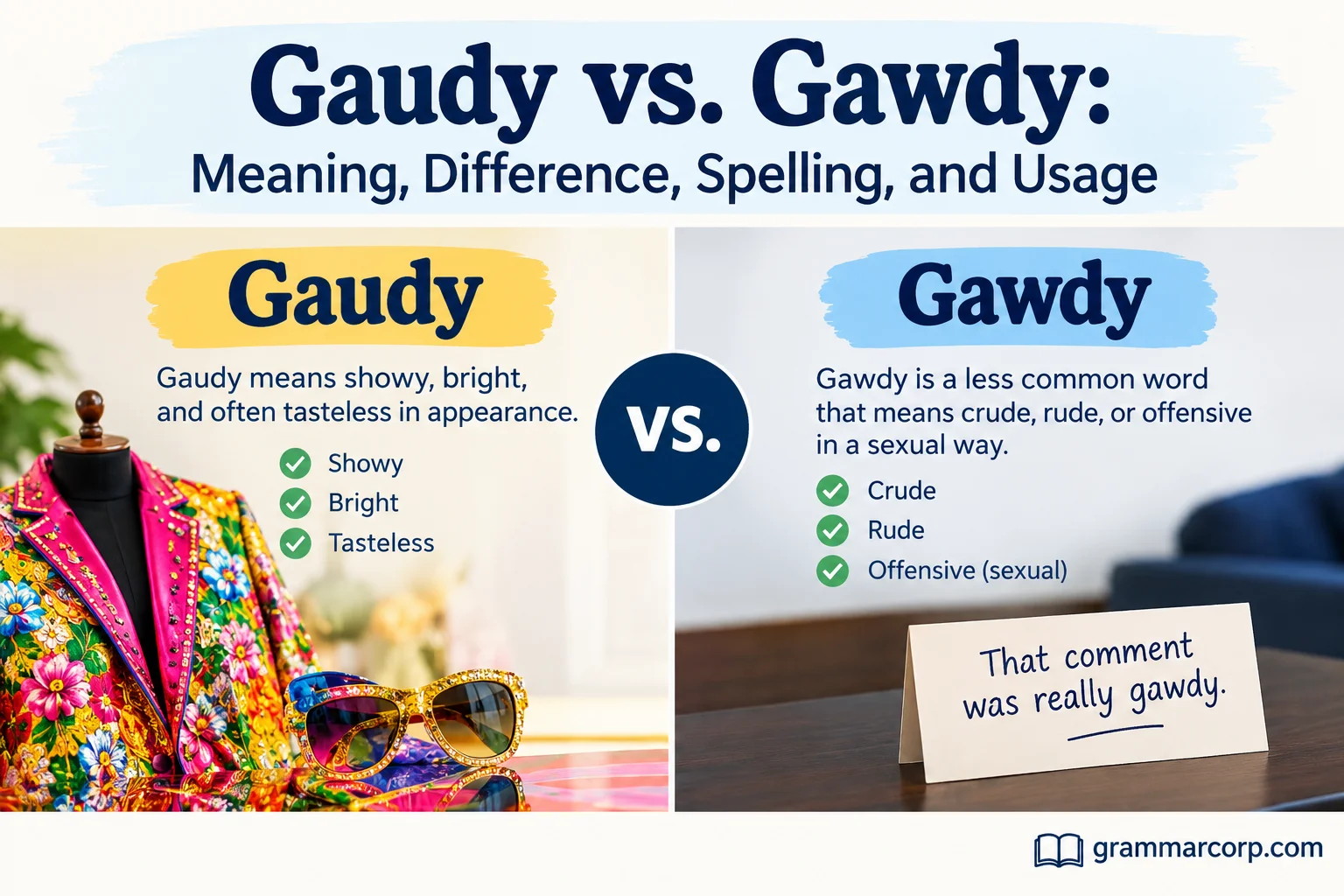
Gaudy vs. Gawdy: Meaning, Difference, Spelling, and Usage can seem confusing because these words look almost identical, have a similar sound, and are often pronounced alike when spoken aloud. This common spelling question often leaves people confused when writing, especially when they wondered about the correct spelling or paused to notice these terms. The standard modern spelling is gaudy, and Merriam-Webster labels gawdy an archaic variant, making gaudy the normal spelling to choose in contemporary English.
Its adjective meaning is to describe something excessively showy, brightly colored, heavily decorated, or lacking good taste. Something bright, showy, flashy, colorful, vibrant, sparkling, glittering, dazzling, extravagant, extravagantly decorated, over the top, loud, garish, ostentatious, vulgar, or tasteless can therefore be called gaudy. A gaudy necklace, dress, costumes, decorations, showy ornament, or gaudy neon lights outside a casino, visible from miles away, are useful examples. I once wore a gaudy necklace to a party, and its description seemed to fit perfectly, which made the distinction easier to remember.
The history of the word makes this tricky language issue more interesting. The term has a long history, and historical evidence traces it to Middle English gaud, a noun connected with a trick or deception. Later, gaudi appeared in the 1520’s and referred to a large ornamental bead on a rosary. This history helps explain the modern meaning, while the familiar adjective sense describes something unusually bright or showy. There is also a noun use in a particular British university context, where a gaudy can refer to a university feast or celebration, showing that the word has more than one function. This British university context is useful to study because context can change interpretation.
Quick Answer:
Gaudy is the correct standard spelling in modern English.
It usually means excessively bright, showy, decorated, or flashy in a way that seems tasteless. Oxford describes it as something that is too brightly colored in a way that lacks taste.
Gawdy is an archaic variant of gaudy. You may encounter it in older writing or historical material. It can also appear as part of historical names or surnames, where changing the spelling would be inappropriate.
| Word | Modern status | Main meaning | Best use today |
| Gaudy | Standard | Excessively showy or tastelessly decorated | Normal modern writing |
| Gawdy | Archaic variant | Same basic word and sense | Historical or specialized contexts |
So, if you’re writing a sentence such as The room was decorated in a gaudy style, choose gaudy.
Comparison Overview
The simplest way to understand gaudy vs. gawdy is to treat them as two historical spellings rather than two completely different words.
Gaudy
Gaudy is the established modern form. It functions primarily as an adjective.
You can use it for clothes, colors, jewelry, decorations, buildings, designs, displays, and even figurative things such as extravagant claims or statistics.
For example:
- The designer rejected the gaudy color scheme.
- His jacket looked gaudy under the bright lights.
- The restaurant had a gaudy interior.
- The advertisement made several gaudy promises.
- The player finished the season with gaudy statistics.
Merriam-Webster defines the adjective as ostentatiously or tastelessly ornamented. It also gives a broader sense involving extravagance or showiness.
Gawdy
Gawdy has essentially the same historical meaning, but modern dictionaries treat it as an archaic variant.
Merriam-Webster’s entry is particularly direct: gawdy is an archaic variant of gaudy.
That distinction matters.
You might see gawdy in an old book, historical document, genealogy, or quotation from earlier English. Its appearance doesn’t mean the writer accidentally added a w. In historical English, spelling was less standardized than it is today.
For modern writing, however, gaudy is the safer and standard choice.
Main Differences Between Gaudy vs. Gawdy
There isn’t a major difference in basic meaning between the two forms. The biggest difference is modern spelling status.
| Feature | Gaudy | Gawdy |
| Standard modern spelling | Yes | No |
| Historical use | Yes | Yes |
| Archaic status | No | Yes |
| Meaning | Excessively showy or tasteless | Historical variant of gaudy |
| Common in modern writing | Yes | Very rare |
| Pronunciation | Usually pronounced like GAW-dee | Historically associated with the same word |
| Suitable for ordinary modern English | Yes | Generally no |
| Can appear in historical names | Yes | Yes |
The key takeaway is simple: the spelling changed more than the core meaning did.
That’s why a modern writer should normally use gaudy, while a historian or editor working with an old source may preserve gawdy.
What Does Gaudy Mean?
The adjective gaudy describes something that attracts attention through excessive color, decoration, brightness, ornamentation, or display.
It usually carries a negative or disapproving tone.
Oxford defines gaudy as being too brightly colored in a way that lacks taste.
Merriam-Webster expands the idea to include things that are ostentatiously or tastelessly ornamented. It also recognizes a broader sense involving extravagance or showiness.
Gaudy Usually Suggests Excess
Imagine a room with bright red walls, gold furniture, glittering decorations, patterned curtains, several enormous mirrors, and multiple chandeliers.
Calling the room colorful would simply describe its appearance.
Calling it gaudy adds judgment.
The word suggests that the decoration has crossed a line from attractive or dramatic into excessive and possibly tasteless.
That distinction is important.
A bright yellow dress isn’t automatically gaudy. A gold necklace isn’t automatically gaudy. A colorful room isn’t automatically gaudy.
The word usually becomes appropriate when the amount, combination, intensity, or style feels excessive.
Gaudy vs. Colorful
These words aren’t interchangeable.
Colorful is often neutral or positive.
Gaudy usually suggests that the colors or decoration have been used without enough restraint.
Compare:
- The artist created a colorful painting.
- The artist created a gaudy painting.
The first sentence can sound complimentary. The second suggests that the painting may be overly bright or decorated.
Gaudy vs. Flashy
Flashy and gaudy overlap, but they aren’t identical.
Flashy often describes something designed to attract attention. It can refer to appearance, behavior, possessions, or performance.
Gaudy more strongly suggests excessive decoration or tasteless visual display.
For example, a sports car might be flashy because it attracts attention. If its exterior combines extremely bright colors, oversized decorations, excessive chrome, and elaborate details, someone might call it gaudy.
Gaudy vs. Garish
Garish is another close synonym.
Oxford lists garish as a synonym for gaudy.
Still, there is a useful difference.
Garish often emphasizes something that is glaring, harsh, or unpleasantly bright.
Gaudy often emphasizes excessive ornamentation, decoration, or showiness.
Merriam-Webster makes a similar distinction by describing garish as distressingly or offensively bright while gaudy emphasizes tastelessly bright colors or excessive ornamentation.
Is Gawdy a Correct Word?
Yes, but context matters.
Gawdy is a real historical form, not simply a meaningless collection of letters. Merriam-Webster lists it as an archaic variant of gaudy.
That means calling every occurrence of gawdy a spelling mistake would be too simplistic.
Historical English contained many spelling variations. Before modern spelling conventions became firmly established, writers could represent sounds in different ways.
The spelling gawdy is therefore something you can encounter in older material.
Should You Use Gawdy in Modern Writing?
Usually, no.
If you are writing an email, blog post, essay, article, report, school assignment, or social media caption today, use gaudy.
For example:
Correct modern usage:
The curtains were too gaudy for the otherwise simple room.
Using gawdy in the same sentence would look unusual and may be interpreted as a spelling error.
When Might Gawdy Be Appropriate?
There are several situations where preserving the spelling can make sense:
- Historical quotations
- Historical documents
- Literary analysis
- Genealogy
- Historical names
- Archival research
- Discussions of older English spelling
The general rule is straightforward:
Modern description → gaudy.
Historical source or established proper name → preserve the original spelling when appropriate.
Gaudy vs. Gawdy Pronunciation
One reason gaudy vs. gawdy causes confusion is that the spelling difference doesn’t necessarily produce an obvious pronunciation difference.
Modern dictionaries give gaudy pronunciations around GAW-dee in English. Oxford lists /ˈɡɔːdi/, while Merriam-Webster provides corresponding American pronunciations.
For an English learner, you can think of it approximately as:
GAW-dee
The exact vowel can vary by accent.
Why Pronunciation Doesn’t Solve the Spelling Problem
English spelling frequently creates situations where two forms can sound similar.
The sound alone doesn’t tell you which spelling is standard.
That’s why relying on pronunciation can lead to mistakes with words such as gaudy. If you’re unsure while writing, remember the modern spelling:
GAU + DY = GAUDY
The w belongs to the historical variant gawdy, not the standard modern spelling.
Where Does the Word Gaudy Come From?
The history of gaudy is more interesting than its modern meaning might suggest.
Oxford traces the adjective to the late 15th century and describes it as probably coming from gaud, meaning a showy or ornamental thing, combined with the suffix -y.
Merriam-Webster gives the adjective’s first known use as 1582 and traces the adjective to gaud + -y.
Etymology sources also connect older forms of gaud with ornaments, trinkets, beads, and ideas involving joy or display. The history isn’t perfectly simple because several related historical words and senses overlap.
A Short Etymology Timeline
| Period | Development |
| Middle English period | Related forms referred to ornaments, beads, tricks, and other meanings |
| Late 15th century | Gaudy develops as an adjective associated with ornamentation |
| 16th century | The adjective develops showy and extravagant senses |
| 1582 | Merriam-Webster records the first known use of the adjective gaudy |
| 17th century | Gaudy also develops a noun sense connected with feasts or celebrations |
| Modern English | Gaudy remains the standard spelling |
The history also explains why modern gaudy has a connection to ornamentation rather than simply meaning “bright.”
Gaudy as a Noun
There is another meaning worth knowing.
Gaudy can also be a noun.
In British university usage, particularly at Oxford and Cambridge, a gaudy can refer to a special dinner or reunion for former students. Oxford describes it as a special annual dinner for former students at some colleges.
Merriam-Webster similarly defines the noun as a feast or entertainment, especially an annual college dinner at a British university.
This meaning is separate from the everyday adjective.
For example:
The alumni returned to the college for the annual gaudy.
Here, gaudy does not mean tasteless or overly colorful.
It refers to a traditional university event.
That makes context especially important.
Gaudy in a Sentence: Real-World Examples
Learning a word becomes much easier when you see how it behaves in natural sentences.
Gaudy Clothes
She wore a gaudy jacket covered in bright patterns.
The adjective suggests that the jacket is more visually dramatic than tasteful.
Another example:
His gaudy outfit attracted attention as soon as he entered the room.
Here, the focus is on excessive visual display.
Gaudy Jewelry
The necklace was so gaudy that it overwhelmed the simple dress.
The word works because the jewelry is being described as excessively ornate.
Oxford specifically notes common combinations such as gaudy clothes and gaudy colours, along with jewelry-related usage.
Gaudy Decorations
The shop was filled with gaudy decorations and flashing signs.
This suggests that the decorations are excessive rather than simply festive.
Gaudy Interior Design
The hotel lobby had a gaudy mixture of gold furniture, bright carpets, and oversized ornaments.
The combination creates the judgment behind gaudy.
Gaudy Colors
The walls were painted in a gaudy combination of purple, orange, and neon green.
Notice that the colors themselves aren’t necessarily “gaudy” in isolation.
The combination and use create the effect.
Gaudy Architecture
Critics considered the building’s exterior unnecessarily gaudy.
Here, gaudy refers to excessive visual ornamentation.
Gaudy Claims
The word can also move beyond physical appearance.
The company made gaudy claims about how quickly its product would transform results.
Merriam-Webster recognizes broader uses involving extravagant or outlandish claims.
This figurative use shows that gaudy can describe something that is excessive even when you cannot literally see it.
Gaudy vs. Gawdy: A Practical Usage Case Study
Consider a writer describing an old-fashioned theater.
The writer has several possible choices:
The theater was colorful.
This is neutral.
The theater was flashy.
This suggests attention-grabbing appearance.
The theater was garish.
This emphasizes an unpleasantly bright or glaring quality.
The theater was gaudy.
This suggests excessive decoration or showiness that lacks taste.
Now imagine the same sentence appearing in a historical novel that deliberately reproduces older spelling:
The theater was gawdy.
In that context, the unusual spelling could be intentional.
The difference isn’t about the object itself. It is about the spelling convention and context in which the word appears.
That is the central lesson of gaudy vs. gawdy.
Is Gawdy a Misspelling of Gaudy?
In ordinary modern English, gawdy should generally be treated as a nonstandard or archaic form rather than the spelling you should choose.
However, calling it simply a “misspelling” can erase its historical status.
Merriam-Webster explicitly identifies gawdy as an archaic variant.
Historical sources can contain spellings that look unusual by today’s standards.
For example, older English frequently displayed greater variation in spelling before dictionaries, printing conventions, education, and standardized usage pushed forms toward greater consistency.
So the best explanation is:
- Gaudy = standard modern spelling
- Gawdy = archaic historical variant
- Neither represents a completely different modern meaning
- Historical context can justify preserving gawdy
- Modern writing should normally use gaudy
Read More : Huckleberry: Features, Pricing, Sleep Tracking, Complete Guide
Is Gaudy Always Negative?
Not necessarily, but the adjective is usually disapproving.
Oxford marks the adjective as disapproving.
If someone says:
That dress is gaudy.
The listener will probably understand that the speaker thinks the dress is overly flashy or lacks taste.
However, context can soften the judgment.
Merriam-Webster also records a broader sense involving something exceptional. Its examples include expressions such as gaudy statistics.
This creates an interesting modern use.
For example:
The team produced some gaudy numbers this season.
Here, the speaker may not be criticizing the numbers. The word can suggest that the statistics are strikingly impressive or unusually large.
That is quite different from calling a shirt gaudy.
The Context Changes the Tone
| Example | Likely meaning |
| Gaudy dress | Excessively flashy |
| Gaudy jewelry | Excessively ornate |
| Gaudy decorations | Tastelessly elaborate |
| Gaudy colors | Overly bright or clashing |
| Gaudy claims | Extravagant or outlandish |
| Gaudy statistics | Exceptionally impressive or striking |
This is one reason dictionary definitions can seem broader than a simple synonym such as tacky.
Common Mistakes With Gaudy and Gawdy
Using Gawdy in Ordinary Modern Writing
The most common mistake is choosing gawdy simply because it seems like an alternative spelling.
For contemporary writing, choose gaudy.
Assuming Gaudy Means Only Bright
Brightness is important, but it isn’t the entire definition.
Something can be gaudy because of:
- Excessive ornamentation
- Clashing colors
- Over-the-top decoration
- Tasteless extravagance
- Excessive visual display
The idea of too much is often central.
Treating Colorful and Gaudy as Synonyms
A colorful design can be beautiful.
A gaudy design is generally being criticized for going too far.
That small distinction changes the emotional meaning of the sentence.
Assuming Gaudy Always Describes Clothing
Clothing is a common context, but the word can describe much more.
You can have:
- Gaudy furniture
- Gaudy jewelry
- Gaudy architecture
- Gaudy decorations
- Gaudy advertisements
- Gaudy claims
- Gaudy statistics
Confusing the Word With Antoni Gaudí
A famous modern name can create another spelling association.
Antoni Gaudí, the Catalan architect, is associated with a distinctive architectural style. However, the English adjective gaudy predates him by centuries, so the adjective did not originate from his name. The word was already established long before the architect was born.
This is an easy historical mix-up to avoid.
How to Remember Gaudy vs. Gawdy
The easiest memory rule is:
Modern English uses GAUDY. Historical English may use GAWDY.
Think of the standard spelling as:
GAU + DY = GAUDY
Then connect the word with excessive showiness.
For example:
- gaudy clothes
- gaudy colors
- gaudy jewelry
- gaudy decorations
If you’re writing a normal article, assignment, email, or report, gaudy is almost certainly the form you want.
If you find gawdy in an old text, don’t automatically assume the writer made a mistake. Check the historical context first.
FAQs:
1. Is gaudy or gawdy the correct spelling?
Gaudy is the standard modern spelling in contemporary English. Gawdy is generally considered an archaic variant and is not the normal spelling for everyday writing.
2. What does gaudy mean?
Gaudy is an adjective that describes something excessively showy, brightly colored, heavily decorated, or lacking good taste. For example, a brightly decorated outfit may be described as gaudy.
3. Is gawdy a real English word?
Yes, gawdy has been recorded as an archaic variant of gaudy. However, gaudy is the preferred standard form in modern English.
4. What is the difference between gaudy and gawdy?
The main difference is their spelling and modern usage. Gaudy is the standard spelling used to describe something flashy or excessively decorated, while gawdy is an archaic variant that is uncommon in contemporary English.
5. How can I remember the spelling of gaudy?
A simple way to remember it is to associate gaudy with things that are bright, flashy, colorful, or excessively decorated. When writing in modern English, choose gaudy rather than gawdy.
Conclusion:
Gaudy vs. Gawdy can be confusing because the two forms look and sound very similar. However, gaudy is the standard modern spelling used for something excessively showy, colorful, flashy, or tasteless, while gawdy is an archaic variant.
Knowing this distinction makes the spelling easier to remember and helps you use the correct form confidently in everyday, professional, and formal writing.













