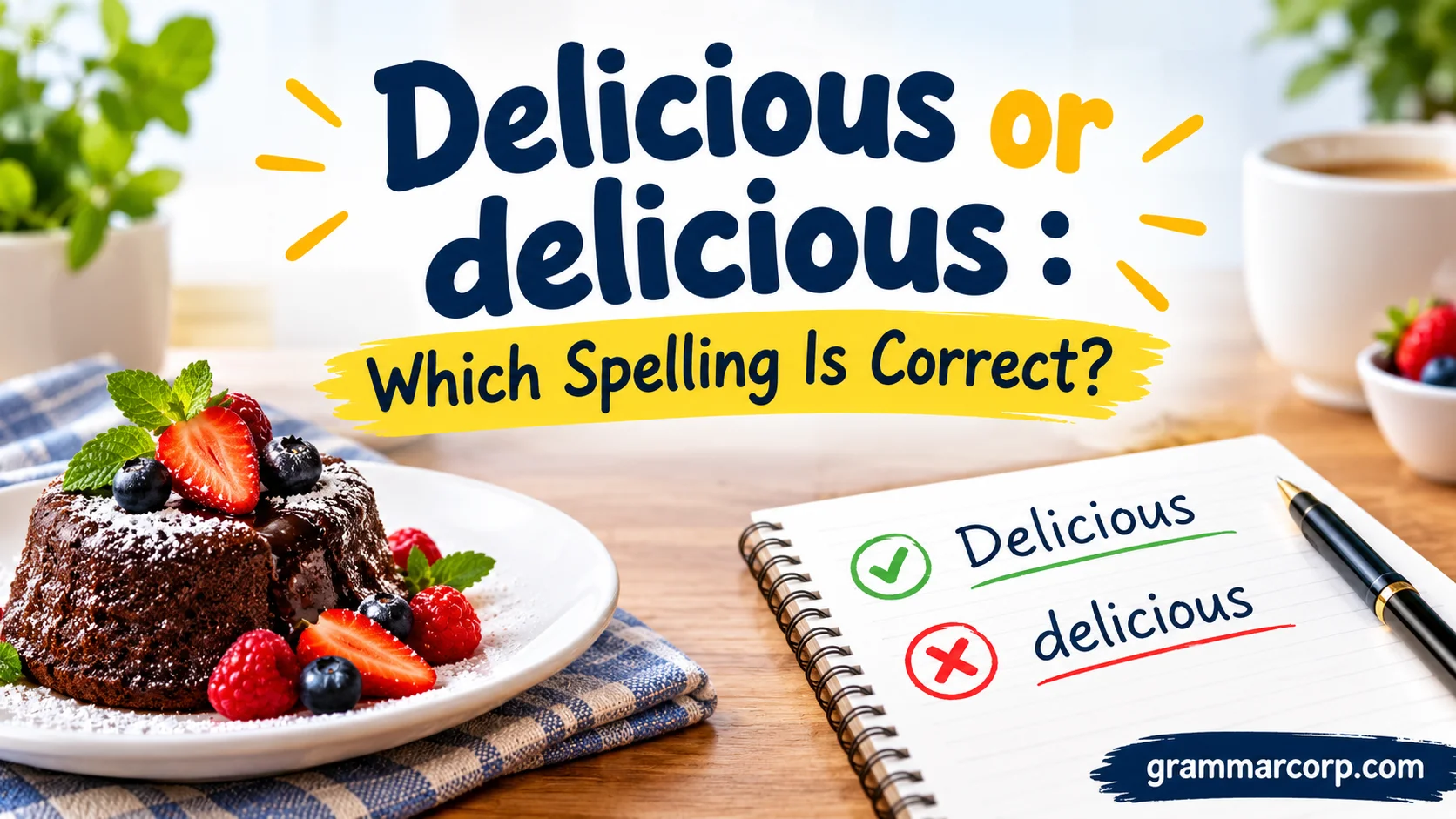
Delicious or delicious : Which Spelling Is Correct? The correct spelling is delicious, not dilicious, and this common spelling confusion is especially easy to make when the two forms look almost identical.
The key difference becomes clearer when comparing delicious with luscious. Delicious directly relates to taste and smell, while luscious suggests richness, ripeness, luxuriant fullness, or a broader sensory appeal. A rich banana, chocolate cake, or soup can have an enjoyable flavour, while luscious can describe music, beauty, or something figuratively appealing. Delicious is common in recipes, restaurant reviews, advertisements, blog posts, social media posts, formal and academic work, content, and professional communication. Japanese speakers may frequently use 美味しい, whereas native English speakers may use amazing, great, so good, looks so good, or tastes incredible in everyday communication.
If you have wanted to write that a meal tasted really good but suddenly questioned whether delicious or dilicious was correct, remember that the two spellings are not equally acceptable. They may look the same, sound quite similar when spoken quickly, and appear in text messages, comments, or informal writing, but seeing a spelling does not mean it is a standard word. Knowing the difference is useful because people use delicious when talking about food, desserts, and sometimes anything that gives great pleasure to the senses.The spelling can seem easy to confuse, but pronunciation, spelling, and context make the correct form easier to recognize.
Quick Answer:
Delicious is correct. delicious is incorrect when you mean the standard English adjective.
| Spelling | Status | Meaning |
| Delicious | ✅ Correct | Very pleasant to taste or smell |
| delicious | ❌ Incorrect | Common misspelling of delicious |
Major English dictionaries recognize delicious as an adjective. Cambridge defines it as something having a very pleasant taste or smell. It also records a broader use for something that gives great pleasure.
For example:
- Correct: This chocolate cake is delicious.
- Incorrect: This chocolate cake is delicious .
- Correct: The soup smells delicious.
- Incorrect: The soup smells delicious .
If you’re writing ordinary English, choose delicious.
Comparison Overview
The easiest way to understand delicious vs. delicious is to compare their spelling, meaning, pronunciation, and usage.
| Feature | Delicious | delicious |
| Standard English spelling | ✅ Yes | ❌ No |
| Dictionary entry as the standard adjective | ✅ Yes | ❌ No |
| Part of speech | Adjective | — |
| Common meaning | Very pleasant to taste or smell | — |
| Used in formal writing | ✅ Yes | ❌ No |
| Used in everyday English | ✅ Yes | ❌ No |
| Commonly caused by spelling confusion | — | ✅ Yes |
| Example | The pizza was delicious. | The pizza was delicious . ❌ |
The important point is simple: delicious doesn’t represent a second accepted spelling of delicious.
It is better understood as a spelling error. A spelling mistake can become familiar because people repeat it online, but repeated use doesn’t automatically turn it into standard English.
Cambridge lists delicious with the pronunciation /dɪˈlɪʃ.əs/ and identifies it as an adjective.
Main Differences Between Delicious and delicious
The biggest difference is that delicious is the established English word while delicious is a misspelling.
Spelling
The correct spelling contains e after the initial d:
D-E-L-I-C-I-O-U-S
The incorrect form changes that opening sequence:
D-I-L-I-C-I-O-U-S
That single vowel creates the entire problem.
When you’re writing quickly, the difference can be easy to overlook. However, only delicious should be used when describing food, drinks, smells, or something figuratively pleasurable.
Meaning
Delicious has a clear dictionary meaning. It commonly describes something that tastes or smells very good. Cambridge also records figurative uses for situations or activities that give great pleasure.
delicious , by contrast, doesn’t have a standard meaning as an English adjective.
Consider the difference:
The homemade bread was delicious.
The sentence communicates a clear idea: the bread tasted extremely good.
Now replace the spelling:
The homemade bread was delicious .
The intended meaning is still obvious from context. Yet the spelling is incorrect.
Pronunciation
One reason people write delicious is that pronunciation doesn’t always make English spelling obvious.
Cambridge gives the American pronunciation as /dɪˈlɪʃ.əs/.
When spoken naturally, the beginning can sound like di-, even though the written word begins de-.
This is an important English-learning lesson: pronunciation and spelling don’t always match perfectly.
Trying to spell every English word exactly as it sounds can create errors. The safest approach is to learn the written form alongside the pronunciation.
Usage
Use delicious in sentences such as:
- The curry was delicious.
- She made a delicious dessert.
- That coffee smells delicious.
- We had a delicious breakfast.
- These strawberries are delicious.
Don’t replace delicious with delicious in standard writing.
What Does Delicious Mean?
Delicious is an adjective used mainly to describe something that provides a very pleasant taste or smell.
For food and drinks, the meaning is straightforward. If something tastes exceptionally good, you can call it delicious.
For example:
- The pasta was delicious.
- This mango tastes delicious.
- The freshly baked bread smells delicious.
- That dessert looks delicious.
Cambridge’s learner dictionary explains that food or drink described as delicious smells or tastes extremely good.
The word can also move beyond literal food descriptions.
Delicious Can Have a Figurative Meaning
English speakers sometimes use delicious to describe something enjoyable or amusing rather than something edible.
For instance:
- The novel contains some delicious irony.
- The story has a delicious sense of humor.
- The debate produced a delicious moment of surprise.
This figurative use isn’t a mistake. It comes from the broader idea of something being highly pleasing.
Cambridge records this wider sense by noting that delicious can describe a situation or activity that gives great pleasure.
So, although food remains the most common context, delicious isn’t limited to meals and drinks.
Why Do People Spell Delicious as delicious ?
The delicious or delicious confusion is mainly a spelling problem influenced by pronunciation.
The Opening Sound Can Be Misleading
The first syllable of delicious doesn’t sound like the ordinary pronunciation of the letter name “e.”
Instead, the word begins with the unstressed sound /dɪ/. That can make the written de- less obvious when someone learns the word through speech.
This is especially common for people who encounter a word in conversation before seeing it written.
English Has Many Pronunciation-Based Spelling Problems
English spelling contains plenty of examples where pronunciation doesn’t provide a perfect guide.
Words can contain:
- Silent letters
- Unexpected vowel sounds
- Different spellings for similar sounds
- Historical spellings
- Letters that change sound depending on the word
Delicious isn’t unusual in that respect.
The mistake doesn’t mean the writer doesn’t understand the word. Often, they understand the meaning perfectly but have stored an inaccurate spelling in memory.
Fast Typing Can Make It Worse
Typing quickly introduces another source of errors.
When someone already expects the word to sound like delicious , the fingers can follow that mental pattern. The resulting spelling then looks familiar enough to escape a quick glance.
That explains why you may occasionally see delicious online.
However, online visibility shouldn’t be confused with dictionary acceptance.
How Do You Spell Delicious Correctly?
The standard spelling is:
D-E-L-I-C-I-O-U-S
A useful way to remember it is to divide the word into smaller pieces:
de + li + cious
Then put them together:
delicious
Another useful approach is to connect the word with related vocabulary.
The word has a long history connected with ideas of delight, pleasure, and enjoyment. Etymological records trace English delicious to Old French delisious, from Late Latin delisiousus, connected with Latin deliciae, meaning delight or pleasure.
That history doesn’t create a modern spelling rule. Still, it provides a useful memory connection: delicious describes something delightful.
A Simple Spelling Trick
Remember this sequence:
DE → LI → CIOUS
Don’t write:
DI → LI → CIOUS
If you pause before typing the first two letters, the mistake becomes much easier to catch.
Write It in Context
Instead of memorizing the word alone, practice it in natural sentences:
- This cake is delicious.
- The restaurant serves delicious food.
- We cooked a delicious dinner.
- The soup smells delicious.
- Those cookies look delicious.
Seeing the word repeatedly in meaningful sentences strengthens your visual memory.
Delicious vs. delicious Examples
Context makes the difference particularly easy to see.
| Incorrect | Correct |
| The pizza was delicious . | The pizza was delicious. |
| We ate a delicious meal. | We ate a delicious meal. |
| This cake looks delicious . | This cake looks delicious. |
| The soup tastes delicious . | The soup tastes delicious. |
| She made delicious cookies. | She made delicious cookies. |
| The coffee smells delicious . | The coffee smells delicious. |
The grammatical structure doesn’t change. Only the spelling changes.
Examples With Food
Delicious works naturally before a food noun:
- a delicious sandwich
- a delicious apple pie
- a delicious breakfast
- a delicious meal
- a delicious dessert
It can also appear after linking verbs:
- The sandwich is delicious.
- The soup tastes delicious.
- The cake smells delicious.
- The fruit looks delicious.
Examples With Drinks
The same pattern works with beverages:
- This tea is delicious.
- The smoothie tastes delicious.
- That coffee smells delicious.
- The fresh juice was delicious.
Examples in Restaurant Reviews
A restaurant review might say:
The grilled vegetables were delicious and perfectly seasoned.
Or:
We ordered the pasta, and it was surprisingly delicious.
The word communicates a strong positive reaction without requiring a complicated description.
How to Use Delicious in a Sentence
Because delicious is an adjective, it usually describes a noun or follows a linking verb.
Delicious Before a Noun
This is one of the most common structures:
delicious + noun
Examples:
- delicious food
- delicious soup
- delicious cake
- delicious fruit
- delicious dinner
Here, delicious tells the reader what kind of food you’re describing.
Delicious After a Linking Verb
You can also place it after verbs such as be, taste, and smell.
Examples:
- The cake is delicious.
- The cake tastes delicious.
- The kitchen smells delicious.
These structures emphasize the quality being experienced.
Delicious With Adverbs
Writers can modify delicious with adverbs when they want to strengthen or soften the description.
Examples include:
- absolutely delicious
- incredibly delicious
- especially delicious
- surprisingly delicious
- wonderfully delicious
However, simple writing often works best:
The bread was delicious.
You don’t need several extra words when one strong adjective does the job.
The History and Origin of Delicious
The history of delicious explains why the word has long been connected with pleasure.
Etymological records trace the English word to around 1300, when it carried the sense of being delightful or highly pleasing to the senses. It came through Old French delisious from Late Latin delisiousus.
The deeper Latin connection involves deliciae, associated with delight, pleasure, or charm. The original idea was therefore broader than food.
That makes sense when you look at older and modern uses. Something delicious can please the taste, but the word can also describe something that gives intense enjoyment in a figurative sense.
Interestingly, delicious later developed specialized uses too. Etymonline records Delicious as the name of an apple variety from the early 20th century and dates the colloquial shortening delish to 1920.
What the History Tells Us
The word’s history reinforces three useful points:
- Delicious is an established English word with centuries of history.
- Its original sense was connected to delight and pleasure.
- Its modern use became especially associated with taste and smell.
So, delicious isn’t a recently invented food adjective. It has deep roots in English vocabulary.
Is Delicious Ever Correct?
For ordinary English writing, no.
If you’re describing food or something enjoyable, write delicious.
There is one important distinction, though. A business, product, username, fictional character, or other proper name could deliberately use an unusual spelling such as delicious .
That would make it a name, not a second standard spelling of the English adjective.
For example, if a fictional restaurant were officially named delicious Café, the unusual spelling could be part of its branding.
The same principle applies to creative names generally. A company can intentionally modify a word. That doesn’t change the spelling used in standard English.
Therefore:
Delicious food → correct standard English.
delicious food → incorrect standard English.
delicious as an intentionally chosen brand name → potentially valid as a proper name.
That distinction prevents a common misunderstanding.
Synonyms for Delicious
Sometimes you want to avoid repeating delicious several times. English offers plenty of alternatives, although they don’t all have exactly the same tone.
| Synonym | Typical sense |
| Tasty | Pleasant to eat; casual and common |
| Flavorful | Having a strong or enjoyable flavor |
| Appetizing | Appealing and likely to make you want to eat |
| Delectable | Very enjoyable, often slightly more formal |
| Mouthwatering | Extremely appealing, especially visually or through description |
| Scrumptious | Very tasty, playful or enthusiastic |
| Savory | Pleasantly salty or spicy rather than sweet |
| Luscious | Rich, appealing, and often juicy or indulgent |
| Tempting | Attractive enough to make you want something |
These words aren’t perfect substitutes in every sentence.
For example, savory describes a flavor profile rather than simply saying something tastes excellent. Appetizing often describes how food looks or smells before you eat it.
Meanwhile, delicious is broader and works naturally in many everyday situations.
Read More : Dialog vs. Dialogue: What’s the Difference and Which Should You Use?
Common Mistakes With Delicious
Spelling isn’t the only thing worth watching.
Writing delicious
The biggest mistake is replacing de with di.
❌ The cookies were delicious .
✅ The cookies were delicious.
Writing Delisious
Another common error changes the c to s.
❌ The meal was delisious.
✅ The meal was delicious.
The ending should be:
-cious
not:
-sious
Adding an Extra L
Some writers accidentally produce forms such as dellicious.
❌ The dessert was dellicious.
✅ The dessert was delicious.
The word contains one l.
Leaving Out a Letter
You may also encounter shortened misspellings such as:
- delicious
- delicious
- delicious
None is the standard spelling of the adjective.
The safest solution is simple: remember the complete form delicious.
How to Remember the Correct Spelling of Delicious
If delicious keeps causing problems, use a small memory system instead of trying to memorize the entire word at once.
Break It Into Parts
Think:
DE + LI + CIOUS
Then combine the parts:
DELICIOUS
Focus on the First Two Letters
The most important difference between the two spellings is right at the beginning:
DELICIOUS ✅
delicious ❌
If you remember DE, you’ve already avoided the main mistake.
Connect It With Delight
The words delicious and delight have related historical connections. Both involve ideas of pleasure and enjoyment.
That gives you a useful mental association:
DELICIOUS → DELIGHT → pleasure
It isn’t a formal spelling rule. It’s simply an easy memory aid.
Use the Word Regularly
A word becomes easier to spell when you see and use it often.
Try writing a few natural sentences:
- The homemade soup was delicious.
- We had a delicious breakfast.
- This fruit tastes delicious.
- That dessert looks delicious.
After repeated exposure, the correct spelling becomes much more familiar.
A Practical Example: Choosing the Right Spelling
Imagine you’re writing a restaurant review.
You type:
The chicken was delicious and the dessert was amazing.
The meaning is understandable, but delicious is misspelled.
Correct it:
The chicken was delicious and the dessert was amazing.
Now the sentence uses the standard English spelling.
This small correction matters because spelling contributes to how polished and credible written communication appears. A reader might understand a misspelled word without consciously noticing it. However, repeated spelling mistakes can distract from otherwise useful content.
The same principle applies to schoolwork, professional writing, recipes, websites, product descriptions, and everyday messages.
FAQs:
1. Is “delicious” the correct spelling?
Yes. Delicious is the standard English spelling. Dilicious is a misspelling.
2. What does “delicious” mean?
Delicious describes food or drinks that taste or smell very pleasant and enjoyable.
3. Why do people spell “delicious” as “dilicious”?
The mistake usually comes from pronunciation. The two spellings look and sound similar, especially when the word is spoken quickly.
4. Can “delicious” describe things other than food?
Yes. It can sometimes describe an experience or sensation that gives great pleasure, although its most common use relates to food and drinks.
5. How can I remember the spelling of “delicious”?
A useful way is to remember the “delici-” pattern in delicious. If you are unsure, checking a dictionary can also confirm the standard spelling.
Conclusion:
Delicious is the correct spelling, while dilicious is a common misspelling. Although the two forms may look and sound similar, using delicious in your writing ensures that your spelling is standard and correct.
Whether you are describing a meal, dessert, drink, or another enjoyable experience, choosing the correct spelling will make your writing clearer and more polished.











1 thought on “Delicious or delicious : Which Spelling Is Correct?”