Intelligent vs. Intellectual: What’s the Difference? Learn how these similar words describe different mental qualities and help you choose the right word in daily English.
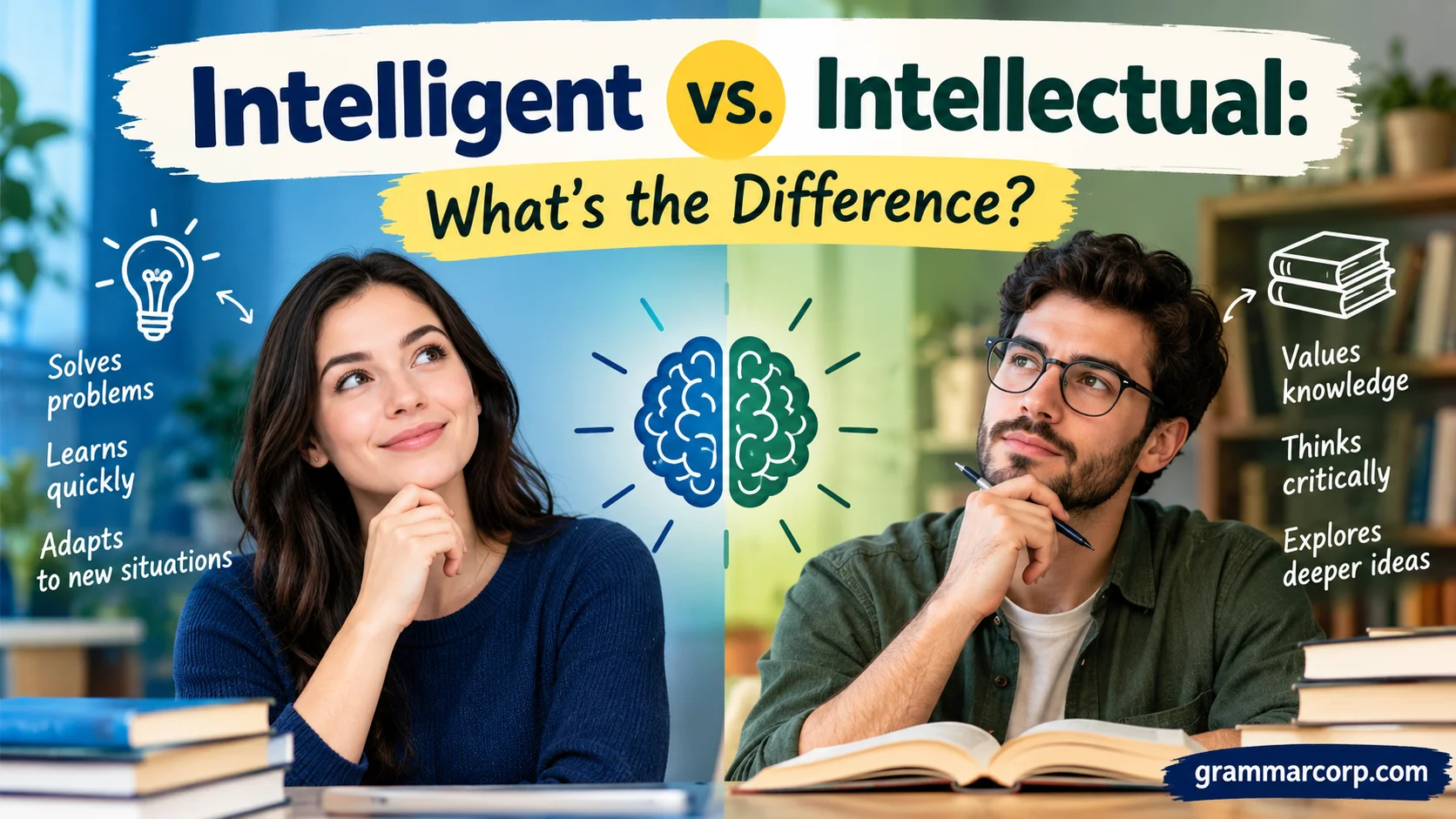
An intelligent person learns quickly, solves problems, grasps complex ideas, and makes sound decisions. For example, a mechanic who diagnoses a complicated engine problem demonstrates intelligence through practical knowledge and effective problem-solving. An intelligent student can also understand a difficult lesson and apply it to real-life situations.
An intellectual person enjoys ideas, theories, scholarship, and thoughtful discussions. They may spend time studying literature, science, philosophy, history, and culture. For example, a historian examining political theories and philosophical questions shows intellectual engagement. Although intelligence and intellectual interests can overlap, the words emphasize different qualities: one highlights mental ability, while the other often describes an interest in exploring ideas in depth.
Quick Answer: Intelligent vs. Intellectual
Intelligent describes someone’s ability to learn, understand, reason, solve problems, and make good decisions. Intellectual describes something related to thinking, reasoning, ideas, and knowledge. As a noun, an intellectual refers to someone who engages deeply with ideas, scholarship, or public debate.
Consider these examples:
- Intelligent: Maya is an intelligent student who understands difficult mathematical problems quickly.
- Intellectual: Maya enjoys intellectual discussions about science, ethics, and philosophy.
- Both: Maya is an intelligent student with a strong intellectual curiosity.
The easiest way to remember the difference is to focus on the emphasis. Intelligent highlights mental ability, while intellectual often highlights thinking, ideas, and engagement with knowledge.
Comparison Overview
The words intelligent and intellectual share a connection to the mind, but their meanings and grammatical uses differ.
| Feature | Intelligent | Intellectual |
| Part of speech | Adjective | Adjective and noun |
| Main meaning | Having or showing mental ability | Relating to thought and ideas; a person engaged with intellectual pursuits |
| Primary emphasis | Learning, understanding, reasoning, and problem-solving | Ideas, analysis, scholarship, and mental activity |
| Common contexts | Decisions, solutions, people, and behavior | Discussions, curiosity, development, and scholarship |
| Related noun | Intelligence | Intellect |
| Related adverb | Intelligently | Intellectually |
| Example | She made an intelligent decision. | They had an intellectual discussion. |
One useful distinction is that intelligent usually evaluates an ability or the quality of an action, while intellectual often describes the subject, character, or nature of an activity.
For instance, an intelligent answer demonstrates good understanding or reasoning. An intellectual discussion focuses on ideas and complex questions. A discussion can be both intelligent and intellectual if participants explore meaningful ideas and reason carefully.
Neither word automatically indicates that someone is better, more educated, or more capable than another person. Context determines what the speaker wants to emphasize.
What Does Intelligent Mean?
Intelligent is an adjective that describes someone or something that demonstrates the ability to learn, understand, reason, solve problems, or make sound judgments.
When you call someone intelligent, you’re generally referring to how effectively they use their mental abilities. They might recognize patterns, understand unfamiliar information, adapt to changing circumstances, or find practical solutions to difficult problems.
For example:
- An intelligent student understands a challenging lesson after examining a few examples.
- An intelligent business owner studies the risks before making an investment.
- An intelligent response addresses the real problem rather than reacting impulsively.
- An intelligent system processes information to perform tasks or support decisions.
Notice that intelligence doesn’t always involve academic knowledge. Someone may excel at repairing machinery, managing a complicated project, interpreting social situations, or finding creative solutions without having extensive formal education.
Likewise, getting high grades doesn’t automatically demonstrate every kind of intelligence. Different tasks require different combinations of knowledge, reasoning, experience, and practical judgment.
Examples of Intelligent in Sentences
Here are several examples showing how intelligent works in everyday English.
- The intelligent student identified the pattern and solved the equation.
- She made an intelligent decision after comparing the available options.
- Our team developed an intelligent solution to a recurring technical problem.
- The dog showed intelligent behavior by adapting to a new routine.
- His questions revealed an intelligent understanding of the issue.
- An intelligent approach considers both immediate results and long-term consequences.
- The software uses intelligent features to help users organize information.
In these examples, the word emphasizes mental ability, effective reasoning, or thoughtful problem-solving.
However, intelligent doesn’t always mean brilliant or exceptionally gifted. It can simply describe a sensible, well-reasoned action. An intelligent decision, for example, doesn’t have to be groundbreaking. It just needs to reflect sound thinking in the circumstances.
Synonyms and Related Words for Intelligent
Several English words overlap with intelligent, but each carries a slightly different emphasis.
| Word | Meaning or emphasis | Example |
| Smart | General mental ability or good judgment | She’s smart enough to recognize the risk. |
| Clever | Ingenuity and the ability to find effective solutions | He found a clever way to save time. |
| Bright | Quick understanding or strong learning ability | The bright child picked up the skill quickly. |
| Sharp | Quick perception and mental alertness | She has a sharp eye for detail. |
| Quick-witted | Responding quickly and cleverly | His quick-witted reply made everyone think. |
| Perceptive | Noticing or understanding subtle details | The perceptive manager noticed the change. |
| Knowledgeable | Having considerable information about a subject | She’s knowledgeable about ancient history. |
These words aren’t perfect substitutes in every sentence. A knowledgeable person knows a great deal about a topic, but that fact alone doesn’t tell you how effectively they solve unfamiliar problems. A clever person may find an ingenious shortcut, while a perceptive person may notice something others overlook.
Usage tip: Choose intelligent when you want to emphasize someone’s ability to understand, reason, learn, or make a sound decision.
What Does Intellectual Mean?
Intellectual is both an adjective and a noun. As an adjective, it describes something connected with thinking, reasoning, ideas, or the understanding of complex subjects. As a noun, it refers to a person whose interests or work center on ideas, scholarship, and careful thought.
According to the Cambridge Dictionary’s definition of intellectual, the adjective relates to the ability to think and understand, particularly when dealing with complicated ideas. The noun describes someone interested in studying and exploring such ideas.
An intellectual person might enjoy reading philosophy, examining historical events, debating ethical questions, or exploring scientific theories. Such a person doesn’t necessarily have to work at a university or hold an advanced degree. What matters is the person’s engagement with ideas and knowledge.
For example, imagine a journalist who investigates how technology affects society. The journalist reads research, questions popular assumptions, and considers competing arguments. Calling the journalist an intellectual may highlight this sustained interest in ideas rather than simply suggesting that the person is smart.
The word also appears in expressions that describe mental activities or challenges. Intellectual curiosity means an interest in exploring and understanding ideas. Intellectual stimulation refers to mental engagement that encourages thought and learning.
Examples of Intellectual in Sentences
The following examples show how intellectual functions as an adjective and a noun.
- The professor encouraged intellectual curiosity by inviting students to question established theories.
- Their intellectual discussion explored the ethical implications of artificial intelligence.
- Reading challenging literature provides intellectual stimulation.
- The researcher approached the problem from an intellectual perspective.
- The journalist became a respected public intellectual through essays on politics and culture.
- The conference attracted artists, scholars, and other intellectuals interested in social change.
- The course encourages intellectual development through research, discussion, and critical analysis.
The grammatical role matters in these examples. In intellectual curiosity, the word describes a type of curiosity. In a public intellectual, it identifies a person.
An intellectual discussion can be difficult without being confusing. It usually involves ideas that require careful thought, evidence, or analysis. However, the word doesn’t guarantee that a discussion is accurate, useful, or well reasoned.
Synonyms and Related Words for Intellectual
Several words overlap with intellectual, although each emphasizes a different quality.
| Word | Meaning or emphasis | Example |
| Academic | Connected with education, scholarship, or research | She pursued an academic career in history. |
| Scholarly | Showing detailed study or specialized knowledge | He published a scholarly article on literature. |
| Theoretical | Concerned with ideas, models, or principles | The team discussed the theoretical basis of the proposal. |
| Philosophical | Related to fundamental questions about knowledge, reality, or values | They had a philosophical debate about fairness. |
| Cerebral | Emphasizing thought and analysis rather than emotion or physical action | The film offers a cerebral examination of memory. |
| Thoughtful | Showing careful consideration | She gave a thoughtful response to the criticism. |
| Erudite | Demonstrating extensive learning and knowledge | The speaker delivered an erudite lecture on ancient history. |
These words aren’t interchangeable in every context. A scholarly article usually involves research or specialized learning, while a theoretical argument focuses on principles or explanations. An erudite person has extensive knowledge, whereas a thoughtful person considers matters carefully.
Usage tip: Use intellectual when you want to describe engagement with ideas, mental activity, scholarship, or a person known for such pursuits.
Main Differences Between Intelligent and Intellectual
The main difference between intelligent and intellectual becomes easier to understand when you examine what each word emphasizes.
Intelligent generally describes the ability to learn, understand, reason, adapt, or solve problems. Intellectual often describes the activity of thinking, the ideas being explored, or a person’s interest in serious mental pursuits.
The distinction isn’t absolute. Dictionaries also use intellectual to describe mental ability, and English speakers sometimes refer to an intelligent conversation as well as an intellectual one. The surrounding words help establish the intended meaning.
Intelligent vs. Intellectual: A Detailed Comparison Table
| Comparison point | Intelligent | Intellectual |
| Core meaning | Having or showing mental ability | Relating to thought, ideas, or intellectual pursuits |
| Grammatical role | Adjective | Adjective and noun |
| Main emphasis | How effectively someone understands or reasons | The ideas someone explores or the nature of their mental activities |
| Common examples | Intelligent student, intelligent decision | Intellectual curiosity, intellectual debate |
| Typical focus | Learning, adaptation, problem-solving | Analysis, theories, scholarship |
| Related noun | Intelligence | Intellect |
| Related adverb | Intelligently | Intellectually |
| Can describe an object or activity? | Yes: an intelligent solution | Yes: intellectual work |
| Can refer to a person as a noun? | Not ordinarily in standard everyday usage | Yes: an intellectual |
| Does it require formal education? | No | No, although the word can suggest extensive study or learning |
The table highlights the central distinction, but the two words can overlap. For example, an intelligent person may enjoy intellectual pursuits, and an intellectual may demonstrate exceptional intelligence.
Can Someone Be Intelligent Without Being an Intellectual?
Yes. A person can have strong reasoning and problem-solving abilities without being particularly interested in academic debates, philosophy, or theoretical questions.
Consider a mechanic who diagnoses engine problems that other people struggle to identify. The mechanic recognizes patterns, tests possible explanations, and finds a practical solution. These actions demonstrate intelligence, even if the mechanic has little interest in discussing philosophical theories.
Other examples include:
- A chef who develops a creative solution when ingredients run short.
- A business owner who identifies a practical way to reduce waste.
- A nurse who quickly understands a changing situation and adjusts a care plan appropriately.
- A programmer who identifies an error in a complicated system.
Each person may demonstrate strong mental abilities without fitting the usual description of an intellectual.
Of course, these people could also have intellectual interests. The point is that being intelligent doesn’t require a particular hobby, profession, educational background, or interest in abstract ideas.
Can Someone Be an Intellectual Without Being Especially Intelligent?
The answer depends on what you mean by intellectual.
As a noun, intellectual commonly describes someone whose work or interests center on ideas, scholarship, and careful thought. It doesn’t function as a standardized measurement of intelligence.
Someone might spend years studying literature, writing about political theory, or participating in philosophical discussions. Those activities may make the person an intellectual in the ordinary sense of the word. However, the label alone doesn’t establish how effectively that person reasons in every situation.
Likewise, someone who enjoys abstract ideas might make poor practical decisions. Another person may have exceptional problem-solving skills but prefer hands-on work over academic discussions.
It’s therefore misleading to treat intelligent and intellectual as two ranks on a ladder. They describe overlapping but different aspects of a person’s abilities, interests, and activities.
Can Someone Be Both Intelligent and Intellectual?
Absolutely. In fact, the words often complement each other.
Imagine a scientist who understands complicated data, identifies errors in an experiment, and develops effective solutions. The scientist also enjoys examining the philosophical questions raised by scientific discoveries and writing about their wider social effects.
You could describe the scientist as intelligent because of their reasoning and problem-solving abilities. You could also call the scientist intellectual because of their engagement with complex ideas.
Here are three ways to describe the same person:
- She’s intelligent. This emphasizes her mental ability.
- She’s intellectual. This emphasizes her interests, approach to ideas, or intellectual pursuits.
- She’s intelligent and intellectual. This highlights both qualities.
The right choice depends on what you want readers to notice.
When to Use Intelligent vs. Intellectual
Choosing between these words becomes straightforward when you identify the meaning you want to express.
Use Intelligent for Ability and Good Judgment
The word intelligent works well when you want to emphasize effective thinking, understanding, or problem-solving.
Common combinations include:
- Intelligent student: A student who demonstrates strong understanding or reasoning.
- Intelligent decision: A decision based on sound reasoning and relevant information.
- Intelligent response: A response that shows understanding and good judgment.
- Intelligent solution: An effective solution developed through careful thought.
- Intelligent approach: A sensible way to handle a problem.
- Intelligent question: A question that shows understanding or identifies an important issue.
- Intelligent design: A design developed with attention to its purpose, requirements, and function.
Consider this example:
After reviewing the costs and risks, Elena made an intelligent decision to delay the launch.
Here, intelligent emphasizes Elena’s judgment. She considered relevant information before deciding what to do.
You can also use the word to describe learning and understanding:
The intelligent student recognized that the two equations followed the same pattern.
The sentence highlights the student’s ability to identify a relationship and apply that understanding.
Use Intellectual for Ideas and Mental Activities
Choose intellectual when the focus shifts from someone’s ability to the nature of an activity, discussion, interest, or concept.
Common combinations include:
- Intellectual curiosity: A desire to explore and understand ideas.
- Intellectual discussion: A conversation involving ideas, theories, or complex questions.
- Intellectual development: Growth in understanding, reasoning, and engagement with ideas.
- Intellectual freedom: The freedom to explore, discuss, and express ideas.
- Intellectual challenge: A task that requires substantial thought or analysis.
- Intellectual property: Creations of the mind, such as inventions, literary works, and artistic works, that may receive legal protection.
- Intellectual stimulation: Mental engagement that encourages learning or thought.
For example:
The university encourages intellectual curiosity by allowing students to investigate questions beyond the required syllabus.
Here, intellectual describes the type of curiosity the university supports. It doesn’t simply mean that the students are smart.
Similarly:
The documentary presents an intellectual challenge by questioning familiar explanations of history.
The phrase emphasizes the thought and analysis the documentary invites.
Use Intellectual as a Noun for a Person
Unlike intelligent, which normally functions as an adjective, intellectual can also serve as a noun.
An intellectual is someone who engages seriously with ideas, often through writing, research, scholarship, criticism, or public discussion.
Common expressions include:
- An intellectual: A person devoted to the exploration of ideas.
- A public intellectual: Someone who contributes ideas and analysis to public discussions.
- A leading intellectual: A prominent thinker or scholar.
- A community of intellectuals: A group of people engaged in serious discussion or the study of ideas.
For example:
The public intellectual wrote essays explaining the social consequences of new technology.
The noun identifies the person’s role in public discussion rather than merely describing their mental ability.
Compare these sentences:
- She is an intelligent researcher. — This emphasizes her mental ability.
- She is an intellectual. — This emphasizes her engagement with ideas and scholarship.
Both sentences may describe the same researcher, but they communicate different information.
Intelligent vs. Intellectual in Different Contexts
The difference between intelligent and intellectual becomes especially clear when you see how people use these words in everyday situations. The same person can fit both descriptions, but the context determines which word communicates the intended meaning.
Intelligent vs. Intellectual in Education
In education, intelligent often describes a student’s ability to understand concepts, recognize patterns, and solve problems. Intellectual often describes a student’s interest in exploring ideas, examining theories, and asking deeper questions.
For example:
- Daniel is an intelligent student who quickly understands algebra.
- Daniel has an intellectual interest in the history of mathematics.
The first sentence emphasizes Daniel’s ability to learn. The second describes his interest in the broader ideas behind a subject.
Students don’t have to choose between these qualities. A student can understand difficult material quickly and enjoy exploring questions that don’t have simple answers.
Intelligent vs. Intellectual at Work
Professional settings offer another useful distinction. Intelligence often appears in practical decisions, efficient problem-solving, and the ability to adapt to unfamiliar situations.
Intellectual engagement, on the other hand, may involve examining theories, questioning established practices, or considering the broader implications of a decision.
Compare these examples:
- An intelligent manager identifies the cause of a recurring production problem.
- An intellectual discussion among managers explores the ethical implications of automation.
The manager’s intelligence appears in the ability to solve a practical problem. The intellectual discussion focuses on ideas and their wider significance.
Neither quality guarantees professional success on its own. Experience, communication, technical knowledge, and other skills also influence workplace performance.
Intelligent vs. Intellectual in Conversations and Debates
Both words can describe conversations, but they emphasize different aspects.
An intelligent conversation generally suggests a discussion that shows understanding, insight, or good reasoning. An intellectual conversation usually focuses on ideas, theories, or complex questions.
For example:
- We had an intelligent conversation about how to improve the project.
- We had an intellectual conversation about whether technological progress always benefits society.
The first sentence highlights the quality of the discussion. The second highlights its subject matter.
However, the distinction isn’t absolute. An intellectual conversation can be intelligent, and an intelligent conversation can explore intellectual topics.
Intelligent vs. Intellectual in Writing and Literature
Writers use both words to describe characters, arguments, and themes.
An intelligent character may solve mysteries, recognize deception, or make effective decisions under pressure. An intellectual character may spend considerable time examining moral dilemmas, political theories, or philosophical questions.
Consider these fictional examples:
- The intelligent detective noticed a contradiction in the witness’s account.
- The intellectual novelist explored the conflict between freedom and responsibility.
The detective demonstrates reasoning through action. The novelist engages with complex ideas through creative work.
These descriptions aren’t mutually exclusive. A detective can be intellectually curious, and a novelist can demonstrate practical intelligence. The choice depends on which aspect of the character matters most to the sentence.
Read More : Do You Ask or Pose a Question? Understanding the Difference
Common Mistakes When Using Intelligent and Intellectual
Although the meanings overlap, a few common mistakes can make your writing less precise.
Mistake 1: Treating Intelligent and Intellectual as Exact Synonyms
The words are related, but they don’t always fit the same sentence.
Incorrect for the intended meaning: She showed intellectual judgment by choosing the safest route.
Better: She showed intelligent judgment by choosing the safest route.
The second sentence emphasizes the quality of her decision. However, intellectual judgment could work in a different context if the writer specifically meant judgment involving theoretical or analytical questions.
Mistake 2: Assuming Intellectual Always Means Smarter
Calling someone an intellectual doesn’t automatically mean that person has greater intelligence than everyone else.
For example:
Although Marcus enjoys philosophical debates, his friend Lena is equally intelligent and prefers practical challenges.
Both people can have strong mental abilities. Their interests simply differ.
Use intellectual to describe engagement with ideas or a person’s role as a thinker, not as a universal ranking of intelligence.
Mistake 3: Confusing Intelligent With Intelligence
Intelligent is an adjective, while intelligence is a noun.
- Incorrect: She is very intelligence.
- Correct: She is very intelligent.
- Correct: She has considerable intelligence.
Use intelligent to describe a person or action. Use intelligence when referring to the ability itself.
Mistake 4: Assuming Intellectual Requires an Advanced Degree
An advanced degree may provide opportunities to develop specialized knowledge, but it isn’t a requirement for having intellectual interests.
Someone who reads widely, questions assumptions, and thoughtfully explores complex ideas may demonstrate intellectual engagement without holding a graduate degree.
Similarly, a university degree alone doesn’t automatically make someone an intellectual in every sense of the word.
Mistake 5: Using Intelligent When You Mean Intellectual
Consider this sentence:
The book offers an intelligent exploration of moral philosophy.
This sentence is grammatically correct. It suggests that the book explores the subject thoughtfully or effectively.
If you want to emphasize the book’s focus on abstract ideas, you could write:
The book offers an intellectual exploration of moral philosophy.
Both versions work, but their emphasis differs slightly. The first evaluates the quality of the exploration. The second highlights its intellectual nature.
Intelligent vs. Intellectual: Related Word Forms
Understanding the related nouns and adverbs makes it easier to use these words correctly in different sentence structures.
| Word | Part of speech | Meaning | Example |
| Intelligent | Adjective | Showing mental ability | She is intelligent. |
| Intelligence | Noun | The ability to learn, understand, and reason | Intelligence helps people adapt to unfamiliar problems. |
| Intelligently | Adverb | In a way that shows understanding or good judgment | He responded intelligently. |
| Intellectual | Adjective or noun | Related to ideas, or a person engaged with them | They discussed an intellectual challenge. |
| Intellect | Noun | The faculty of reasoning and understanding | The problem challenged his intellect. |
| Intellectually | Adverb | In a way related to thought or the intellect | The book is intellectually stimulating. |
Intelligence vs. Intellect
The nouns intelligence and intellect are closely related, but their emphasis can differ.
Intelligence generally refers to the ability to learn, understand information, reason, adapt, and solve problems. The American Psychological Association describes intelligence in terms of learning from experience, adapting to the environment, understanding, and using thought and reason. See its definition of intelligence.
Intellect refers to the faculty of reasoning and understanding. The word often emphasizes the mind’s capacity for thought and analysis.
For example:
- Her intelligence helped her solve an unfamiliar problem.
- The philosophical debate challenged her intellect.
The first sentence focuses on her ability to solve the problem. The second emphasizes the mental effort required by the debate.
The terms overlap, so you shouldn’t treat them as completely separate mental faculties. Their meanings depend partly on the context.
Intelligently vs. Intellectually
The adverbs intelligently and intellectually modify verbs, adjectives, or other adverbs, but they emphasize different things.
Intelligently means in a way that demonstrates understanding, reasoning, or good judgment.
The team intelligently adjusted its strategy after reviewing the results.
The sentence emphasizes the team’s sound decision-making.
Intellectually means in a way related to the intellect, thinking, or mental activity.
The novel is intellectually challenging because it explores competing ideas about justice.
Here, the word emphasizes the mental engagement the novel requires.
Remember that neither adverb is automatically more formal or more sophisticated than the other. Choose the one that expresses your intended meaning.
FAQs:
1. What is the main difference between intelligent and intellectual?
Intelligent describes the ability to learn, understand, and solve problems effectively. Intellectual often describes an interest in ideas, knowledge, theories, and deep thinking.
2. Can a person be both intelligent and intellectual?
Yes, a person can be both intelligent and intellectual. They may solve problems quickly while also enjoying books, research, philosophy, and thoughtful discussions.
3. Is intelligent a positive word?
Yes, intelligent is generally a positive word. It describes someone who can understand information, learn skills, think clearly, and make good decisions.
4. Does intellectual mean highly intelligent?
Not necessarily. Intellectual often describes a person’s interest in learning, ideas, and complex subjects. It doesn’t automatically mean that the person has greater intelligence than others.
5. How can I use intelligent and intellectual correctly in a sentence?
Use intelligent when discussing someone’s mental ability and intellectual when describing an interest in ideas or serious subjects.
- She is an intelligent student who solves difficult problems quickly.
- He enjoys intellectual discussions about science and philosophy.
Conclusion:
Understanding the difference between intelligent and intellectual helps you choose the right word in everyday English. An intelligent person can learn quickly, solve problems, and make sound decisions. An intellectual person enjoys exploring ideas, studying complex subjects, and discussing theories.
Although these qualities can overlap, they emphasize different aspects of a person’s abilities and interests. By learning their meanings and practicing with examples, you can use both words more naturally in your writing and conversations.