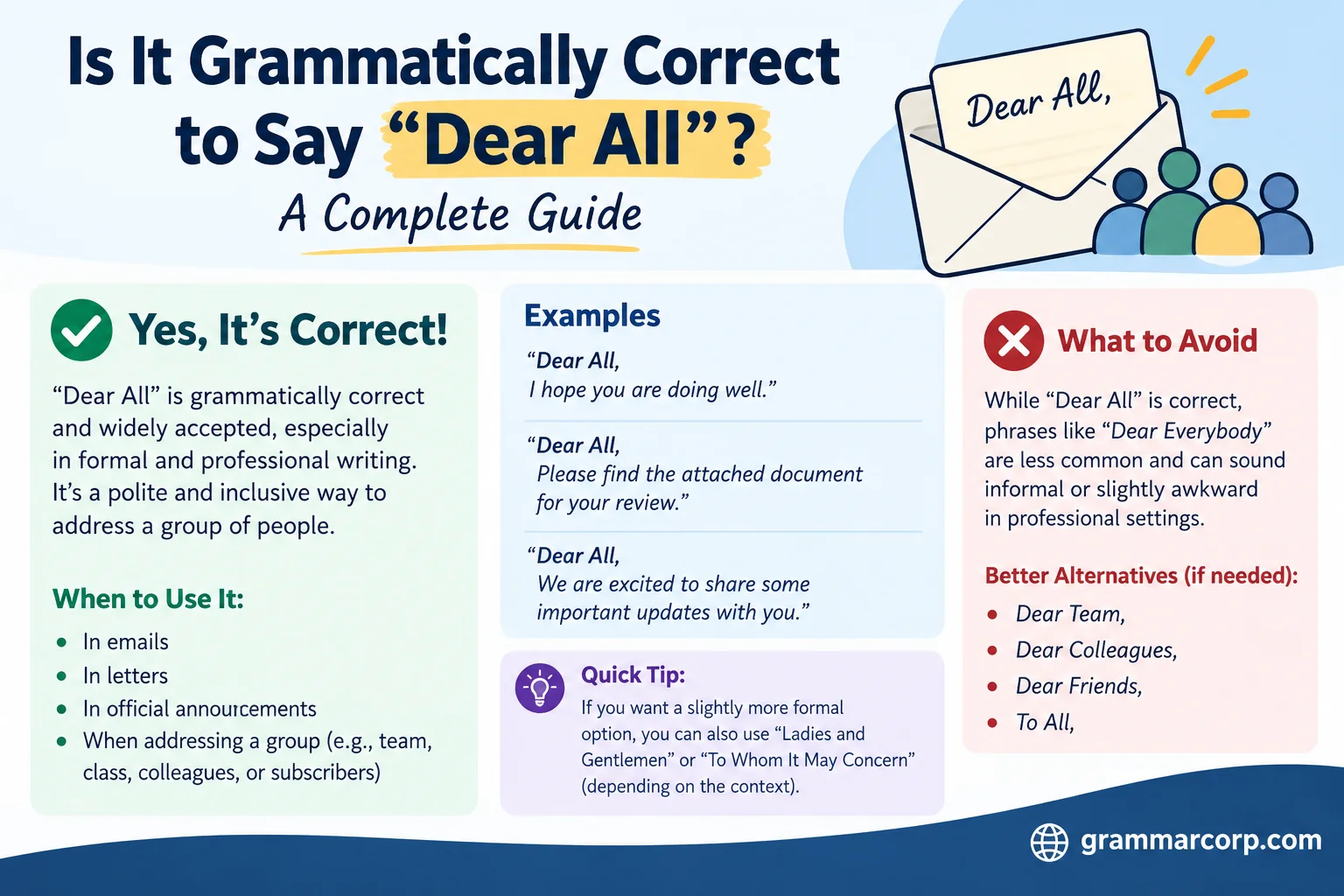
Is It Grammatically Correct to Say “Dear All”? A Complete Guide explains why Dear All remains a grammatically correct, widely accepted greeting for professional emails, group messages, and group email communication in workplaces, schools, and business communication. From my experience, the phrase works naturally when a sender is addressing a group of recipients without listing individual names, although grammar, capitalization, tone, formality, and professionalism can create confusion. Its usage as an indefinite pronoun remains completely correct, even though it may sound informal in casual notes.
The right greeting is not always the best greeting, so consider your particular audience, addressees, situation, communication goal, and level of formality before you use it. In formal writing, semi-formal writing, and other professional settings, Dear All is an acceptable and formal approach, while casual situations may call for a warmer, more natural alternative. Email etiquette and modern email etiquette also make email writing skills and professional etiquette important when deciding how to communicate effectively.
Depending on the relationship, purpose, and context, writers can avoid sounding outdated or impersonal by choosing Dear team, Dear colleagues, Hello everyone, Hello Everyone, Hi Team, Greetings, Greetings Team, Hi All, Attention Everyone, To the Group, or Greetings All. Each option can influence meaning, clarity, connection, inclusivity, correspondence, structure, and intention.
Quick Answer:
Yes, “Dear all” is grammatically correct and is widely used to address a group of people in an email or letter.
Here’s a standard example:
Dear all,
I’m writing to let you know that tomorrow’s meeting has been moved to 2 p.m.
The phrase works because “Dear” functions as a greeting or term of address, while “all” identifies the entire group being addressed.
However, grammatical correctness doesn’t automatically make a phrase the best stylistic choice. If you’re writing to a specific team, “Dear team” may sound more natural. If you’re addressing professional colleagues, “Dear colleagues” can be more precise.
At a glance
| Question | Answer |
| Is “Dear all” grammatically correct? | Yes |
| Is it suitable for emails? | Yes |
| Is it professional? | Yes, in many situations |
| Is it highly formal? | Usually neutral to moderately formal |
| Is “Dear All” wrong? | No, capitalization is mainly a style issue |
| Should you use a comma? | Yes, in standard email formatting: “Dear all,” |
| Is it suitable for one person? | No |
| Are there better alternatives? | Sometimes, depending on the audience |
Comparison Overview
The best greeting depends on who you’re addressing, how formal the message is, and how closely you know the recipients.
| Greeting | Formality | Best For | Overall Tone |
| Dear all | Moderate | General group emails | Professional and neutral |
| Dear team | Moderate | Team members | Professional and friendly |
| Dear colleagues | Moderate–formal | Coworkers | Respectful |
| Hello everyone | Neutral | Broad groups | Friendly and clear |
| Hi everyone | Casual–neutral | Familiar groups | Warm and relaxed |
| Dear members | Formal | Clubs, committees, organizations | Official |
| Dear [Names] | Formal | Small groups | Personal and respectful |
| Greetings everyone | Neutral–formal | General announcements | Polite |
There isn’t one greeting that works perfectly everywhere.
For example, a company-wide announcement might reasonably begin with “Dear all.” An email to five coworkers who work closely together could sound warmer with “Hi everyone.”
The goal isn’t to choose the most formal phrase possible. The goal is to choose the greeting that matches the relationship and purpose of the message.
Main Differences Between “Dear All” and Other Group Greetings
Although these greetings can perform the same basic function, they don’t create exactly the same impression.
“Dear All” vs. “Dear Team”
“Dear all” addresses everyone included in the message without defining the group.
“Dear team” specifically identifies the recipients as members of the same team.
Compare these:
Dear all,
Please review the attached company update.
Dear team,
Please review the attached project update before Friday.
The second greeting feels more targeted because team tells readers why they’re receiving the message.
Use “Dear team” when the recipients genuinely belong to the same team or working group.
“Dear All” vs. “Dear Colleagues”
“Dear colleagues” is useful when you’re addressing professional peers.
It can sound slightly more formal than “Dear all” because it identifies the recipients through their professional relationship.
For example:
Dear colleagues,
Thank you for your contributions to this year’s conference.
This works particularly well in academic, corporate, professional, and organizational communication.
“Dear All” vs. “Hello Everyone”
“Hello everyone” feels more conversational.
It’s a strong option when you want your email to remain professional without sounding overly formal.
For example:
Hello everyone,
I wanted to share a quick update about Friday’s schedule.
This can feel more approachable than “Dear all” while still being perfectly appropriate for many workplaces.
“Dear All” vs. “Hi Everyone”
“Hi everyone” is generally more casual.
It’s particularly suitable when you’re writing to people you know well or when your workplace culture uses relaxed communication.
For example, a close project team might naturally use:
Hi everyone,
Just a quick reminder about our meeting tomorrow.
However, if you’re writing a formal organizational announcement, “Dear all” may be a safer choice.
Is “Dear All” Grammatically Correct?
Yes. “Dear all” is a grammatically acceptable form of address.
The word dear has a long-established role in greetings and letters. It doesn’t necessarily mean romantic affection or deep personal attachment. In formal and professional communication, it functions as a conventional term of address.
The word all then refers collectively to the people receiving the message.
This is similar in structure to greetings such as:
- Dear everyone
- Dear colleagues
- Dear team
- Dear members
- Dear students
The important distinction is between grammar and style.
A phrase can be grammatically correct while still being less effective in a particular context.
For instance, “Dear all” is correct when addressing a group. But if you’re writing to three people by name, “Dear Sarah, Michael, and David” may feel more direct and personal.
What Does “Dear All” Mean?
“Dear all” essentially means that the message is addressed to everyone in the group.
The word all is intentionally broad. It doesn’t identify individual recipients because the writer wants to address the group collectively.
You might see it in:
- Workplace announcements
- Team updates
- Meeting invitations
- School communication
- University emails
- Committee messages
- Club announcements
- Organizational notices
- Community updates
For example:
Dear all,
Please find the revised schedule attached.
The sender isn’t speaking to one particular person. The message applies to everyone receiving it.
Importantly, “dear” doesn’t make the message emotionally intimate. In professional writing, it’s simply part of a conventional greeting.
When Is “Dear All” Appropriate?
The phrase works particularly well when the entire group has a reason to receive the same information.
Professional emails
“Dear all” is useful for communicating a shared workplace update.
For example:
Dear all,
Please note that the office will close at 3 p.m. on Friday.
There’s no need to name each recipient because the announcement applies equally to everyone.
Team announcements
It can work for teams when the writer doesn’t want to emphasize the team’s identity.
However, “Dear team” may be a stronger option when the message specifically concerns team performance, goals, or responsibilities.
Academic communication
Teachers, administrators, researchers, and students may use group greetings when communicating with multiple people.
For example:
Dear all,
The deadline for submitting your project has been extended to Monday.
The greeting is broad and efficient.
Committee communication
“Dear all” can work well when communicating with committee members about:
- Meetings
- Documents
- Deadlines
- Decisions
- Agenda items
- Administrative updates
If the committee is the central focus, however, “Dear committee members” may be more specific.
Read More : Sore vs. Soar: What’s the Difference?
When Should You Avoid “Dear All”?
“Dear all” isn’t wrong in most of these situations. It simply may not be the strongest choice.
When you’re writing to one person
Don’t use “Dear all” for a one-to-one email.
Instead, address the recipient directly:
Dear James,
or:
Hello James,
A group greeting becomes confusing when only one person is being addressed.
When the group has a clear identity
If you’re writing specifically to members of a sales team, using “Dear sales team” can make the message more relevant.
Likewise, a committee email may benefit from “Dear committee members.”
Specific greetings often help readers immediately understand why the message concerns them.
When you know the recipients personally
If you’re emailing three people you work with closely, addressing them by name can create a more natural opening.
For example:
Dear Maria, James, and Daniel,
This feels more personal than a generic group greeting.
When the communication is extremely formal
For highly formal correspondence, consider whether the recipients should be addressed by their names, titles, positions, or official group designation.
“Dear all” isn’t inherently informal. Yet it can feel too general for correspondence requiring a particularly formal tone.
How to Use “Dear All” Correctly in an Email
Using the greeting correctly involves more than simply typing the words.
Use appropriate capitalization
Both “Dear all” and “Dear All” appear in real-world writing.
However, in ordinary sentence-style writing, “Dear all” is a clean and natural choice because all isn’t a proper noun.
For example:
Dear all,
Some organizations use title-style capitalization in email greetings:
Dear All,
That doesn’t make the second version grammatically wrong. Capitalization is largely a matter of style and house convention here.
If your workplace follows a particular style guide, follow it consistently.
Use punctuation after the greeting
A comma is a common choice:
Dear all,
The greeting is then followed by the main body of the email.
A simple structure looks like this:
Dear all,
I’m writing to confirm that Friday’s meeting will begin at 10 a.m.
Please review the attached agenda before the meeting.
Best regards,
[Name]
This structure is clear, professional, and easy to scan.
Examples of “Dear All” in Different Situations
Context matters more than memorizing one universal rule.
Workplace announcement
Dear all,
Please note that the office will operate on a reduced schedule this Friday.
This is appropriate because everyone receiving the message needs the same information.
Meeting reminder
Dear all,
This is a reminder that our monthly meeting will take place tomorrow at 10 a.m.
The greeting works because the meeting involves the entire group.
Schedule change
Dear all,
Please be aware that the training session has been moved to Thursday afternoon.
Again, the group greeting makes sense because the update applies collectively.
Academic message
Dear all,
Please submit your final assignments through the course portal by Monday.
This works when the entire class is receiving the same instruction.
Committee communication
Dear all,
Attached is the revised agenda for next week’s committee meeting.
This is concise and professional.
Common Mistakes With “Dear All”
Understanding what not to do can make your email writing much stronger.
Using “Dear all” for a single recipient
This is the clearest mistake.
Incorrect for one recipient:
Dear all,
Better:
Dear Alex,
The word all specifically suggests a group.
Assuming “Dear all” is always the most professional option
Professional writing isn’t about making every sentence sound formal.
Sometimes “Hello everyone” is clearer and more approachable.
Other times “Dear colleagues” is more precise.
The best greeting depends on the situation.
Treating capitalization as a grammar problem
Whether you write “Dear all” or “Dear All” usually isn’t the central grammatical issue.
The more important questions are:
- Are you addressing a group?
- Is the tone appropriate?
- Does the greeting fit the relationship?
- Is the message clear?
- Does your organization’s style guide specify a format?
Using a generic greeting when names would help
Imagine sending an important message to four people who all have different responsibilities.
A greeting such as “Dear Sarah, James, Maria, and David” can immediately establish that the message is intentionally directed to them.
A generic greeting isn’t necessarily wrong. It may simply be less personal.
Better Alternatives to “Dear All”
There are several strong alternatives, but each serves a slightly different purpose.
Dear team
Best for people who belong to the same team.
Example:
Dear team,
Thank you for completing the project ahead of schedule.
Dear colleagues
Best for professional peers.
Example:
Dear colleagues,
Please review the attached report before Thursday’s meeting.
Hello everyone
Best for neutral, friendly communication.
Example:
Hello everyone,
I wanted to share a quick update about tomorrow’s event.
Hi everyone
Best for familiar groups and relaxed workplace cultures.
Example:
Hi everyone,
Just a quick reminder about our meeting tomorrow.
Dear members
Best for formal groups, organizations, clubs, and committees.
Example:
Dear members,
Please review the updated membership guidelines.
Dear [Names]
Best for smaller groups when personalization matters.
Example:
Dear Anna, David, and Mark,
This approach can make a group email feel more intentional.
“Dear All” in Formal vs. Informal Communication
The same greeting can feel slightly different depending on the surrounding message.
In formal communication
“Dear all” can introduce an official announcement without being excessively stiff.
For example:
Dear all,
Following yesterday’s meeting, please find the approved policy attached.
The rest of the email establishes the formal tone.
In neutral professional communication
This is where “Dear all” often fits best.
It creates a professional opening without sounding overly ceremonial.
For many routine group emails, it’s a practical middle ground.
In informal communication
You may prefer:
Hi everyone,
or:
Hello everyone,
These alternatives can sound warmer and more conversational.
The important lesson is simple: formality should serve clarity rather than replace it.
Case Study: Choosing the Right Group Greeting
Imagine a manager needs to send an email to ten employees about a schedule change.
Option A: Dear all
Dear all,
Please note that Friday’s team meeting has been moved to 3 p.m.
Result: Professional and neutral.
Option B: Dear team
Dear team,
Please note that Friday’s team meeting has been moved to 3 p.m.
Result: Slightly warmer and more team-focused.
Option C: Hi everyone
Hi everyone,
Please note that Friday’s team meeting has been moved to 3 p.m.
Result: More relaxed and conversational.
None of these greetings is inherently wrong.
The decision depends on the company culture, relationship between the sender and recipients, and purpose of the message.
Facts to Remember About “Dear All”
Here are the most useful points to keep in mind:
- “Dear all” is grammatically correct.
- It is specifically suited to group communication.
- It can be used in professional emails.
- It is generally neutral to moderately formal.
- “Dear all” doesn’t imply romantic or personal affection in professional writing.
- “Dear all” and “Dear All” can both be found in use.
- A comma after the greeting is standard in many email styles.
- “Dear team” is more specific when recipients belong to one team.
- “Dear colleagues” emphasizes a professional relationship.
- “Hello everyone” is generally friendlier and less formal.
- A personalized greeting can work better for a small group.
- The greeting should match the audience and communication style.
FAQs:
Is “Dear All” grammatically correct?
Yes. “Dear All” is grammatically correct and commonly used when addressing a group in professional emails, workplace messages, and formal or semi-formal communication.
Is “Dear All” formal or informal?
“Dear All” is generally formal or semi-formal. It can work well in professional settings, although some readers may find it slightly traditional or less personal than alternatives such as “Hello everyone.”
Should I write “Dear All” or “Dear all”?
Both forms can appear in professional writing, but “Dear all” follows the common style of capitalizing the first word of the greeting while keeping “all” lowercase. Consistency matters more than using unnecessary capitalization.
What can I say instead of “Dear All”?
Depending on your audience and tone, you can use “Dear Team,” “Dear Colleagues,” “Hello Everyone,” “Hi Team,” or “Greetings.” Choose the option that best matches your relationship with the readers and the purpose of your message.
Is “Dear All” appropriate for business emails?
Yes. “Dear All” can be appropriate for business emails, particularly when you are addressing several recipients at once. However, a more specific greeting may sound warmer and more natural when you know the group well.
Conclusion:
“Dear All” is grammatically correct, and there is nothing inherently wrong with using it in a professional email or group message. It remains a useful greeting when you need to address several people at once without writing every recipient’s name. The main consideration is not grammar but tone, formality, audience, and context.
If you want your message to sound more personal or modern, alternatives such as “Dear Team,” “Dear Colleagues,” or “Hello Everyone” may work better. Ultimately, the best greeting is the one that fits your readers, your relationship with them, and the purpose of your communication.














1 thought on “Is It Grammatically Correct to Say “Dear All”? A Complete Guide”