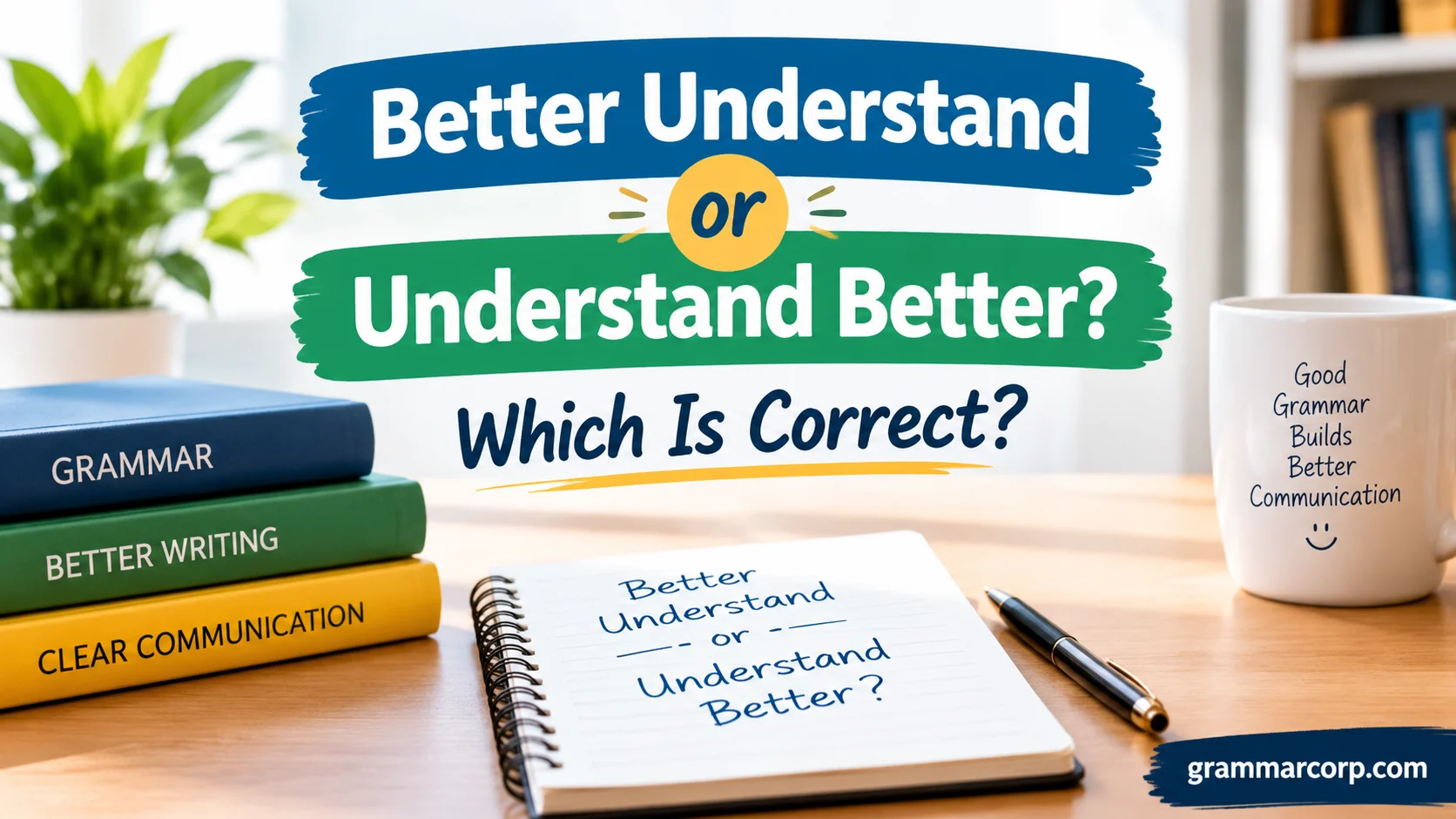
Better Understand or Understand Better: Which Is Correct? The phrases better understand and understand better are both grammatically correct in standard American English. The keyword Better Understand or Understand Better: Which Is Correct? captures a common question among English learners who want to improve their language proficiency.
Both expressions communicate the same idea: gaining a deeper understanding of something. The main difference lies in word order, sentence structure, and emphasis. For example, “I want to better understand the instructions” sounds direct and suits formal writing, while “I want to understand the instructions better” feels natural in everyday conversation. In my experience with English grammar and language usage, context, purpose, and word choice help determine the most suitable expression for a particular situation.
The grammatical structure of these similar phrases explains why both forms work. In “I want to better understand the lesson,” the adverb better appears between to and the verb, creating a split infinitive. Although some traditional grammar guides once discouraged this infinitive construction, it is widely accepted in contemporary English and modern usage.
This flexible adverb placement can improve readability, create natural phrasing, and give a sentence the right emphasis. In contrast, “I want to understand the lesson better” places the comparative adverb after the transitive verb and its direct object. Both sentence patterns preserve the basic meaning and follow accepted English usage. Understanding their syntactic structure, phrase structure, and verb placement helps writers use modern American English with greater grammatical flexibility.
Quick Answer
Both better understand and understand better are correct. The phrase better understand places better before the verb, while understand better places it after the verb.
Consider these examples:
- Better understand: I want to better understand the rules before the test.
- Understand better: I want to understand the rules better before the test.
Both sentences express the same basic intention. The speaker wants to improve their understanding of the rules.
Use whichever construction fits your sentence naturally. However, pay attention to the phrase had better understand, which can express necessity or a warning rather than improved comprehension.
Comparison Overview
Although the two expressions share the same meaning, their structure gives you different ways to organize a sentence. Understanding how they work will help you write more naturally and avoid unnecessary grammar corrections.
| Feature | Better Understand | Understand Better |
| Meaning | Understand something more clearly | Understand something more clearly |
| Word order | Better comes before understand | Better comes after understand |
| Grammatical status | Correct | Correct |
| Common use | Explanations, learning goals, and formal writing | Everyday conversation and general statements |
| Example | I need to better understand the process. | I need to understand the process better. |
| Emphasis | Can place attention on improving the act of understanding | Can emphasize the resulting degree of understanding |
The most important point is that these are not two expressions with different dictionary meanings. Both describe improved comprehension.
Their suitability depends on the sentence around them. For example, you can use better understand in a professional email without sounding stiff, and you can use understand better in an academic paper without making a grammatical mistake.
Main Differences Between Better Understand and Understand Better
The difference between better understand and understand better becomes clearer when you examine how the adverb better works.
1. Better Understand Places the Adverb Before the Verb
In the expression better understand, the adverb better appears immediately before the verb understand. It modifies the verb by describing the quality or degree of understanding.
For example:
- I want to better understand American grammar.
- The training helped employees better understand the new policy.
- We need to better understand the reasons behind the decision.
In each sentence, the speaker or writer refers to gaining a clearer or deeper understanding.
This construction often works well when you want to introduce the subject someone hopes to understand. It also fits naturally into explanatory and professional writing.
Consider this sentence: “The teacher used several examples to help students better understand the concept.” The phrase flows smoothly because it connects the teaching method directly to the learning goal.
2. Understand Better Places the Adverb After the Verb
In understand better, the adverb follows the verb. When the sentence includes a direct object, better often appears after that object.
For example:
- I want to understand American grammar better.
- The training helped employees understand the new policy better.
- We need to understand the reasons behind the decision better.
These sentences communicate the same ideas as the examples above. The difference is simply where the adverb appears.
This construction can sound especially natural in conversation because speakers often describe the subject first and then explain how well they understand it.
For instance, a student might say, “I understand this chapter better after watching the video.” The sentence describes an improvement in comprehension without changing the original meaning.
3. Both Expressions Can Appear in Formal and Informal English
A common misconception is that better understand belongs exclusively to formal writing while understand better belongs to casual conversation.
That distinction is too rigid.
You can use both phrases in emails, essays, reports, meetings, classroom discussions, and everyday conversations. The surrounding sentence matters more than the level of formality.
Compare these examples:
- Professional: We need to better understand our customers’ concerns.
- Professional: We need to understand our customers’ concerns better.
- Casual: I want to better understand what happened.
- Casual: I want to understand what happened better.
All four sentences are grammatically acceptable. Choose the version that sounds clearest in your particular context.
What Does Better Understand Mean?
The phrase better understand means to understand something more fully, accurately, or clearly than before. It can refer to learning new information, recognizing someone’s feelings, or making sense of a complicated situation.
The word better indicates improvement. It doesn’t necessarily mean that the person already understands the subject completely.
For example, someone learning English might understand basic sentence structure but still struggle with complex grammar rules. That person could say, “I want to better understand verb tenses.”
The goal isn’t to begin understanding verb tenses from scratch. Instead, the person wants to improve their existing knowledge.
Examples of Better Understand in Different Situations
Education: A teacher explains a difficult concept using diagrams and practical examples.
The diagrams helped us better understand how the system works.
Workplace communication: A manager wants employees to understand a change in company policy.
We scheduled a meeting to better understand the team’s concerns.
Personal relationships: Someone wants to recognize another person’s feelings and perspective.
Listening carefully can help you better understand your friend’s point of view.
Research: A scientist investigates why a particular result occurred.
Researchers collected additional data to better understand the results.
Each example uses better understand to describe a process of improving knowledge or comprehension.
What Does Understand Better Mean?
The expression understand better has the same central meaning. It describes a greater ability to understand information, people, ideas, or situations.
The phrase often appears when someone compares their current understanding with an earlier level of knowledge.
For example, consider the sentence, “I understand the instructions better now.” The word now highlights a change over time. Perhaps the speaker struggled earlier but can follow the instructions more easily after receiving an explanation.
The phrase can also describe improved understanding without directly mentioning a previous difficulty.
Examples of Understand Better in Different Situations
Learning: A student reviews a lesson before completing an assignment.
I understand the formula better after practicing several problems.
Communication: Two colleagues discuss a disagreement and explain their viewpoints.
We understand each other better after talking openly.
Technology: A person learns how a new application works.
I understand the software better after completing the tutorial.
Everyday life: Someone reflects on an experience and recognizes why it happened.
You may understand the situation better once you have all the facts.
Notice that the phrase works with different subjects and sentence structures. You can use it when describing people, processes, instructions, or abstract ideas.
Is It Grammatically Correct to Say Better Understand?
Yes. Better understand is grammatically correct when better functions as an adverb modifying understand.
English allows adverbs to appear in different positions. Their placement depends on the verb, sentence structure, intended emphasis, and established patterns of usage.
For example:
- I hope to better understand the assignment.
- She wants to better understand her responsibilities.
- They worked together to better understand the problem.
- We can better understand the results by examining the data.
These constructions are acceptable in standard American English.
Better Understand With Auxiliary Verbs
The phrase also works with auxiliary verbs such as can, could, will, and may.
Consider these examples:
- I can better understand the instructions now.
- We could better understand the issue with more information.
- This explanation will help you better understand the topic.
- The additional evidence may help investigators better understand what happened.
Here, the auxiliary verb comes before better understand. The construction remains grammatical because better modifies the main verb understand.
However, don’t confuse better understand with had better understand. These expressions can communicate different ideas.
Better Understand vs. Had Better Understand
This distinction deserves attention because the word better doesn’t always function the same way.
Compare the following sentences:
| Sentence | Meaning |
| I want to better understand the rules. | I want to improve my understanding of the rules. |
| I had better understand the rules. | I should understand the rules; otherwise, there may be a consequence. |
| You can better understand the rules by reading the guide. | Reading the guide can improve your understanding. |
| You had better understand the rules before entering. | You are strongly advised to understand the rules first. |
In had better, the words form a common English expression used to give strong advice or indicate an expected consequence.
For example, “You had better understand the instructions before operating the equipment” sounds like a warning or firm recommendation.
By contrast, “You can better understand the instructions by reading them twice” describes a way to improve comprehension.
The key lesson: Don’t interpret every use of better as a comparison of understanding. Examine the complete phrase and its meaning.
Is It Grammatically Correct to Say Understand Better?
Yes. Understand better is a correct and widely used English construction.
In this arrangement, understand is the verb, and better functions as an adverb that describes the degree of understanding.
For example, the sentence “I understand the material better now” means that the speaker has a stronger grasp of the material than before.
You can also use this construction in questions, negative statements, and sentences with modal verbs.
- Question: Do you understand the instructions better now?
- Negative: I don’t understand the problem any better after that explanation.
- Modal verb: You might understand the concept better with another example.
- Past tense: She understood the process better after the demonstration.
These examples demonstrate how the phrase adapts to different grammatical structures.
Where Should Better Appear in a Sentence?
When you use understand better, the best position for better depends partly on whether the verb has an object.
Compare these examples:
- I understand better now.
- I understand the lesson better now.
- I understand why the decision was made better after hearing the explanation.
The first sentence has no direct object. The second places better after the object the lesson. The third uses a clause beginning with why.
Although these structures are grammatically possible, the third example can sound awkward because the final word better may seem to describe how the decision was made rather than how well the speaker understands it.
A clearer alternative is:
I better understand why the decision was made after hearing the explanation.
Another option is:
After hearing the explanation, I understand the reason for the decision better.
The practical rule is simple: Choose the word order that makes the intended meaning immediately clear.
When Should You Use Better Understand vs. Understand Better?
Neither construction is always superior. However, certain sentence patterns may make one version easier to read.
Use Better Understand When It Fits the Sentence Naturally
Better understand often works well when you want to connect an action, method, or purpose directly to improved comprehension.
For example:
- This guide will help you better understand the rules.
- We conducted interviews to better understand customer needs.
- Read the instructions carefully to better understand each step.
In these sentences, better understand follows an expression of purpose or assistance. The wording creates a clear connection between the action and its intended result.
You may also prefer this construction when the object is long or when placing better before the verb improves the sentence’s rhythm.
Use Understand Better When It Sounds Clearer
Understand better works naturally when you want to describe someone’s improved comprehension, especially in ordinary conversation.
For example:
- I understand the topic better today.
- She understands her responsibilities better now.
- We understand the problem better after reviewing the evidence.
These sentences emphasize the state of understanding rather than the method used to achieve it.
However, this is a tendency rather than a strict grammatical rule. You can rewrite each example using better understand without changing its essential meaning.
A Simple Decision-Making Method
If you’re unsure which expression to choose, follow these steps:
- Write the complete sentence. Don’t choose the phrase in isolation.
- Check the meaning. Decide whether you mean improved comprehension or strong advice.
- Read both versions aloud. Listen for awkward phrasing or unintended meanings.
- Choose the clearer version. Don’t change correct wording simply because another version exists.
- Check for ambiguity. If the placement of better could confuse the reader, rewrite the sentence.
This method works for school assignments, professional emails, articles, and everyday messages.
Better Understand vs. Understand Better in Different Contexts
The two phrases work across many settings. Their shared meaning makes them flexible, but the surrounding context can affect which construction feels more natural.
Better Understand vs. Understand Better in Academic Writing
Academic writing often explains concepts, presents evidence, and describes the goals of research. Both expressions fit these purposes.
Examples include:
- The experiment helped researchers better understand the chemical reaction.
- The experiment helped researchers understand the chemical reaction better.
- Students should review the chapter to better understand the central argument.
- Students should review the chapter to understand the central argument better.
Neither version is automatically more academic. Choose the one that creates the clearest sentence and fits the surrounding paragraph.
Better Understand vs. Understand Better in Business Communication
At work, these phrases often describe customer research, employee training, policy changes, and team discussions.
For example:
Our team conducted a survey to better understand customer expectations.
You could also write:
Our team conducted a survey to understand customer expectations better.
Both sentences communicate the purpose of the survey.
In a business email, you might write, “I’d like to better understand your concerns before we finalize the proposal.” Alternatively, “I’d like to understand your concerns better before we finalize the proposal” works just as well.
Focus on clarity rather than assuming that one construction sounds more professional.
Better Understand vs. Understand Better in Everyday Conversation
In conversation, people often use whichever word order comes naturally.
You might hear:
- Now I understand the problem better.
- I want to better understand what you mean.
- I understand your point better after hearing your explanation.
- Let me ask a few questions so I can better understand the situation.
All four sentences sound natural in ordinary American English.
The main goal is to communicate your meaning without making the sentence harder to follow.
Read More : Autumn vs. Fall: What’s the Difference and Which Should You Use?
Better Understand vs. Understand Better: Example Sentences
The following examples show how both expressions work in similar situations.
| Better Understand | Understand Better |
| I want to better understand the lesson. | I want to understand the lesson better. |
| We need to better understand the problem. | We need to understand the problem better. |
| She hopes to better understand her role. | She hopes to understand her role better. |
| The chart helps readers better understand the results. | The chart helps readers understand the results better. |
| He asked questions to better understand the instructions. | He asked questions to understand the instructions better. |
| The discussion helped us better understand each other. | The discussion helped us understand each other better. |
| I need more time to better understand the process. | I need more time to understand the process better. |
| The report aims to better understand customer behavior. | The report aims to understand customer behavior better. |
| This example will help you better understand the rule. | This example will help you understand the rule better. |
| Researchers hope to better understand the results. | Researchers hope to understand the results better. |
The table illustrates a useful point: both constructions can express the same idea without changing the sentence’s essential meaning.
Still, some sentences may benefit from a different arrangement. For instance, if the object is long, placing better before understand can make the sentence easier to process.
Compare:
The new evidence helped the committee better understand why the project had failed.
With:
The new evidence helped the committee understand why the project had failed better.
The second version sounds awkward because better appears at the end of a long clause. The first version makes the intended meaning easier to recognize.
Common Mistakes to Avoid
Even though both expressions are correct, a few common mistakes can create confusion.
Mistake 1: Assuming One Phrase Is Incorrect
Some writers believe that better understand is the only correct expression. Others assume that understand better is the only natural option.
Neither belief is accurate.
Both constructions are acceptable in standard American English. You don’t need to replace one with the other unless the sentence becomes clearer or more natural after revision.
Mistake 2: Confusing Better Understand With Had Better Understand
These phrases don’t always communicate the same idea.
- I want to better understand the instructions. This expresses a desire for improved comprehension.
- I had better understand the instructions. This expresses strong advice or an expectation, possibly with consequences.
The difference matters because readers interpret words according to their grammatical structure and context.
Mistake 3: Placing Better Where It Creates Ambiguity
Consider this sentence:
I understand better how the machine works.
The meaning is understandable, but many writers would find the following version smoother:
I better understand how the machine works.
Alternatively:
I understand how the machine works better now.
The best choice depends on the surrounding text. When a sentence feels awkward, try moving better or restructuring the sentence.
Mistake 4: Treating Formality as a Grammar Rule
It’s reasonable to consider your audience when writing. However, you shouldn’t assume that academic writing requires better understand or that casual conversation requires understand better.
Both constructions can appear in formal and informal settings. Accuracy, clarity, and natural phrasing matter more than an artificial distinction between the two.
Better Understand or Understand Better: Quick Grammar Rules
Keep these practical rules in mind whenever you encounter the two expressions.
- Both are correct: Neither phrase is inherently ungrammatical.
- Word order differs: Better understanding places the adverb before the verb, while understanding better places it afterward.
- Meaning usually stays the same: Both generally describe improved comprehension.
- Context matters: The surrounding sentence can affect clarity and naturalness.
- Watch for better: This expression often communicates strong advice or a warning.
- Avoid awkward placement: Move better or rewrite the sentence when its position creates confusion.
These rules cover most everyday and professional situations. You don’t need to memorize a long list of exceptions to use either expression correctly.
FAQs:
1. Is it better to understand or understand better?
Both expressions are correct. Better understanding places the adverb before the main verb, while understanding better places it after the verb and its object. Choose the version that sounds most natural in your sentence.
2. Is “to better understand” grammatically correct?
Yes. To better understand is a widely accepted construction in contemporary English. It contains a split infinitive because the adverb better appears between to and the verb understand.
3. Is “understand better” more natural in everyday conversation?
It often sounds natural in everyday conversation, especially when the object comes directly after understanding. For example, “I want to understand the topic better” is clear and conversational. However, better understanding is also common and acceptable.
4. Should I use “better understand” in formal writing?
Yes. Better understanding works well in formal writing, academic explanations, reports, and professional emails. For example, “This report will help employees better understand the new policy.” The alternative, “This report will help employees understand the new policy better,” is also grammatically correct.
5. Does the word order change the meaning?
Usually, no. Both phrases express the idea of gaining clearer or deeper understanding. The word order may change the emphasis, tone, or rhythm of a sentence, so consider your intended meaning and surrounding words when choosing between them.
Conclusion:
Both better understand and understand better are grammatically correct in standard American English. The main difference lies in word order, emphasis, and sentence flow rather than meaning. Use better understanding when it fits naturally into your sentence, especially in formal writing, and choose to understand better when it sounds clearer in conversation.
Remember that context, readability, and natural expression matter more than rigid grammar rules. By understanding how adverbs work and how split infinitives are used in contemporary English, you can communicate your ideas with greater clarity and confidence.






1 thought on “Better Understand or Understand Better: Which Is Correct?”