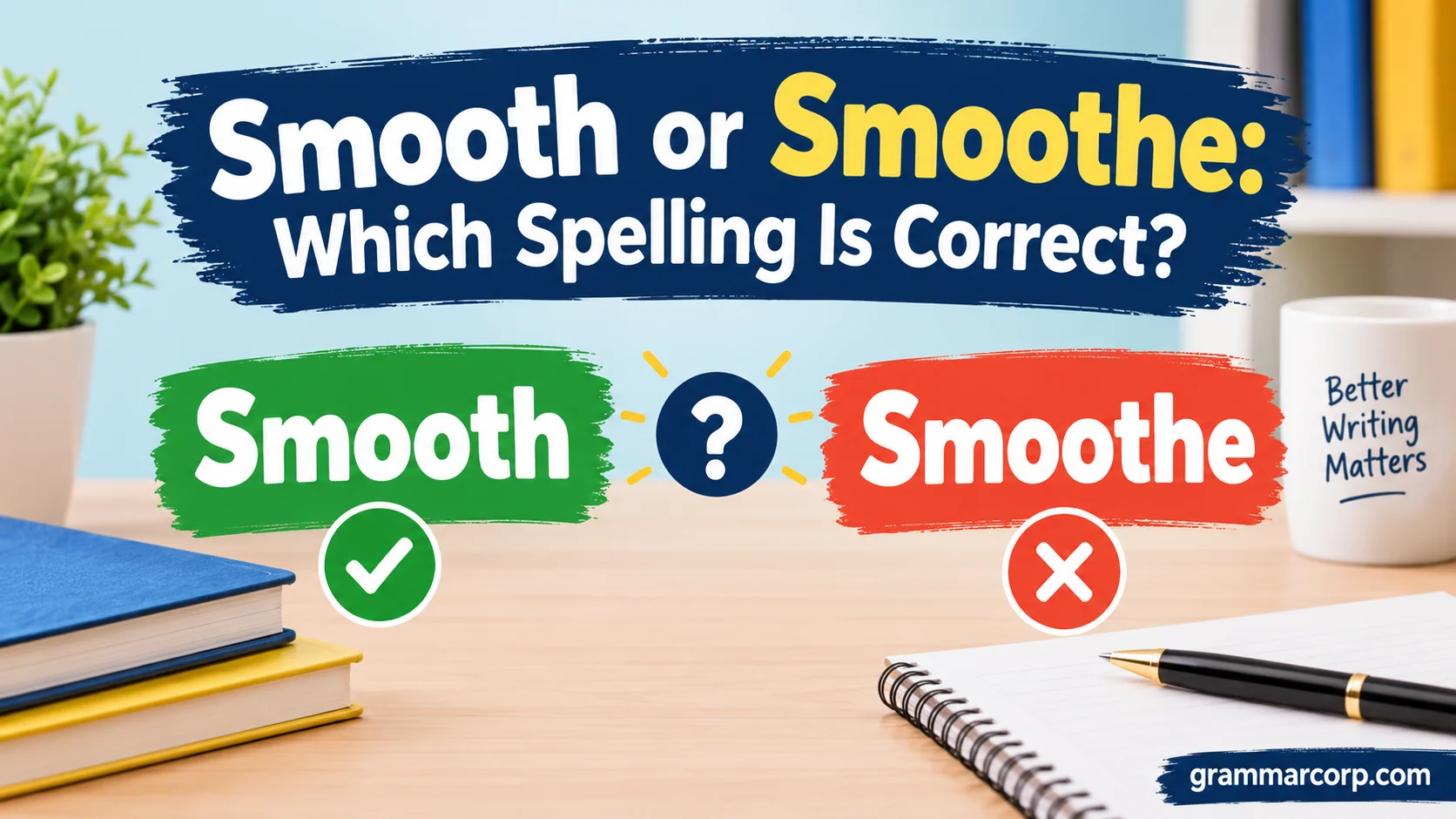
Smooth or Smoothe: Which Spelling Is Correct? Learn why “smooth” is standard, how it works as a verb and adjective, and how to avoid errors. Smooth is the correct spelling in standard English, including modern American English. Although smoothe sometimes appears in online discussions, it isn’t the standard spelling.
As an adjective, smooth describes a surface that feels even or a situation that proceeds without problems. As a verb, it means to make something even or remove wrinkles, as when you smooth a wrinkled shirt or run your hand over a polished wooden table. Its related forms include smoothed, smooths, and smooth, each serving a different grammatical purpose.
You don’t need to add a silent e to form the verb. Understanding these spelling rules helps you avoid common mistakes in emails, essays, reports, and everyday conversations. During proofreading and editing, check your word choice and context to maintain spelling accuracy, clarity, and professional writing standards.
Quick Answer:
Smooth is the correct and standard spelling for everyday modern English. Smoothe is a rare or historical variant that isn’t recommended in ordinary contemporary writing.
Use smooth as an adjective when describing something even, soft, or free from roughness. Use it as a verb when you mean to make something even or less rough.
Examples:
- Correct: The surface feels smooth.
- Correct: Please smooth the wrinkles from the fabric.
- Correct: The presentation went smoothly.
- Not recommended: The surface feels smoothe.
- Not recommended: Please smoothe the fabric.
Remember this simple rule: smooth already has the correct spelling, so don’t add an extra e.
Comparison Overview
Although smooth and smoothe look similar, they don’t have the same standing in modern English. One is the standard form you’ll find in contemporary dictionaries, while the other is an uncommon variant that most writers should avoid.
| Feature | Smooth | Smoothe |
| Standard modern spelling | Yes | No |
| Common in American English | Yes | No |
| Use as an adjective | Yes | Not recommended |
| Use as a verb | Yes | Not recommended |
| Suitable for professional writing | Yes | Generally no |
| Example | The road is smooth. | Use smooth instead. |
The word smooth can describe a physical surface, a person’s manner, a movement, or a process that happens without difficulty. It can also function as a verb, meaning to make something even, neat, or less rough.
By contrast, smoothe isn’t the usual spelling for any of these meanings in contemporary standard English. You may encounter it in older material or unusual spelling choices, but that doesn’t make it the appropriate form for everyday writing.
One important point: the fact that smoothe is uncommon doesn’t mean every appearance is necessarily a typographical error. Historical spelling and unusual usage can differ from present-day conventions. For ordinary writing, however, smooth is the safest and clearest choice.
Main Differences Between Smooth and Smoothe
The main difference between smooth and smoothe is their spelling status, not their intended meaning. In standard contemporary English, smooth is the established form used in dictionaries, books, professional documents, and everyday communication.
Understanding the word’s grammatical roles also helps explain why the extra e isn’t necessary.
| Difference | Smooth | Smoothe |
| Spelling | Standard | Nonstandard in ordinary modern usage |
| Meaning | Even, level, uninterrupted, or made less rough | Generally intended to convey the same meaning |
| Grammar | Adjective and verb | Not recommended as a standard form |
| Written communication | Appropriate for all common contexts | Best avoided unless reproducing a source’s spelling |
| Related forms | Smoothly, smoothness, smoothed | Does not provide a standard alternative word family |
Consider this example: “Please smooth the surface before applying the paint.” The verb already expresses the action clearly. Adding an e doesn’t create a new grammatical form or change the meaning.
Similarly, “The road is smooth” uses the standard adjective. There’s no reason to write smoothe when describing the road’s surface.
definition in the Cambridge English Dictionary
Why Is Smooth the Correct Spelling?
English spelling can be unpredictable, but you don’t need a complicated rule to remember this word. Smooth is the complete base form whether you use it to describe something or to explain an action.
For instance, these sentences all use the correct spelling:
- The glass has a smooth finish.
- Smooth the paper with your palm.
- She smoothed her jacket before the interview.
- The machine is running smoothly.
Notice how the word changes when you add an ending. The base spelling remains smooth, while the endings help express tense or grammatical function.
The word’s final h is also part of its established spelling. It isn’t a silent e that you need to add or remove. The letters in smooth form a complete word on their own.
Does Smoothe Have a Different Meaning?
No separate everyday meaning distinguishes smoothe from smooth. When someone writes smoothe in a sentence such as “Smoothe the edges,” they usually intend the standard verb smooth.
However, context matters when reading historical documents, quotations, or material that deliberately preserves an unusual spelling. If you encounter smoothe in an older text, don’t automatically assume the writer meant something different.
For your own writing, the practical choice remains straightforward: use smooth unless you’re reproducing a source exactly or discussing a specific historical spelling.
What Does Smooth Mean?
The word smooth has several related meanings. At its most basic, it describes something without roughness, bumps, or uneven areas. It also describes actions, experiences, and movements that happen without sudden changes or unnecessary difficulty.
According to the Cambridge Dictionary, smooth can describe a regular surface, an uninterrupted experience, a pleasant taste, or a confident manner that may sometimes seem insincere. It also functions as a verb for making something flatter or removing difficulties.
definition in the Cambridge English Dictionary
Here are some common contexts in which you’ll encounter the word:
- Physical texture: The marble felt smooth beneath my fingers.
- Movement: The elevator made a smooth stop.
- Communication: He gave a smooth explanation of the plan.
- Processes: We want a smooth transition between departments.
- Taste: The sauce had a smooth, creamy consistency.
- Problem-solving: The new schedule helped smooth the process.
These examples share one basic idea: something feels even, moves steadily, or proceeds without unnecessary obstacles.
Still, the exact meaning depends on the sentence. A smooth wooden surface and a smooth business negotiation aren’t physically alike. In the first example, smooth describes texture. In the second, it describes how easily an event progresses.
Smooth as an Adjective
An adjective describes a noun or pronoun. When you use smooth as an adjective, you tell readers something about a person’s manner, an object’s texture, or the way an event unfolds.
For example, consider this sentence:
“The carpenter sanded the wooden panel until it felt smooth.”
Here, smooth describes the panel’s surface. The word tells readers that the carpenter removed the roughness rather than simply making the wood look attractive.
You can use the adjective in many other situations.
Physical objects and materials
- The table has a smooth wooden finish.
- This fabric feels smooth against the skin.
- The river stones have smooth surfaces.
- Mix the ingredients until the batter looks smooth.
Experiences and processes
- We had a smooth journey to the conference.
- The software update was a smooth process.
- The meeting started smoothly after everyone arrived.
Speech and behavior
- Her smooth delivery kept the audience engaged.
- The salesperson gave a smooth presentation.
- His smooth manner made the conversation feel easy.
Be careful with the last group of examples. Describing someone as smooth can sometimes suggest that the person sounds overly polished, persuasive, or insincere. The surrounding words and the situation determine whether the description is positive or negative.
For example, “He delivered a smooth presentation” usually praises someone’s delivery. However, “He’s a smooth talker” can suggest that he persuades people with charm rather than honesty.
Smooth as a Verb
A verb expresses an action or state. When you use smooth as a verb, you mean to make something even, flatten wrinkles, spread a substance across a surface, or make a situation easier to manage.
Consider the sentence, “She smoothed the tablecloth before setting the plates.”
The word smoothed describes an action that happened in the past. The person moved the cloth to remove wrinkles and create a neater surface.
Here are more examples:
- Smooth the paper before folding it.
- He smoothed his hair in front of the mirror.
- The artist smoothed the clay with a wet tool.
- The coordinator worked to smooth the transition between teams.
- The lotion spreads easily when you smooth it over the skin.
The verb also appears in common phrasal expressions.
Smooth out means to resolve a problem, remove irregularities, or make something more consistent.
Example: “The team met to smooth out the remaining scheduling issues.”
Smooth over means to reduce tension or make a disagreement seem less serious.
Example: “She tried to smooth over the misunderstanding before it affected the project.”
Smooth down means to flatten or press something into a neater position.
Example: “He smoothed down the collar of his shirt.”
These expressions show that smooth can describe both physical actions and changes in a situation. Its spelling remains the same regardless of the meaning.
Why Do People Confuse Smooth and Smoothe?
The confusion often starts with the way English handles word endings. Some familiar verbs end in e, so writers may assume that smooth needs the same ending to work as a verb.
Words such as breathe, clothe, and soothe can make smoothe look plausible. However, English spelling doesn’t follow one pattern for every word with a similar sound.
Compare these examples:
| Word | Correct spelling | Example |
| Smooth | Smooth | Smooth the paper. |
| Soothe | Soothe | Music can soothe a worried listener. |
| Breathe | Breathe | Take a moment to breathe. |
| Clothe | Clothe | The organization helps clothe families in need. |
The extra e belongs to the established spelling of soothe, breathe, and clothe. It doesn’t belong in the standard spelling of smooth.
Another source of confusion is the difference between a word’s base form and its related forms. Writers may recognize smoothly or smoothed and wonder whether the original word should be smoothe.
It shouldn’t. The correct word family starts with smooth.
A useful way to remember this distinction is to compare the forms side by side:
- Smooth is the base word.
- Smoothed is the past tense.
- Smoothing is the -ing form.
- Smoothly is the adverb.
- Smoothness is the noun.
Once you learn the base form, the rest becomes easier to remember.
Is Smoothe Ever Correct?
Although smoothe isn’t the standard spelling for contemporary everyday English, it’s worth distinguishing an unusual spelling from a word that has no possible historical use.
Older texts, transcriptions, and specialized sources sometimes preserve spellings that modern writers wouldn’t normally choose. A historical spelling can be relevant when you’re studying an original document, quoting an author, or examining changes in English over time.
However, that doesn’t make smoothe an appropriate substitute for smooth in a modern email, school assignment, website article, or business report.
If you encounter the unusual spelling, consider the context:
- In modern writing: Replace smoothe with smooth when editing an ordinary sentence.
- In a direct quotation: Preserve the original spelling if accuracy requires it.
- In a historical document: Check the source and its publication date before drawing conclusions about the spelling.
- In a name or brand: Follow the official spelling if the unusual form is intentional.
It’s also important not to make unsupported claims about the history of a word. Establishing whether smoothe appeared in a particular period requires historical dictionary evidence or dated written examples. Its resemblance to other English words doesn’t prove when or why people used it.
For current writing, you don’t need to settle every historical question. The practical recommendation is clear: choose smooth for standard modern English.
Smooth, Smooths, Smoothed, or Smoothing?
The word smooth follows familiar English verb patterns when you use it in different tenses. Learning these forms helps you avoid mistakes beyond the original smooth or smoothe question.
| Word form | Grammatical use | Example |
| Smooth | Base form | Please smooth the fabric. |
| Smooths | Simple present with a third-person singular subject | She smooths the paper carefully. |
| Smoothed | Simple past or past participle | He smoothed the wrinkles away. |
| Smoothing | Present participle or gerund | They are smoothing the surface. |
These forms all come from the same base word. You don’t need to add an e before using the verb in a sentence.
Smooths or Smoothes?
Both smooths and smoothes appear as verb forms, but smooths is the straightforward choice for modern American English.
The difference comes from how English forms the third-person singular present tense. Most verbs add -s or -es, depending on their endings and spelling patterns. With smooth, the regular form is smooths.
Compare these sentences:
- Preferred: She smooths the fabric before sewing.
- Preferred: The software smooths the data to reveal the overall trend.
- Alternative form: She smoothes the fabric before sewing.
The last example may appear in usage, but you don’t need it. When clarity and consistency matter, choose smooths.
Smoothly or Smoothely?
Smoothly is the standard spelling of the adverb. It describes an action that happens evenly, easily, or without interruption.
For example:
- The meeting went smoothly.
- The wheels turned smoothly.
- The team worked smoothly together.
- The new system runs smoothly.
The spelling follows a simple pattern: smooth plus -ly becomes smoothly. You don’t insert an e between the base word and the suffix.
definition in the Cambridge English Dictionary
Avoid smoothely in ordinary contemporary writing. If you’re describing a process that happens without problems, use smoothly.
Smooth vs. Smoothen vs. Smoothe
The word smoothen introduces a slightly different question. Unlike smoothe, it is a recognized English verb, although smooth is often the more concise choice.
Both smooth and smoothen can describe making something smooth or becoming smooth. Their meanings overlap, so you can often choose between them without changing the main idea.
| Word | Meaning | Example |
| Smooth | Make something even or remove roughness | Smooth the surface with sandpaper. |
| Smoothen | Make or become smooth | The treatment helps smoothen the material. |
| Smoothe | Nonstandard for ordinary modern use | Write smooth instead. |
Consider the difference in these sentences:
“The worker smoothed the plaster before painting.”
“The worker smoothened the plaster before painting.”
Both communicate the intended action, but smoothed is more concise and natural in this context. In everyday writing, the simpler verb is usually enough.
You may encounter smoothen in technical descriptions, product information, or discussions of materials. Its presence doesn’t make it incorrect. It simply has a narrower place in common usage than smooth.
The important distinction is that smoothen is a legitimate alternative verb, while smoothe isn’t the standard spelling of smooth.
Read More : Hasn’t vs. Haven’t: What’s the Difference and When Should Each?
Common Mistakes When Using Smooth
A small spelling error can distract readers, particularly in professional documents or published content. Fortunately, most mistakes involving smooth are easy to fix once you recognize the standard forms.
Adding an Extra E to Smooth
The most direct mistake is writing smoothe instead of smooth.
- Incorrect: Please smoothe the edges before painting.
- Correct: Please smooth the edges before painting.
The verb doesn’t require an extra letter. Use smooth for the action and smooth for the description.
Misspelling the Past Tense
The past tense adds -ed to the base word.
- Incorrect: She smothed the paper.
- Correct: She smoothed the paper.
Notice that the spelling smooth stays intact. You simply add -ed to form smoothed.
Using Smoothely Instead of Smoothly
The standard adverb ends in -ly, not -ely.
- Incorrect: The event went smoothely.
- Correct: The event went smoothly.
When you want to describe a process that proceeds without difficulty, smoothly is the right choice.
Confusing Smooth With Soothe
These words look similar and share a similar ending, but they have different meanings.
Smooth generally refers to an even surface, steady movement, or the removal of roughness or difficulty. Soothe means to calm, comfort, or relieve distress.
For example:
- She smoothed the wrinkles from her shirt.
- The gentle music helped soothe the child.
In the first sentence, someone changes the fabric’s surface. In the second, something helps a person feel calmer.
Choosing the right word depends on what you want to express, not just how the word sounds.
How to Remember the Correct Spelling of Smooth
The easiest way to remember the difference is to treat smooth as a complete word. You don’t need an extra e at the end, whether you’re describing a surface or explaining an action.
Try these practical memory tips.
- Remember the base word: Write smooth, not smoothe.
- Learn the word family: Practice smooth, smooths, smoothed, smoothing, and smoothly together.
- Use a simple sentence: “Smooth the surface until it feels smooth.”
- Check the word’s role: If you’re describing a texture, use smooth as an adjective. If you’re describing an action, use it as a verb.
A short practice exercise can help reinforce the rule.
| Sentence | Correct word |
| The road feels ___. | Smooth |
| Please ___ the paper. | Smooth |
| She ___ the wrinkles yesterday. | Smoothed |
| The project went ___. | Smoothly |
| He ___ the fabric every morning. | Smooths |
These examples cover the most common forms you’ll need in everyday writing. Once you recognize the pattern, choosing the correct spelling becomes almost automatic.
FAQs:
1. Is it smooth or smooth?
Smooth is the correct spelling. Smoothe is a common misspelling when used as the adjective or verb.
2. Is smooth a noun, verb, or adjective?
Smooth can function as both an adjective and a verb. As an adjective, it describes something even or free from roughness. As a verb, it means to make something even or less rough.
3. What is the past tense of smooth?
The past tense of smooth is smoothed. For example, “She smoothed the wrinkles out of her shirt.”
4. Is smoothen a correct English word?
Yes, smoothen is a recognized verb meaning to make something smooth. However, smooth is often the more natural and concise choice in everyday American English.
5. What is the adverb form of smooth?
The adverb form is smooth. For example, “The presentation went smoothly.” It describes how an action takes place.
Conclusion:
Choosing between smooth and smooth becomes easy once you understand the standard spelling rules. Smooth is the correct spelling in modern American English and works as both an adjective and a verb. You can describe a smooth surface, smooth a wrinkled shirt, or explain that a meeting went smoothly.
Remember that the past-tense form is smoothed, not smoothe. By using the correct spelling and checking your writing carefully, you can avoid common errors and make your emails, essays, and reports clearer and more professional.












1 thought on “Smooth or Smoothe: Which Spelling Is Correct?”