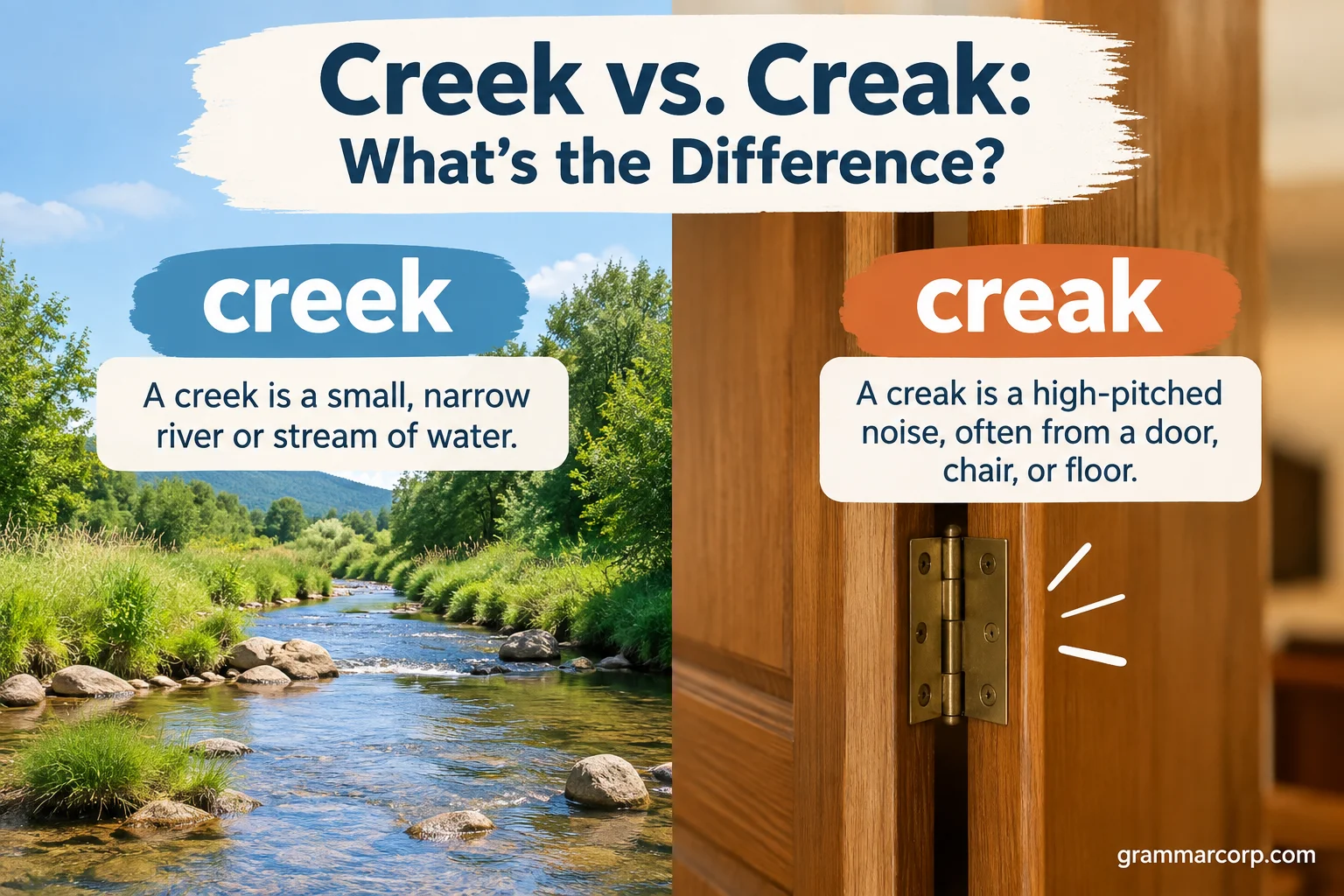
Creek vs. Creak: What’s the Difference? explains how two similar-sounding words differ in meaning, spelling, and everyday English usage clearly. Creek and creak are similar-sounding words with different meanings, spellings, and uses. Both can sound similar, but a creek is a natural stream, while a creak refers to a prolonged grating or squeaking sound. Merriam-Webster defines a creek as a natural stream that is normally smaller than a river and may be a tributary to one. Their grammar, sentence patterns, word forms, and usage become easier to understand when the surrounding context is clear.
You can imagine walking through a quiet forest at sunset along a trail beside a narrow stream that flows gently through the landscape. Water moves over smooth stones with a peaceful rhythm, and you may go fishing near the creek by your house. Then, suddenly, an old wooden bridge beneath your feet makes a long groaning sound. An old door, wooden floorboard, or hinge can make a similar unpleasant sound, which helps make the two words easier to understand. From my experience, I have often heard someone say creak when they meant creek, or vice versa.
This small difference can confuse many people, lead to misunderstandings, weaken communication, and affect writing and conversation. When writing, it is normal to be concerned about clarity, because choosing the wrong word can change the tone of a sentence entirely. These perfect examples show why this spelling pair can be tricky, even though both are homophones and may sound almost identical. A useful memory trick is to look at the meaning, avoid common mistakes, and remember whether the word describes a small, shallow inlet from the sea or a squeaking, grating, or scraping sound.
Quick Answer:
Creek refers to a small natural stream or waterway.
Creak refers to a prolonged squeaking, grating, or scraping sound. It can also mean to make that sound.
| Word | Meaning | Part of Speech | Example |
| Creek | A small stream or waterway | Noun | We crossed the creek. |
| Creak | A squeaking or grating sound | Noun | I heard a creak upstairs. |
| Creak | To make a squeaking or grating sound | Verb | The old door began to creak. |
The simplest memory rule is:
Creek = water. Creak = sound.
Both words are generally pronounced /kriːk/ in US and UK English. Cambridge gives the same pronunciation for both words, which explains why spelling causes so much confusion.
Comparison Overview
The easiest way to understand creek vs. creak is to compare their meanings side by side.
| Feature | Creek | Creak |
| Basic meaning | A small stream or waterway | A squeaking, grating, or scraping sound |
| Common part of speech | Noun | Verb and noun |
| Pronunciation | /kriːk/ | /kriːk/ |
| Refers to | Water | Sound or sound-producing action |
| Common examples | Creek, stream, river | Door, floorboard, chair, hinge |
| Plural | Creeks | Creaks |
| Past tense | — | Creaked |
| -ing form | — | Creaking |
| Related adjective | — | Creaky |
| Easy association | Water | Noise |
Merriam-Webster lists creek primarily as a noun meaning a natural stream of water that is normally smaller than a river. It also records a chiefly British meaning involving a small inlet or bay.
By contrast, creak works as both a verb and a noun. As a verb, it describes something producing a prolonged squeaking or grating sound. As a noun, it names that sound.
So although creek and creak sound alike, their meanings have no practical connection in modern everyday English.
Main Differences Between Creek vs. Creak
The biggest difference between creek vs. creak is what each word represents.
A creek is something you can usually see, cross, follow, fish in, or walk beside. A creak is something you hear.
That one distinction solves most spelling problems.
Creek Refers to Water
A creek is a natural stream of flowing water. In general American English, the word commonly describes a stream smaller than a river.
For example:
- The children played beside the creek.
- We crossed the creek using the wooden bridge.
- A narrow creek runs through the forest.
- Heavy rain caused the creek to rise.
- The trail follows the creek for several miles.
The exact size of a creek isn’t determined by one universal measurement. Local naming traditions, geography, and regional usage influence whether a watercourse is called a creek, stream, brook, or another term.
Merriam-Webster describes a creek as a natural stream normally smaller than and often tributary to a river.
Creak Refers to Sound
A creak describes a particular kind of noise. It often comes from something moving against another surface or from an older or stiff structure.
Common sources include:
- Doors
- Floorboards
- Wooden stairs
- Chairs
- Beds
- Hinges
- Gates
- Wooden bridges
- Tree branches
- Old machinery
For example:
- The door began to creak.
- The floorboards creaked beneath our feet.
- We heard a strange creak from the hallway.
- The old gate creaked when it moved.
- The wooden stairs were creaking.
Cambridge defines creak as the sound made when something such as a door or floorboard moves. It also treats creak as a noun for the resulting noise.
Creek Is Usually a Noun
In its common modern meaning, creek functions as a noun.
You can use it as the subject or object of a sentence:
- The creek flows behind the house.
- We followed the creek.
- The creek flooded after the storm.
- They built a bridge over the creek.
Its plural form is creeks.
For example:
Several creeks flow through the valley.
Creak Can Be a Verb or Noun
Creak has two common grammatical roles.
As a verb:
The wooden door creaked open.
As a noun:
We heard a loud creak.
This difference matters because the surrounding sentence can tell you immediately which word you need.
Compare:
- The door creaked.
- We heard a creak.
The first sentence uses creak as a verb. The second uses it as a noun.
What Does Creek Mean?
The word creek has a straightforward everyday meaning in American English: a small natural stream.
Merriam-Webster describes it as a natural stream of water normally smaller than and often tributary to a river. It also records a chiefly British meaning for a small inlet or bay.
Creek as a Small Stream
When you picture a creek, think of flowing water that may pass through a forest, valley, park, field, or residential area.
A creek can be:
- Shallow or relatively deep
- Narrow or wider
- Fast-moving or slow-moving
- Seasonal or flowing throughout the year
- Connected to a larger river system
The word itself doesn’t establish an exact width or depth.
For example, these sentences all use creek correctly:
- We sat beside the creek.
- The hikers crossed the creek.
- Fish moved through the clear creek water.
- The creek flows into a larger river.
- A footbridge spans the creek.
Creek and Related Water Words
Several English words describe flowing water. They aren’t always interchangeable in every regional context.
| Word | General meaning |
| Creek | A natural stream usually smaller than a river |
| Stream | A general term for flowing water |
| Brook | A small stream, especially common in certain varieties of English |
| Rivulet | A very small stream |
| Tributary | A stream or river that flows into a larger watercourse |
The important point is that creek identifies a water feature. It has nothing to do with the squeaking sound represented by creak.
What Does Creak Mean?
Creak describes a particular type of sound or the act of making that sound.
Merriam-Webster defines the verb as making a prolonged grating or squeaking sound. Its noun form refers to a rasping or grating noise.
Creak as a Verb
As a verb, creak tells you that something produces the characteristic noise.
Consider these examples:
- The door creaked on its hinges.
- The floorboards creaked as she walked.
- The old chair creaked when he sat down.
- The wooden gate creaked in the wind.
- The stairs creaked under the pressure.
Cambridge similarly gives examples involving doors and floorboards that make a sound when they move.
Creak as a Noun
As a noun, creak refers to the sound itself.
Examples include:
- I heard a creak upstairs.
- A loud creak came from the old chair.
- The creak of the door broke the silence.
- We noticed every creak in the wooden floor.
This gives you an easy grammar test.
If the word describes what something does, use creak as a verb.
If it identifies the noise itself, use creak as a noun.
Creak and Its Related Forms
The word has several common forms.
| Form | Example |
| Creak | The door may creak. |
| Creaks | The floor creaks at night. |
| Creaked | The gate creaked open. |
| Creaking | We heard a creaking sound. |
| Creaky | The old chair is creaky. |
Merriam-Webster lists creaked, creaking, and creaks as forms of the verb.
Are Creek and Creak Homophones?
Yes. Creek and creak are homophones in common English pronunciation.
A homophone is a word that sounds the same as another word but has a different spelling and meaning.
Examples of other familiar homophone pairs include:
- Their / there
- To / too
- Flower / flour
- Right / write
- Sea / see
The same principle applies to creek and creak.
Cambridge gives both creek and creak the pronunciation /kriːk/ in US and UK English.
That means you generally cannot solve this spelling problem by listening to the word.
You need to understand what the speaker or writer means.
Why Pronunciation Creates Confusion
Imagine someone says:
We heard a creek.
You can’t know from the sound alone whether the person means:
- They heard a creak, meaning a noise.
- They are talking about a creek, perhaps in another context.
The surrounding sentence provides the missing information.
For example:
We crossed the creek.
The verb crossed makes a waterway the logical choice.
Now consider:
The floor began to creak.
The subject floor makes a sound the logical interpretation.
Context acts like a signpost.
Creek vs. Creak Examples in Sentences
Seeing the words in real sentences makes the difference much easier to remember.
Examples With Creek
Here are natural examples using creek:
- We followed the creek through the woods.
- The children played near the creek.
- A narrow creek runs behind the farm.
- The hikers stopped beside the creek.
- Heavy rain caused the creek to overflow.
- The bridge crosses a shallow creek.
- Fish swam through the clear creek.
- The trail ends near the creek.
- We could hear the water rushing through the creek.
- Several small creeks feed the larger river.
Notice the pattern. Every example involves water or a waterway.
Examples With Creak
Now look at sentences using creak:
- The old door began to creak.
- The floorboards creaked under our feet.
- I heard a strange creak upstairs.
- The wooden stairs creaked as we climbed.
- The chair gave a loud creak.
- The gate creaked when the wind pushed it.
- The old bridge creaked as it moved.
- A faint creak came from the hallway.
- The hinges creaked when the door opened.
- The floor is so old that it creaks constantly.
Every example centers on sound.
Side-by-Side Examples
The following comparison makes the distinction even clearer.
| Creek | Creak |
| We walked beside the creek. | The door began to creak. |
| The creek flows through the valley. | The floorboards creak at night. |
| They crossed the creek. | We heard a loud creak. |
| Fish live in the creek. | The chair gave a creak. |
| The creek rose after heavy rain. | The old gate creaked open. |
A useful observation emerges here: creek usually answers the question “What water feature?” while creak answers “What sound?” or “What did the object do?”
Common Mistakes With Creek and Creak
Because these words sound identical, spelling mistakes are easy to make.
Mistake: Using Creek for a Sound
Incorrect:
The door made a loud creek.
Correct:
The door made a loud creak.
The sentence describes a noise. Therefore, creak is the correct spelling.
Mistake: Using Creak for a Stream
Incorrect:
We walked beside the creak.
Correct:
We walked beside the creek.
The sentence describes a waterway. Therefore, creek is correct.
Mistake: Writing Creeked
A common spelling error occurs when someone tries to turn creek into a verb for a sound.
Incorrect:
The floor creeked when I stepped on it.
Correct:
The floor creaked when I stepped on it.
The verb is creak, not creek.
Its past-tense form is creaked.
Mistake: Choosing the Spelling From Sound Alone
This is the hardest mistake to avoid.
Since creek and creak are pronounced alike, listening isn’t enough.
Instead, ask:
What does the word mean in this sentence?
That question usually gives you the answer immediately.
Read More : No Thank You or No, Thank You? Comma Rules Explained
How to Remember the Difference Between Creek and Creak
You don’t need a complicated mnemonic. A simple meaning-based connection works best.
Remember: Creek = Water
Think of a creek as a little stream.
You can connect:
Creek → Stream → Water
For example:
The creek runs through the forest.
If water belongs in the sentence, creek is probably your word.
Remember: Creak = Sound
Think of an old wooden door.
Imagine pushing it open and hearing:
Creak!
You can connect:
Creak → Noise → Door
If you’re describing a squeaking or grating sound, choose creak.
Use the Water-or-Sound Test
When you’re unsure, ask one question:
Am I talking about water or a sound?
If the answer is water, choose creek.
If the answer is sound, choose creak.
This works because the two words occupy completely different semantic categories.
Use the Stream Test
Try replacing the word with stream.
If the sentence still makes sense, creek is likely correct.
We walked beside the stream.
Therefore:
We walked beside the creek.
Now try it with a sound:
The door began to stream.
That clearly doesn’t work.
The correct sentence is:
The door began to creak.
Creek vs. Creak: Grammar and Word Forms
Grammar provides another useful way to separate these words.
Creek Grammar
Creek is primarily used as a noun in its common waterway sense.
Common patterns include:
- the creek
- a creek
- near the creek
- across the creek
- along the creek
- several creeks
Examples:
A creek flows through the park.
We walked along the creek.
Several creeks join the river.
Creak Grammar
Creak can function as both a noun and a verb.
As a verb:
The floorboards creak.
As a noun:
I heard a creak.
Its common verb forms include:
- Creak
- Creaks
- Creaked
- Creaking
Its adjective form is:
- Creaky
Examples:
The old stairs are creaky.
The stairs creaked as we climbed.
We heard a creak behind us.
Creek vs. Creak: A Practical Editing Test
Suppose you’re proofreading an article, essay, story, or email and see the word creek or creak.
Don’t immediately look at the spelling.
First, identify the meaning.
Step One: Identify the subject
Ask what the sentence discusses.
Is it a:
- Stream?
- River system?
- Waterway?
- Door?
- Floorboard?
- Hinge?
- Chair?
- Noise?
Step Two: Identify the action
If something is making a sound, creak may be the correct verb.
If you’re describing a body of water, creek is the correct noun.
Step Three: Check the sentence pattern
Compare:
The creek runs behind the house.
Here, creek is the subject and represents water.
Now:
The door creaked behind the house.
Here, creaked describes an action involving sound.
Step Four: Check related forms
If you need creaked, creaking, or creaky, you’re dealing with the creak word family.
If you need creeks, you’re probably talking about waterways.
A Simple Creek vs. Creak Case Study
Consider this short editing example:
We walked along the old creak until we reached a wooden bridge. As we crossed, the boards began to creek beneath our feet.
Both words are wrong.
The corrected version is:
We walked along the old creek until we reached a wooden bridge. As we crossed, the boards began to creak beneath our feet.
Why?
The first word describes water.
The second describes sound.
This tiny example captures the entire difference between the two words.
The spelling changes because the meaning changes, even though the pronunciation stays the same.
Creek vs. Creak in Everyday Writing
These words appear in different kinds of writing.
Creek in Descriptive Writing
Writers commonly use creek when describing landscapes, travel, nature, geography, or outdoor settings.
For example:
A narrow creek wound through the trees.
The word immediately gives the reader a picture of moving water.
Creak in Narrative Writing
Writers often use creak to create an audible detail.
For example:
The old wooden door creaked open.
That sentence doesn’t merely tell the reader that the door opened. It adds a sound.
This makes creak particularly useful in descriptive and narrative writing.
It can create an atmosphere of age, movement, tension, or quiet without needing a long explanation.
Creek vs. Creak: Key Facts to Remember
Here are the most important facts in one place:
- Creek is primarily a noun referring to a natural stream.
- A creek is generally smaller than a river.
- Creak can be a noun or verb.
- A creak is a squeaking, grating, or scraping sound.
- To creak means to make that kind of sound.
- Creek and creak are generally pronounced the same.
- Both are commonly pronounced /kriːk/ in US English.
- Creeks is the plural of creek.
- Creaked is the past tense of creak.
- Creaking is the present participle of creak.
- Creaky is an adjective related to creak.
The first known use dates also differ. Merriam-Webster traces creek in its waterway sense to the 13th century. It dates the first known use of creak as a verb to 1582 and its noun use to 1606.
FAQs:
1. What is the difference between creek and creak?
Creek means a small stream or waterway, while creak means a long, unpleasant squeaking or grating sound.
2. Are creek and creak homophones?
Yes. Creek and creak are homophones because they have the same pronunciation but different spellings and meanings.
3. What does creek mean in a sentence?
Creek refers to a small natural stream or waterway. For example, “We walked beside the creek.”
4. What does creak mean in a sentence?
Creak describes a squeaking or grating sound, often made by an old door, floorboard, hinge, or wooden bridge. For example, “The old door began to creak.”
5. How can I remember the difference between creek and creak?
A simple memory trick is to connect creek with water and creak with sound. Thinking about the context can help you choose the correct spelling.
Conclusion:
In Creek vs. Creak, the two words may sound the same, but their meanings and spellings are different. Creek refers to a small stream or waterway, while creak describes an unpleasant squeaking or grating sound.
Remembering these simple meanings and checking the context can help you avoid spelling mistakes and use both words clearly in your writing.














1 thought on “Creek vs. Creak: What’s the Difference?”