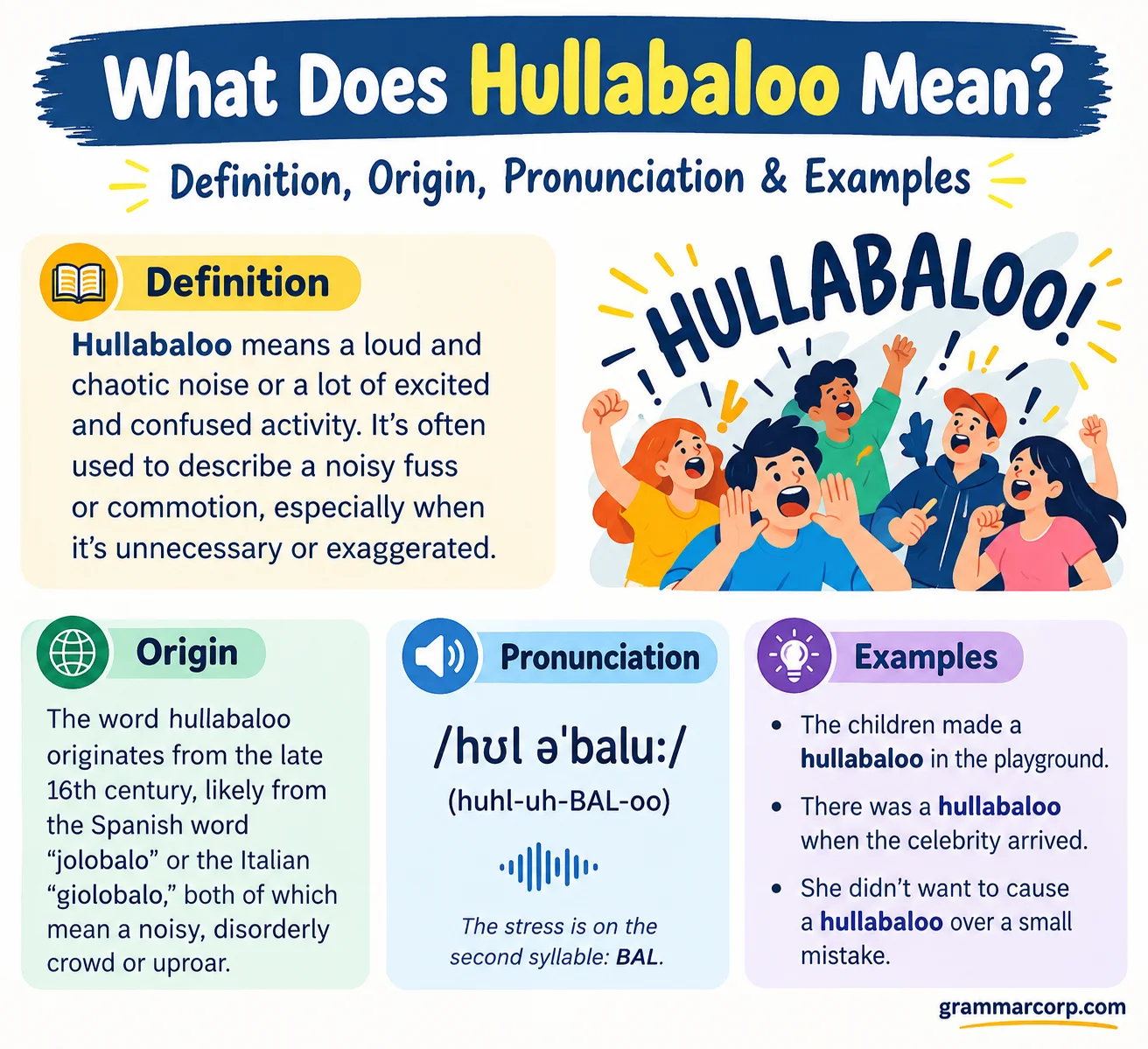
What Does Hullabaloo Mean? Definition, Origin, Pronunciation and Examples explains how this informal English noun describes a loud, noisy commotion. Hullabaloo is a loud disturbance, uproar, or fuss involving actual noise, public excitement, complaints, or arguments surrounding an issue. In everyday conversation, news writing, and humorous commentary, this unusual word gives your English vocabulary a colorful sound and helps describe a situation that has attracted attention.
A simple way to understand the meaning of hullabaloo is to imagine a busy market where everyone is talking loudly, or a sports game filled with cheering and shouting. The loud noise or commotion can come from excited or upset people, creating lots of noise and activity. As a fun and quirky term, hullabaloo adds attention and emphasis while giving ordinary noise a more colorful tone. It can describe a ruckus, kerfuffle, or clamorous confusion, although the exact tone depends on the situation.
The pronunciation, origin, and history of hullabaloo make the word particularly intriguing. Historical forms include Hullabaloo , Hullabaloo , halloo-Hullabaloo , hallooballoo, and halloo-bo-loo, which appear among historical examples in the OED. Today, hullabaloo prevails as the common spelling, while hullaballoo is the second most common spelling. On the web, the latter appears about one time for every thirty instances of hullabaloo. activity.
Quick Answer:
Hullabaloo means a lot of loud, confused noise or a public fuss, uproar, or commotion.
For example:
What’s all the hullabaloo about?
This means:
Why is everyone making such a fuss or causing so much commotion?
The word is generally informal. Oxford defines it as a lot of loud noise, especially noise made by people who are annoyed or excited about something. Cambridge also includes the idea of angry public comments or complaints.
Hullabaloo Meaning at a Glance
| Feature | Meaning |
| Word | Hullabaloo |
| Part of speech | Noun |
| Basic meaning | Loud noise, commotion, uproar, or fuss |
| Tone | Informal and often playful |
| Pronunciation | /ˌhʌl.ə.bəˈluː/ |
| Plural | Hullabaloos |
| Common synonyms | Commotion, uproar, fuss, hubbub |
| Typical phrase | What’s all the hullabaloo about? |
| Origin | Mid-18th century |
Comparison Overview
Hullabaloo overlaps with several English words, but the words aren’t completely interchangeable.
| Word | Core Meaning | Typical Tone | Key Difference |
| Hullabaloo | Noisy fuss or commotion | Informal, playful | Often makes a situation sound colorful or less severe |
| Commotion | Confused activity or disturbance | Neutral | More straightforward and less expressive |
| Uproar | Loud public reaction | Strong | Often involves protest, anger, or controversy |
| Fuss | Excessive concern or attention | Informal | Can suggest people are overreacting |
| Ruckus | Loud, disorderly noise | Informal | Focuses strongly on noise and disorder |
| Hubbub | Noisy confusion | Informal | Very close to hullabaloo |
| Kerfuffle | Minor disagreement or disturbance | Playful | Usually suggests a relatively small problem |
| Chaos | Complete disorder | Strong | Much broader and more serious |
The choice depends on what you want to emphasize.
If a crowd is loudly arguing, uproar may fit. If people are simply making a lot of confusing noise, hullabaloo or hubbub may sound more natural.
If everyone is getting unnecessarily worked up over a small issue, fuss or kerfuffle may idea better.
Main Differences Between Hullabaloo and Similar Words
Understanding hullabaloo becomes easier when you compare it with words that appear in similar sentences.
Hullabaloo vs. Commotion
Both words can describe noisy or confused activity.
However, commotion is more neutral. It can describe movement, disturbance, or confusion without suggesting a particular emotional reaction.
For example:
- There was a commotion outside the store.
- There was a hullabaloo outside the store.
The first sounds plain and descriptive. The second sounds more colorful and informal.
Hullabaloo vs. Uproar
Uproar often suggests a stronger public reaction.
It can describe loud protest, anger, controversy, or widespread disagreement.
Hullabaloo can describe those things too. However, it often carries a lighter feel.
For example, a controversial announcement could cause an uproar. A noisy public reaction to a relatively minor announcement could be described as a hullabaloo.
Hullabaloo vs. Fuss
Fuss focuses more on excessive concern, attention, or agitation.
If someone says, “Why are you making such a fuss?” they may be suggesting that the issue doesn’t deserve so much attention.
Hullabaloo can communicate a similar idea, especially in the phrase all the hullabaloo.
Hullabaloo vs. Ruckus
A ruckus usually emphasizes loud, disorderly noise.
Hullabaloo can also mean loud noise. However, it can extend beyond physical sound to include public complaints, excitement, or controversy.
Hullabaloo vs. Kerfuffle
A kerfuffle usually refers to a small disturbance, disagreement, or fuss.
Both words can sound humorous.
The difference is mainly one of emphasis. Kerfuffle often suggests a minor disagreement, while hullabaloo can describe a much louder or more widespread disturbance.
Hullabaloo vs. Chaos
These words aren’t exact synonyms.
Chaos means extreme disorder or a complete lack of organization.
Hullabaloo means noisy disturbance or fuss. A situation can involve a lot of hullabaloo without being truly chaotic.
That distinction matters when choosing the right word.
How Do You Pronounce Hullabaloo?
The standard pronunciation is:
/ˌhʌl.ə.bəˈluː/
A simple pronunciation guide is:
hul-uh-buh-LOO
The main stress falls on the final syllable, loo. Cambridge gives the same pronunciation for both its UK and US entries.
Break Hullabaloo Into Syllables
You can divide the word into four spoken parts:
hul – a – ba – loo
The final loo receives the strongest emphasis.
If you’re learning English, don’t worry about making every sound perfectly technical. Saying hul-uh-buh-LOO will give you a useful approximation.
Is Hullaballoo Another Spelling?
You may encounter hullaballoo with an extra l.
Collins records hullaballoo as a variant spelling. The standard spelling hullabaloo is the form commonly presented in major modern dictionary entries.
Where Did the Word Hullabaloo Come From?
The history of hullabaloo is more uncertain than its meaning.
The word is documented from the mid-18th century. The Scottish National Dictionary records an early form, hollow-ballow, from 1762 and traces the word’s historical use to Scottish and northern English dialects.
Oxford describes its origin as a mid-18th-century reduplication of hallo or hullo.
The word has also appeared in many historical spellings. That variation reflects the fact that its early development wasn’t based on a simple modern word-building process.
Why Is the Origin Uncertain?
Several explanations have been proposed.
One widely cited explanation connects the word with hallo, hullo, or halloo, old forms of a shouted call used to attract attention. The repeated sounds may have helped create a word that itself sounded energetic and noisy.
Another proposed explanation involves the Scottish word baloo, associated with a lullaby. Collins records this possibility while also giving an echoic or rhyming explanation in its American English material.
The important point is that these explanations shouldn’t be presented as certain fact.
The documented history is clear: the word is found in English from the 18th century and refers to uproar, noise, or disturbance. Its precise formation is less certain.
Hullabaloo Historical Timeline
| Period | What We Know |
| Mid-18th century | Early forms of the word are documented |
| 1762 | The Scottish National Dictionary records an early hollow-ballow example |
| 18th–19th centuries | Numerous spelling variations appear |
| Modern English | Hullabaloo remains an informal word for commotion, uproar, or fuss |
The Dictionary of the Scots Language specifically records forms such as hulli-, hally-, hallo-, hollo-, and several different versions of the second element.
What Does Hullabaloo Mean in Different Contexts?
The exact meaning becomes clearer when you look at how people use it.
Hullabaloo as Loud Noise
The most literal sense involves a lot of noise.
Imagine a crowded place where several people are shouting, arguing, cheering, or reacting loudly.
You might say:
There was a terrible hullabaloo outside the building.
Here, the word describes the noisy disturbance itself.
Hullabaloo as Commotion
Hullabaloo can also describe a situation filled with confusion and activity.
For example:
The children created quite a hullabaloo when the magician arrived.
The focus isn’t necessarily on anger. The word can simply describe energetic noise and excitement.
Hullabaloo as a Fuss
Sometimes the word means that people are making too much fuss about something.
For example:
I don’t understand all this hullabaloo over a minor change.
Here, the speaker isn’t merely describing sound. They’re commenting on the amount of attention and reaction surrounding the issue.
Hullabaloo as Public Complaints
The word can also refer to public anger, criticism, or complaints.
Cambridge specifically includes angry comments made in public about someone or something as one of its meanings.
For example:
The new policy caused a hullabaloo among local residents.
In this sentence, the word refers to the public reaction rather than literal noise alone.
Hullabaloo in News and Commentary
Writers sometimes use hullabaloo when they want to describe public controversy without making the language sound extremely serious.
Compare:
- The announcement caused an uproar.
- The announcement caused a hullabaloo.
The first sounds more forceful. The second has a more conversational or slightly humorous flavor.
How Is Hullabaloo Used in a Sentence?
The word usually functions as a noun.
Here are several natural examples:
- The sudden announcement caused a huge hullabaloo.
- We could hear a hullabaloo coming from the playground.
- What’s all the hullabaloo about?
- The new rule created quite a hullabaloo.
- There was a great hullabaloo when the team arrived.
- The neighbors made a hullabaloo over the construction work.
- After all the hullabaloo, everything returned to normal.
- The story created a surprising amount of hullabaloo online.
- Nobody expected such a hullabaloo over a simple decision.
- The room erupted into a hullabaloo when the surprise was revealed.
These examples show an important feature of the word: context controls its emotional force.
The same noun can describe excitement, anger, noise, confusion, or excessive attention.
Read More : On a Wing and a Prayer: Meaning, Origin, Examples, and Usage
What Are the Most Common Phrases With Hullabaloo?
Some combinations occur naturally in everyday English.
What’s All the Hullabaloo About?
This is one of the most recognizable expressions.
It means:
Why is everyone making so much noise or fuss about this?
Example:
What’s all the hullabaloo about? I only changed the meeting time.
The phrase often sounds curious, humorous, or mildly dismissive.
Make a Hullabaloo
This means to create a noisy disturbance or public fuss.
Example:
The crowd made a hullabaloo when the gates opened.
Cambridge specifically makes a hullabaloo as a common construction.
Cause a Hullabaloo
This means to cause a commotion, fuss, or public reaction.
Example:
The unexpected decision caused a hullabaloo throughout the organization.
All the Hullabaloo
This phrase refers to the entire fuss or commotion surrounding something.
Example:
After all the hullabaloo, the issue turned out to be quite simple.
A Great Hullabaloo
This simply means a large or noticeable commotion.
Example:
There was a great hullabaloo when the performers entered the hall.
Is Hullabaloo Positive, Negative, or Neutral?
Hullabaloo isn’t inherently positive or negative.
Its meaning depends heavily on context.
Negative Use
It can describe anger, complaints, arguments, or public disagreement.
The decision caused a hullabaloo among residents.
Here, the word refers to an unwanted reaction.
Neutral Use
It can simply describe noise and activity.
There was a hullabaloo in the courtyard.
Nothing in the sentence necessarily tells us whether the situation was good or bad.
Playful Use
The word often sounds humorous because of its unusual rhythm.
The birthday surprise caused quite a hullabaloo.
Here, the word makes the excitement sound lively rather than threatening.
This flexible tone is one reason the word remains useful.
Is Hullabaloo Formal or Informal?
Hullabaloo is generally informal.
Oxford marks it as an informal noun. Cambridge labels it old-fashioned and also describes its American entry as informal.
That doesn’t mean the word is incorrect in formal writing. It simply has a more conversational flavor than words such as disturbance, public outcry, or commotion.
Where Hullabaloo Works Well
You can comfortably use it in:
- Everyday conversation
- Informal articles
- Humorous writing
- Personal writing
- Commentary
- Storytelling
- Lighthearted descriptions
Where Another Word May Be Better
In highly technical, legal, or academic writing, a more precise term may communicate the intended meaning more clearly.
For example:
Instead of:
The regulation caused a hullabaloo.
A formal report might say:
The regulation generated significant public opposition.
The second sentence tells the reader exactly what happened.
The first is more colorful.
What Is the Plural of Hullabaloo?
The plural is:
hullabaloos
Cambridge explicitly lists hullabaloos as the plural form in its American English entry.
For example:
Several hullabaloos erupted during the debate.
That plural form is grammatically possible, although singular hullabaloo is much more likely in ordinary conversation.
You’ll usually encounter constructions such as:
- a hullabaloo
- the hullabaloo
- all the hullabaloo
- such a hullabaloo
What Does Hullabaloo Mean in Modern English?
In modern English, hullabaloo still means essentially what it has meant historically: noisy commotion, uproar, fuss, or public disturbance.
Merriam-Webster’s thesaurus groups it with words including commotion, fuss, disturbance, hubbub, ruckus, rumpus, kerfuffle, and uproar.
The word may sound somewhat old-fashioned to some speakers. However, it remains understandable and useful, especially when a writer wants a colorful and informal expression.
Its continued presence in modern dictionaries and contemporary usage shows that it hasn’t disappeared from English.
Why Does Hullabaloo Sound So Funny?
There’s a good reason many people find hullabaloo memorable.
The word has a strong rhythmic pattern:
HUL – uh – buh – LOO
It contains repeated sounds and a prominent ending. That gives it a playful quality that words such as disturbance don’t have.
This doesn’t mean the sound alone proves its etymology. Historical sources actually disagree about the precise origin.
Still, the word’s sound fits its meaning remarkably well.
When you say hullabaloo, the word itself feels energetic and noisy.
That’s part of its charm.
Hullabaloo Facts You Should Know
Here are some useful facts about the word:
- Hullabaloo is a noun.
- It means noise, commotion, uproar, or fuss.
- Oxford dates its origin to the mid-18th century.
- An early recorded Scottish form was hollow-ballow, dated to 1762.
- Its exact etymology is uncertain.
- Oxford connects its formation with hallo/hullo and reduplication.
- Other sources discuss possible Scottish influences involving baloo.
- Its pronunciation is /ˌhʌl.ə.bəˈluː/.
- The plural is hullabaloos.
- The word is generally informal.
- Hubbub, commotion, uproar, fuss, and ruckus can serve as context-dependent synonyms.
A Practical Case Study: Understanding Hullabaloo From Context
Consider three situations.
Situation One: A Noisy Crowd
A crowd gathers outside a venue. People shout and talk over each other.
There was a hullabaloo outside the venue.
Here, hullabaloo means loud, confused noise.
Situation Two: A Public Controversy
A small policy change receives hundreds of complaints.
The policy caused a major hullabaloo.
Here, hullabaloo means public fuss and criticism.
Situation Three: Excessive Attention
Someone spends hours worrying about a tiny mistake.
There was a lot of hullabaloo over nothing.
Here, the word suggests unnecessary fuss.
The word stays the same. The surrounding context changes the exact shade of meaning.
Hullabaloo Synonyms: Which Word Should You Choose?
There isn’t one perfect replacement for hullabaloo in every sentence.
| If You Mean… | Better Choice |
| General noisy activity | Commotion |
| Loud public anger | Uproar |
| Excessive concern | Fuss |
| Loud disorderly noise | Ruckus |
| Noisy confusion | Hubbub |
| Minor disagreement | Kerfuffle |
| Complete disorder | Chaos |
| Extreme confusion | Pandemonium |
| Public criticism | Public outcry |
| Informal general disturbance | Hullabaloo |
This distinction helps you write with greater precision.
For instance, chaos suggests disorder. Uproar suggests strong public reaction. Hullabaloo can cover either idea in a lighter, more colorful way.
Common Mistakes When Using Hullabaloo
Mistake: Treating Hullabaloo as a Verb
In ordinary modern English, hullabaloo is primarily used as a noun.
Instead of inventing an unusual verb form, use constructions such as:
The announcement caused a hullabaloo.
Mistake: Assuming It Always Means Anger
Anger is one possible context, but it isn’t required.
A hullabaloo can involve excitement, noise, confusion, or fuss.
Mistake: Treating It as a Synonym for Chaos
The words overlap, but they’re not identical.
A hullabaloo doesn’t necessarily mean complete disorder.
Mistake: Assuming Its Origin Is Certain
Several etymological explanations exist.
Oxford’s explanation connects it with hallo and hullo, while other historical sources discuss additional possibilities.
It’s better to describe the origin as uncertain with documented theories.
FAQs:
What does hullabaloo mean?
Hullabaloo means a loud disturbance, uproar, commotion, or big fuss. It can describe actual noise, excited activity, arguments, or public excitement.
Is hullabaloo a formal or informal word?
Hullabaloo is an informal English noun. It works well in everyday conversations, humorous writing, stories, and news writing when you want a lively or playful expression.
How do you pronounce hullabaloo?
Hullabaloo is commonly pronounced with four syllables, with the strongest stress on the final syllable. The ending sounds like the word “boo.”
What is the origin of hullabaloo?
The exact origin of hullabaloo isn’t certain. Historical forms such as hallaballoo, hollowballoo, and halloo-balloo appear in older English sources, showing that the spelling changed over time.
What are some synonyms for hullabaloo?
Depending on the context, you can use commotion, uproar, ruckus, kerfuffle, fuss, disturbance, or noise. The best choice depends on whether you’re emphasizing sound, confusion, excitement, or unnecessary attention.
Conclusion:
Hullabaloo is a colorful English word used to describe a loud disturbance, commotion, uproar, or big fuss. You can use it for noisy crowds, heated arguments, public excitement, or situations where people make a lot of noise over an issue.
Its unusual spelling and uncertain historical origin make hullabaloo an interesting word to know. Whether you see it in a book, hear it in conversation, or use it in your own writing, it adds a playful and expressive way to describe noise, excitement, and confusion.









1 thought on “What Does Hullabaloo Mean? Definition, Origin, Pronunciation & Examples”