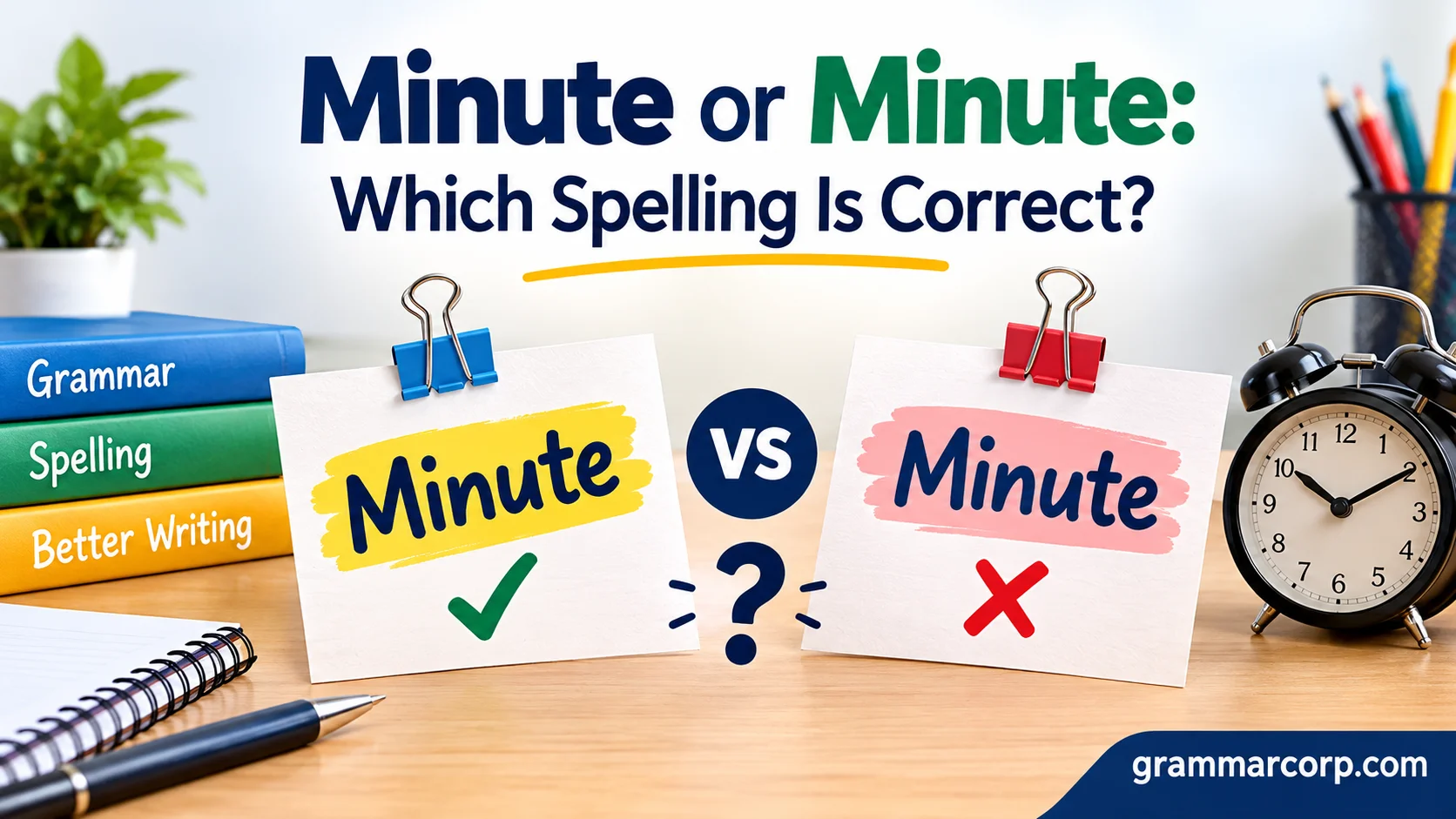
Minute or Minute: Which Spelling Is Correct? explains why one spelling has two pronunciations, meanings, and uses in everyday English sentences. Minute is an English word whose spelling remains the same even though its pronunciation and meaning can change. As a noun, minute, pronounced MIN-it, means a unit of time equal to 60 seconds, or one-sixtieth of an hour. As an adjective, minute, pronounced my-NOOT, means extremely small, tiny, or very small, often describing something of small size or insignificant detail. Cambridge recognizes these meanings, and both are part of standard English spelling.
The two forms have different pronunciations, but the spelling stays same, which makes this word an interesting example of the quirks of the English language. If you have wondered how to pronounce it, a simple phonetic attempt is MIN-it for the time unit and my-NOOT for something very small. For example, “The meeting lasted five minutes” clearly refers to time, while “a minute detail” describes something tiny. Learning these sounds, pronunciations, and uses helps you write, say, and pronounce the correct word in real sentences and avoid a common mix-up.
In academic writing, edited writing, professional writing, emails, messages, school assignments, and work documents, understanding the correct pronunciation can make your communication clearer. You can write minute correctly in both cases, but you must pronounce it according to the intended meaning. An incorrect pronunciation may confuse listeners or change the sentence meaning, especially in everyday conversation. A useful guide is to remember that MIN-it relates to sixty seconds, while my-NOOT describes something extremely small.
Quick Answer
Minute is the correct spelling. Minoot is not the standard spelling.
The confusion comes from the fact that minute has two common pronunciations:
- MIN-it — a unit of time equal to 60 seconds.
- my-NOOT — extremely small or very slight.
For example:
- Wait one minute. → MIN-it
- The scientist noticed a minute change. → my-NOOT
The spelling doesn’t change when the meaning changes.
| Spelling | Pronunciation | Meaning | Correct? |
| minute | MIN-it | 60 seconds | Yes |
| minute | my-NOOT | Extremely small | Yes |
| minoot | my-NOOT | Phonetic spelling of minute | No, not standard |
Cambridge gives the noun pronunciation as /ˈmɪn.ɪt/ in both British and American English. For the adjective meaning extremely small, it gives /maɪˈnjuːt/ in British English and /maɪˈnuːt/ in American English.
That difference explains almost the entire minute or minute spelling problem.
Comparison Overview
The easiest way to understand the difference is to compare the words by spelling, pronunciation, grammar, and meaning.
| Feature | Minute | Minoot |
| Standard English spelling | Yes | No |
| Used for 60 seconds | Yes | No |
| Used to mean extremely small | Yes | No |
| Standard dictionary spelling | Minute | Not the standard form |
| Common pronunciation | MIN-it or my-NOOT | Usually intended to imitate my-NOOT |
| Appropriate in formal writing | Yes | No |
| Used as an adjective | Yes | No |
| Used as a noun | Yes | No |
| Main source of confusion | Two pronunciations | Phonetic spelling |
The important point is simple: there aren’t two spellings for the two meanings.
There is one standard spelling: minute.
The pronunciation changes according to the meaning.
Cambridge defines minute as a time unit consisting of 60 seconds. It also defines the adjective minute as meaning extremely small and gives examples such as minute detail.
Main Differences Between Minute and Minute
The biggest difference is that minute is the standard English word, while minoot usually represents the way someone thinks minute sounds when it means very small.
Minute Is the Correct Spelling
Use minute whenever you’re writing about either of the two common meanings.
For time:
Please wait one minute.
For something extremely small:
The researcher observed a minute difference.
Notice that the spelling remains identical.
The pronunciation changes, but the written form doesn’t.
Minoot Is a Phonetic Spelling
When people hear my-NOOT, they may naturally try to write what they hear.
That can produce minoot.
This makes the spelling understandable. However, understandable does not mean standard.
English contains many words whose spelling doesn’t perfectly match their pronunciation. If you tried to spell every word exactly as it sounds, written English would become inconsistent very quickly.
Minoot is therefore best understood as a phonetic guess, not as the standard spelling of a separate word.
Minute Has More Than One Grammatical Use
Minute can function as a noun, adjective, and verb.
As a noun, it can refer to a unit of time:
The class lasted forty minutes.
As an adjective, it can describe something extremely small:
The instrument can detect minute changes.
It can also appear as a verb related to recording what happens during a meeting:
The secretary was asked to minute the discussion.
Cambridge includes the noun, adjective, and verb uses of minute in its dictionary entries.
That range makes minute more complicated than its simple spelling suggests.
What Does Minute Mean?
The word minute has several established meanings. Two are especially important when discussing minoot or minute.
Minute Means 60 Seconds
The most familiar meaning is a unit of time.
One minute contains 60 seconds, while one hour contains 60 minutes.
You encounter this meaning constantly:
- Give me one minute.
- The movie starts in five minutes.
- The meeting lasted thirty minutes.
- The timer has one minute left.
- The bus should arrive in ten minutes.
In these sentences, minute is pronounced MIN-it.
Cambridge defines this use as one of the 60 parts into which an hour is divided.
Minute Can Mean a Very Short Time
English also uses minute more loosely to mean a short period.
For example:
I’ll be there in a minute.
The speaker doesn’t necessarily mean exactly 60 seconds.
Instead, the phrase usually means very soon or after a short amount of time.
Common expressions include:
- Wait a minute
- Just a minute
- In a minute
- At the last minute
- At any minute
- The minute that…
Cambridge also records this broader use of minute to mean a very short period of time.
Minute Means Extremely Small
This is the meaning that causes the minoot or minute confusion.
When minute means extremely small, it is pronounced my-NOOT.
For example:
The scientist detected a minute change in temperature.
Here, minute doesn’t refer to time.
It means the change was extremely small.
Other examples include:
- a minute amount
- a minute particle
- a minute difference
- a minute detail
- a minute variation
- a minute crack
Cambridge defines this adjective as extremely small and also uses minute detail to describe close attention to very small details.
How Do You Pronounce Minute?
Pronunciation is the heart of the minute or minute confusion.
The spelling stays the same, but the pronunciation changes with the meaning.
Minute Pronounced MIN-it
When minute means a unit of time, pronounce it:
MIN-it
The dictionary pronunciation is /ˈmɪn.ɪt/.
Examples:
- one minute
- ten minutes
- five-minute break
- last minute
- a few minutes
Try these sentences:
I’ll call you in a minute.
The train leaves in three minutes.
We only have five minutes left.
Each use refers to time, so the pronunciation is MIN-it.
Minute Pronounced my-NOOT
When minute means extremely small, pronounce it:
my-NOOT
Cambridge records /maɪˈnuːt/ for American English and /maɪˈnjuːt/ for British English.
Examples:
- minute details
- minute particles
- minute quantities
- minute differences
- minute changes
For example:
The report examined the issue in minute detail.
Here, minute means very detailed or concerned with very small details.
Pronunciation Comparison
| Meaning | Pronunciation | Example |
| 60 seconds | MIN-it | Wait one minute. |
| Short period | MIN-it | I’ll be there in a minute. |
| Extremely small | my-NOOT | We found a minute crack. |
| Very detailed | my-NOOT | She examined the document in minute detail. |
This is why someone may hear my-NOOT and assume the word must be spelled minoot.
It isn’t.
The sound changes. The spelling does not.
Why Do People Spell Minute as Minoot?
The mistake is easy to understand once you focus on pronunciation.
People Often Spell Words the Way They Hear Them
When someone encounters an unfamiliar word through speech, they may try to reproduce its sound on paper.
If they hear:
my-NOOT
they may reasonably guess:
minoot
That guess follows the sound more closely than the traditional spelling does.
However, English spelling isn’t a simple sound-to-letter system. Many English words contain spellings that learners cannot predict from pronunciation alone.
The Two Pronunciations Create a Strong Contrast
Most people learn minute as a time word at a young age.
They hear:
one minute
and learn the pronunciation MIN-it.
Later, they may encounter:
minute details
and suddenly hear my-NOOT.
Because the two pronunciations sound so different, the connection between them isn’t immediately obvious.
The reader may think they have encountered a completely different word.
The Spelling Looks Unusual for the Second Pronunciation
The spelling minute doesn’t visually suggest the sound my-NOOT to many English learners.
That’s another reason Minoot seems plausible.
Someone who has only heard the adjective may have no obvious reason to know that its spelling is minute.
This is especially common when someone learns English primarily through conversation rather than extensive reading.
Pronunciation Does Not Determine Standard Spelling
This is an important lesson beyond this particular word.
A word can sound one way while having a spelling that looks unexpected.
For example, English contains many words whose pronunciation cannot be predicted perfectly from their letters.
So when you encounter an unfamiliar word, checking its established spelling is safer than creating a phonetic spelling yourself.
Minute Examples in Sentences
Seeing the word in context makes the distinction much easier.
Examples of Minute Meaning 60 Seconds
Here are natural examples:
- Please wait one minute.
- The presentation begins in ten minutes.
- We arrived a few minutes early.
- The timer has two minutes remaining.
- She spoke for five minutes.
- The repair took about twenty minutes.
- They reached the station at the last minute.
In every example, minute is pronounced MIN-it.
Examples of Minute Meaning Extremely Small
Now look at the adjective:
- The scientist noticed a minute change in pressure.
- There was a minute crack in the glass.
- The microscope revealed minute particles.
- The report included minute details about the experiment.
- The difference between the samples was minute.
- The instrument measures minute variations.
- The artist paid attention to every minute detail.
In these sentences, minute is pronounced my-NOOT.
Side-by-Side Examples
| Sentence | Meaning | Pronunciation |
| Give me a minute. | A short period | MIN-it |
| The meeting lasted an hour and ten minutes. | 60-second unit | MIN-it |
| We found a minute crack. | Extremely small | my-NOOT |
| She recorded every minute detail. | Extremely detailed | my-NOOT |
| The test takes ten minutes. | Time | MIN-it |
| The machine detected a minute variation. | Very small | my-NOOT |
This side-by-side comparison is the easiest way to remember the distinction.
Read More : Roll Call or Role Call: Which Is Correct?
Minoot or Minute in Formal Writing
If you’re writing an essay, report, email, article, assignment, or professional document, use minute.
Don’t replace it with minoot simply because the adjective sounds like my-NOOT.
Correct
The researchers observed a minute difference between the two samples.
Incorrect Standard Spelling
The researchers observed a minoot difference between the two samples.
The first sentence uses the established spelling.
The second tries to spell the pronunciation rather than the actual word.
The same rule applies regardless of whether you’re writing about science, business, school, journalism, or everyday communication.
Common Mistakes With Minute and Minute
The most useful way to avoid this problem is to recognize the mistakes before they happen.
Mistake: Writing Minute for Something Tiny
This is the most common issue.
If you mean extremely small, write:
minute
Not:
minoot
For example:
The scientist observed a minute particle.
The pronunciation is my-NOOT, but the spelling remains minute.
Mistake: Pronouncing Every Minute as MIN-it
The opposite mistake can happen too.
If you’re reading:
minute details
you shouldn’t use the time-related pronunciation.
The correct pronunciation is my-NOOT.
Context tells you which pronunciation belongs to the sentence.
Mistake: Assuming Two Pronunciations Require Two Spellings
They don’t.
English has words that change pronunciation according to meaning or grammatical use.
In this case:
minute → MIN-it for time
minute → my-NOOT for something extremely small
The written form remains unchanged.
Mistake: Confusing Minute With Minuet
Another word that can cause confusion is minuet.
A minuet is a type of dance and also refers to a musical form associated with that dance.
It is not an alternative spelling of minute.
Compare them:
| Word | Meaning |
| minute | 60 seconds or extremely small |
| minuet | A dance or musical form |
| minoot | Nonstandard phonetic spelling of minute |
These words may sound confusing in some contexts, but their meanings and spellings are different.
Is Minoot a Real Word?
In the context of the minoot or minute spelling question, minoot is not the standard English spelling for either common meaning of minute.
The standard word is minute.
You might still encounter minoot online. Someone could use it as a phonetic spelling, a playful spelling, a username, a name, or some other informal label.
Those uses don’t make it the standard spelling of the English word minute.
This distinction matters because words can appear online in many forms that aren’t accepted standard spellings.
If you’re writing for school, work, publication, or any situation where standard English matters, choose minute.
How to Remember the Correct Spelling of Minute
You don’t need a complicated memory trick.
Use the meaning to identify the pronunciation while remembering that the spelling never changes.
If It Means Time
Think:
Minute = MIN-it = 60 seconds
Example:
I’ll be ready in one minute.
If It Means Tiny
Think:
Minute = my-NOOT = extremely small
Example:
The microscope detected a minute particle.
One Simple Rule
Different sound. Same spelling.
That’s the key.
You don’t need to write minoot just because the word sounds like my-NOOT.
Practice the Difference
Fill in each blank with the correct spelling:
- I’ll call you in one ___.
- The scientist detected a ___ change.
- The meeting lasted thirty ___.
- The report examined the issue in ___ detail.
- Please wait a ___.
- The machine measured a ___ variation.
Answers
Every answer is spelled:
minute
What changes is the pronunciation and meaning.
- I’ll call you in one minute. → MIN-it
- The scientist detected a minute change. → my-NOOT
- The meeting lasted thirty minutes. → MIN-its
- The report examined the issue in minute detail. → my-NOOT
- Please wait a minute. → MIN-it
- The machine measured a minute variation. → my-NOOT
Minute as a Noun, Adjective, and Verb
Understanding the grammar also helps explain why the same spelling appears in different contexts.
Minute as a Noun
As a noun, minute commonly refers to time.
The lesson lasted forty minutes.
It can also refer to a short period:
Give me a minute.
And minutes can refer to an official written record of a meeting:
The secretary distributed the meeting minutes.
Cambridge lists this meeting-record meaning separately from the time meaning.
Minute as an Adjective
As an adjective, minute can mean extremely small.
A minute amount of dust remained on the surface.
It can also describe something examined or presented in very fine detail:
The investigator provided a minute description of the scene.
Cambridge’s learner dictionary specifically includes the senses extremely small and done in great detail.
Minute as a Verb
The verb minute relates to making a written record of what was said or decided during a meeting.
For example:
The secretary was asked to minute the discussion.
This use is less common in everyday American conversation, but it appears in formal and organizational contexts.
The pronunciation here follows the MIN-it form rather than the adjective’s my-NOOT pronunciation.
Why Context Matters When You Hear Minute
If someone says minute without showing you the written word, you may need context to understand which meaning they intend.
Consider this sentence:
I need a minute.
The meaning is clearly related to time.
Now consider:
There was a minute difference between the samples.
Here, the word means extremely small.
The surrounding words tell you what the speaker means.
This is why pronunciation alone isn’t always enough. Context completes the meaning.
A Practical Minoot vs. Minute Cheat Sheet
Keep this simple reference in mind:
| If you mean… | Write | Say |
| 60 seconds | minute | MIN-it |
| A short amount of time | minute | MIN-it |
| Extremely small | minute | my-NOOT |
| Very detailed | minute | my-NOOT |
| Meeting records | minutes | MIN-its |
| A phonetic spelling of the tiny meaning | minoot | Avoid it in standard writing |
The biggest takeaway is that minoot isn’t the standard spelling you should substitute for minute.
FAQs
1. Is “minute” spelled the same for both meanings?
Yes. Minute has the same spelling whether it means a unit of time or something extremely small.
2. How do you pronounce “minute” meaning 60 seconds?
When minute means a unit of time, it is pronounced MIN-it.
3. How do you pronounce “minute” meaning very small?
When minute means extremely small or tiny, it is pronounced my-NOOT.
4. Why does “minute” have two pronunciations?
English has many words whose spelling stays the same while their pronunciation and meaning differ. Minute is one example of this feature of English.
5. Is “minute” correct in both meanings?
Yes. Both meanings and pronunciations are correct. The context tells you whether minute means 60 seconds or something very small.
Conclusion
Minute is a fascinating English word because its spelling remains unchanged while its pronunciation and meaning can differ. Use MIN-it when referring to a unit of time and my-NOOT when describing something extremely small.
Learning this simple distinction can help you pronounce and use the word correctly in conversation and writing.










1 thought on “Minute or Minute: Which Spelling Is Correct?”