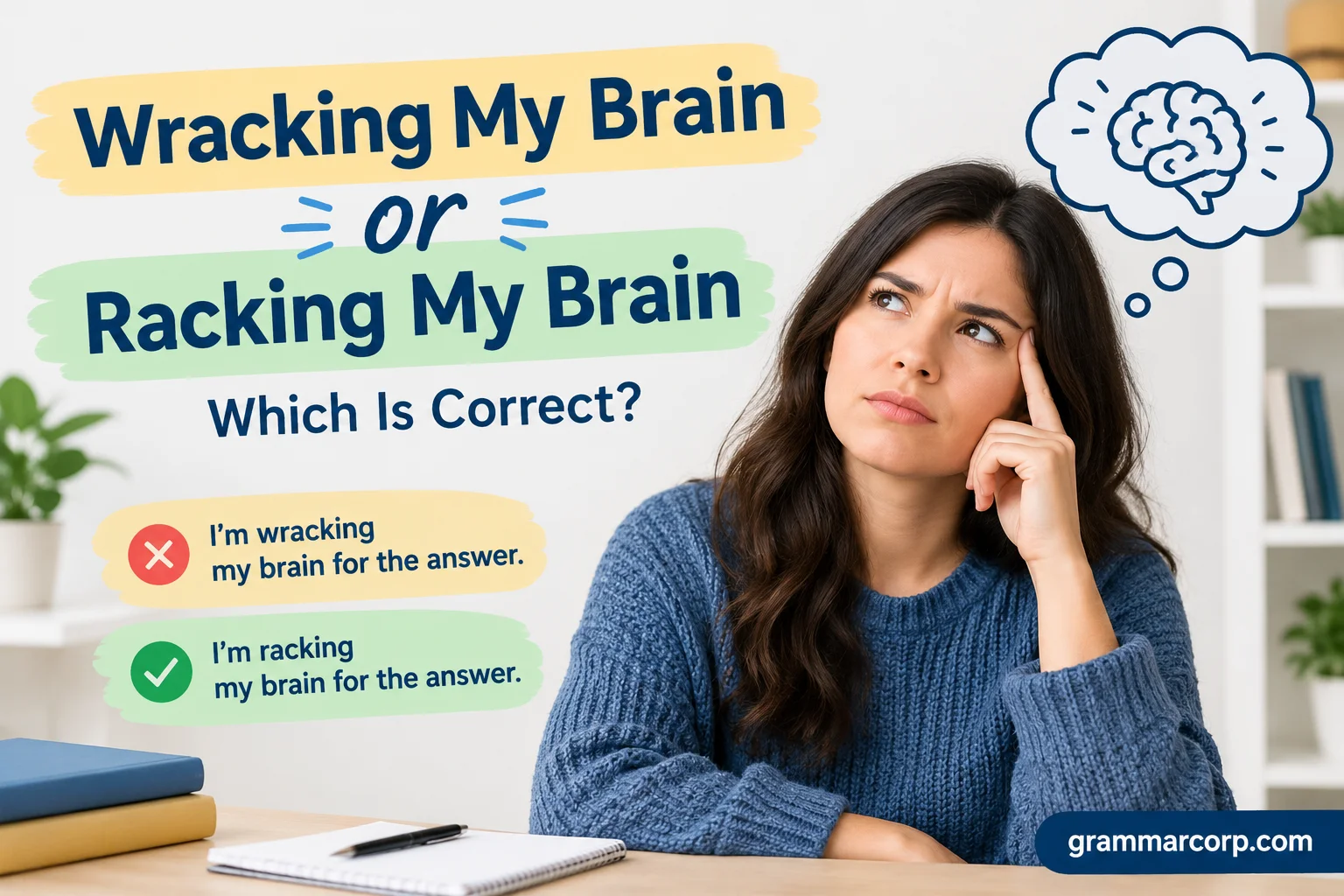
Wracking My Brain or Racking My Brain: Which Is Correct? Learn why “racking my brain” remains the preferred phrase in American English writing.
Have you ever stopped while writing and wondered whether to use “wracking my brain” or “racking my brain”? You’re not alone because English has a vast vocabulary, sneaky exceptions, and commonly confused words that can challenge even a diligent learner. The correct phrase, “racking my brain,” describes thinking very hard, trying to remember something, or working to solve a tricky problem and find the answer.
The word rack can suggest causing pain or distress, which helps describe straining your mind and putting a lot of effort into thinking or remembering something. In contrast, wrack relates to ruin and destruction, which may not fit the intended meaning of this same idiom. Although both spellings appear in modern English, “racking my brain” remains the traditional form and safest choice for standard American English writing. The alternative has gained acceptance in some dictionaries and everyday usage, so understanding the difference between rack and wrack, the history and origin of the phrase, and common examples can help you choose the right expression for emails, school assignments, articles, formal writing, and everyday conversations.
This grammar guide also highlights common mistakes, spelling confusion, and how language evolves while some expressions stick and others fade into obscurity. Resources such as Twominenglish discuss similar word questions, including “believe or beleive” and “alot vs. a lot,” reminding writers that correctness matters when they want to communicate an idea clearly. Whether the phrase sounds intense or you feel your mind is working overtime, use “racking my brain” to describe the effort of thinking through a question or recalling an important detail.
Quick Answer
“Racking my brain” is the traditional and preferred expression in American English. It means thinking very hard to remember something, solve a problem, or find an answer.
“Wracking my brain” is also used with the same meaning and is recognized as a variant by some dictionaries. However, if you want to follow traditional usage, choose racking my brain.
Here are two examples:
- Correct and preferred: I’m racking my brain to remember where I parked my car.
- Recognized variant: I’m wracking my brain to remember where I parked my car.
The first version is the better choice when you’re unsure which spelling to use. The past tense follows the same pattern: racked my brain is the traditional form.
Comparison Overview
Although racking my brain and wracking my brain look different, they usually communicate the same idea. The main distinction involves traditional spelling, word history, and editorial preference rather than meaning.
| Feature | Racking My Brain | Wracking My Brain |
| Meaning | Thinking very hard to remember or solve something | The same meaning in common usage |
| Traditional status | Established, traditional form | Alternative spelling |
| American English | Preferred choice | Used, but less traditional |
| British English | Commonly used, often with brains | Occasionally used as a variant |
| Verb form | Racking, racked | Wracking, wracked |
| Best choice for formal writing | Yes | Usually choose racking instead |
| Example | I’m racking my brain for an answer. | I’m wracking my brain for an answer. |
The distinction becomes clearer when you consider the origins of the two words. Rack has a historical connection to stretching and straining, which fits the image of someone struggling to remember something. Wrack is associated with ruin and destruction, although the words have overlapped in English usage over time.
For everyday American English, you don’t need to overthink the choice. Use racking my brain unless you’re deliberately following a source or style guide that accepts the alternative.
Main Differences Between Wracking My Brain or Racking My Brain
The difference between these expressions comes down to three things: their traditional forms, their historical associations, and how writers use them today.
1. Traditional spelling and usage
Racking my brain is the established form found in standard dictionary entries for the idiom. Cambridge Dictionary defines rack your brain as thinking very hard, while Collins Dictionary explains that it involves straining mentally to remember something or find a solution.For example:
- I’m racking my brain to remember the password.
- She racked her brain for a suitable answer.
- We’ve been racking our brains over the assignment.
In each sentence, rack describes the effort involved in thinking. The expression doesn’t suggest that someone is physically damaging their brain. It’s a figurative way to describe intense mental effort.
2. Meaning and modern usage
Wracking my brain appears in contemporary writing and is understood to mean the same thing. Some dictionaries acknowledge wrack as an alternative in this expression, even though rack remains the traditional choice.
This overlap isn’t unusual in English. Words with different historical backgrounds sometimes develop similar meanings or spellings through repeated use. Once a variation becomes familiar, readers may understand it even when traditional usage guides prefer another form.
Consider these examples:
- I’m wracking my brain to remember the name of that restaurant.
- He was wracking his brain for a fresh idea.
Most readers will understand both sentences. However, if you’re editing an article, preparing a professional email, or writing for an American audience, racking my brain is the more dependable option.
3. The connection between rack and wrack
The words rack and wrack have different historical associations, but their meanings have sometimes overlapped. In the idiom about thinking hard, rack is traditionally connected with strain and torment.
The word wrack, meanwhile, is associated with ruin or destruction. That association helps explain why some writers choose wracking my brain: they may imagine their thoughts being overwhelmed or their mind being figuratively wrecked.
The spelling is understandable, but the traditional idiom doesn’t require that interpretation. Its established form is rack your brain.
The following examples show the difference in emphasis:
| Expression | Example | Explanation |
| Rack your brain | I racked my brain for an answer. | I made a strong mental effort. |
| Wrack and ruin | The abandoned building fell into wrack and ruin. | The phrase refers to decay or destruction. |
| Wrack your brain | I wracked my brain for an answer. | A recognized alternative spelling of the idiom. |
The important point is that wrack isn’t automatically wrong in every context. English usage is more complicated than a simple rule that one spelling always works and the other never does.
What Does “Racking My Brain” Mean?
Racking my brain means thinking very hard to remember information, solve a problem, or come up with an idea. The phrase often suggests that the mental effort feels difficult or frustrating.
Imagine that someone asks you about a movie you watched years ago. You remember the plot, the actors, and even the ending, but the title escapes you. You might say, “I’m racking my brain, but I can’t remember the name.”
The expression is especially useful when ordinary thinking doesn’t seem to produce an answer.
Common situations where you can use it
Trying to remember something
You might rack your brain when you’re searching for a forgotten name, date, location, or detail.
Example: “I’m racking my brain to remember where I put the spare key.”
Solving a difficult problem
The phrase also works when you need to find a solution that isn’t immediately obvious.
Example: “The team spent the afternoon racking their brains over the technical problem.”
Finding the right words
Writers, students, and speakers sometimes struggle to express an idea clearly.
Example: “I was racking my brain for a better way to explain the concept.”
Coming up with a creative idea
When a project requires an original approach, the idiom can describe the search for inspiration.
Example: “She’s racking her brain for a memorable title for the school newsletter.”
In all these situations, the expression highlights effort rather than the final result. You can rack your brain for hours without finding the answer.
Is “racking my brain” always about memory?
No. Although remembering something is a common use, the expression also applies to problem-solving and creative thinking.
For example, a business owner might rack their brain to find a practical way to improve customer service. A student might rack their brain to understand a difficult math problem. Neither person is necessarily trying to recall a forgotten fact.
The common thread is sustained mental effort.
What Does “Wracking My Brain” Mean?
In modern usage, wracking my brain generally means the same thing as racking my brain: struggling to remember, understand, or solve something.
The spelling likely appeals to writers because wrack is associated with destruction or ruin. Someone who thinks intensely might imagine their mind being figuratively exhausted or overwhelmed.
However, that association doesn’t make wracking the traditional spelling of the idiom.
Collins Dictionary specifically notes that the older spelling wrack is occasionally used instead of rack in the expression rack your brains. This supports a careful distinction: the variant exists, but the traditional form remains well established.
Examples of “wracking my brain”
- “I’m wracking my brain to remember the name of the book.”
- “She was wracking her brain for a way to solve the puzzle.”
- “We’ve been wracking our brains to plan a more effective presentation.”
These sentences communicate the intended meaning clearly. Nevertheless, an editor who follows traditional spelling conventions may change wracking to racking.
Should you use “wracking my brain” in formal writing?
You can encounter the variant in published and informal writing, but racking my brain is the safer editorial choice.
For example, suppose you’re writing a college essay, a workplace report, or an article for an American audience. Choosing the traditional form avoids an unnecessary spelling debate and keeps the sentence aligned with established dictionary usage.
That doesn’t mean every instance of wracking should be treated as an error. Context matters, and dictionaries don’t always draw the same boundaries between traditional forms and accepted variants.
The practical rule is straightforward: recognize both forms, but use racking my brain when you want the conventional choice.
Why Is It “Racking My Brain” Instead of “Wracking My Brain”?
The history of the word rack explains why the traditional expression uses this spelling. The idiom draws on the idea of stretching or straining something under pressure.
The historical origin of “rack your brain”
The word rack has historical roots connected to stretching. One older meaning refers to a rack used to stretch a person’s body as a form of torture. Over time, the verb developed figurative uses associated with causing severe physical or mental strain.
The idiom rack one’s brains emerged from this association. It describes the mental strain involved in trying hard to remember something or find a solution.
Dictionary.com traces the expression to the older phrase rack one’s wit, recorded in the 16th century. Its explanation connects the idiom with the historical instrument of torture and the figurative idea of forcing the mind to work under strain. See Dictionary.com’s explanation of the idiom.
Today, the expression is entirely figurative. When you say you’re racking your brain, you’re describing a difficult thinking process, not a physical action.
How “wrack” became associated with the expression
The word wrack has a separate historical connection with shipwreck and destruction. It later overlapped with rack in some expressions involving ruin, suffering, and distress.
That overlap helps explain spellings such as wracking my brain and nerve-wracking. Writers sometimes associate the experience of intense thinking with mental exhaustion or distress.
Merriam-Webster notes that wrack has long appeared as a variant of rack in some contexts. Its usage guidance also explains why many traditional style recommendations favor rack in the brain-related idiom. Merriam-Webster’s usage discussion provides further detail.
The history is interesting, but you don’t need to memorize every historical development to write the phrase correctly.
Remember this simple rule: the traditional expression is rack your brain, so the usual forms are racking my brain and racked my brain.
Racking My Brain vs. Racking My Brains
Should you write racking my brain or racking my brains? Both forms are used, and the preference often depends on the variety of English.
Cambridge Dictionary identifies rack your brain as the American English form and rack your brains as the British English form. Cambridge’s entry for the idiom explains this regional distinction.
| Form | Regional preference | Example |
| Racking my brain | American English | I’m racking my brain for the answer. |
| Racking my brains | British English | I’m racking my brains for the answer. |
| Racked my brain | American English past tense | I racked my brain all afternoon. |
| Racked my brains | British English past tense | She racked her brains for a solution. |
These are tendencies, not rigid rules that every speaker follows. You’ll encounter both singular and plural forms in different regions and publications.
If you’re writing for an American audience, racking my brain is the natural default. If you’re following British English conventions, racking my brains is equally appropriate.
The important thing is to maintain consistency within your writing rather than switching between forms without a reason.
Examples of “Racking My Brain” in Sentences
Examples make it easier to understand how this idiom works in everyday communication. Notice how the phrase fits different situations while retaining the same central meaning.
Examples involving memory
- “I’m racking my brain to remember the name of our new neighbor.”
- “She racked her brain trying to recall where she had parked.”
- “I’ve been racking my brain all morning, but I still can’t remember the date.”
Each sentence describes someone trying hard to retrieve information from memory.
Examples involving problem-solving
- “The engineers racked their brains to find a solution to the problem.”
- “I’m racking my brain to figure out why the program keeps crashing.”
- “We racked our brains for hours before discovering the missing step.”
Here, the idiom emphasizes the effort involved in finding an answer rather than remembering a fact.
Examples involving writing and creativity
- “The author was racking her brain for a stronger opening sentence.”
- “I’m racking my brain for an original idea for the school magazine.”
- “He racked his brain to find a title that captured the story’s central theme.”
These examples show that the expression works well when someone is searching for words, ideas, or creative solutions.
Examples in workplace conversations
- “I’ve been racking my brain for a better way to organize the project.”
- “Our manager racked her brain to find a solution that worked for everyone.”
- “We’re racking our brains to understand why the sales figures changed.”
The idiom is suitable for everyday workplace conversations. In a formal report, however, you might choose a more precise phrase such as examined several possible solutions.
A short case study: Choosing the right spelling
Imagine that an editor is reviewing this sentence:
“I’ve been wracking my brain to remember the client’s name.”
The sentence communicates the intended meaning, so the reader will probably understand it without difficulty. However, the editor wants to follow traditional American English usage.
The editor revises it to:
“I’ve been racking my brain to remember the client’s name.”
The change preserves the meaning while using the established form of the idiom. This is a practical example of why recognizing a variant and choosing a preferred spelling aren’t necessarily the same thing.
Read More : Better Understand or Understand Better: Which Is Correct?
Common Mistakes to Avoid
Even a familiar expression can cause confusion when two spellings look plausible. These are the most common mistakes to watch for.
Mistake 1: Assuming “wracking my brain” is the only correct form
The traditional spelling is racking my brain. Although wracking my brain appears in modern usage, it isn’t the original form of the idiom.
Better choice: “I’m racking my brain for an answer.”
Mistake 2: Assuming “wrack” is always wrong
This is also too simplistic. The words rack and wrack overlap in some English expressions, and dictionaries acknowledge that overlap.
For example, wrack and ruin is an established expression referring to destruction. The spelling distinction depends on the particular word or phrase.
Mistake 3: Writing “wracked my brain” when you mean the traditional idiom
The standard past-tense form is racked my brain.
- Preferred: “I racked my brain for a solution.”
- Alternative: “I wracked my brain for a solution.”
The second version is understandable, but the first follows traditional usage.
Mistake 4: Confusing “rack your brain” with “rack up”
These expressions have different meanings.
- Rack your brain: Think hard about something.
- Rack up: Accumulate or achieve something.
For example, “I racked my brain for an answer” describes mental effort, while “She racked up three wins” describes accumulating victories.
Mistake 5: Thinking the idiom only applies to memory
You can use rack your brain when solving a problem, developing an idea, or trying to understand something complicated.
For example, “The team racked their brains to improve the design” describes problem-solving rather than remembering information.
Synonyms for “Racking My Brain”
Sometimes a synonym communicates your meaning more clearly or helps you avoid repeating the same idiom. The best alternative depends on whether you’re remembering something, considering a decision, or solving a problem.
| Synonym or alternative | Meaning | Example |
| Thinking hard | Making a strong mental effort | I’m thinking hard about the answer. |
| Searching my memory | Trying to recall information | I’m searching my memory for her name. |
| Pondering | Considering something carefully | She’s pondering the best way to respond. |
| Mulling it over | Thinking about something before deciding | I’m mulling it over before making a choice. |
| Trying to figure it out | Working toward an explanation or solution | We’re trying to figure out what went wrong. |
| Giving it serious thought | Considering something carefully | He’s giving the proposal serious thought. |
| Wracking my brain | An alternative form of the original idiom | I’m wracking my brain for a solution. |
These alternatives aren’t always interchangeable. Searching my memory specifically suggests recall, while pondering often describes careful consideration. Trying to figure it out works particularly well when you’re solving a problem.
Choose the expression that matches the situation instead of relying on one phrase for every kind of thinking.
FAQs:
1. Is it “racking my brain” or “wracking my brain”?
“Racking my brain” is the traditional and preferred expression. It means thinking very hard to remember something, solve a problem, or find an answer. Although “wracking my brain” also appears in modern usage, “racking my brain” is the safer choice in standard American English.
2. What does “racking my brain” mean?
“Racking my brain” means making a strong mental effort to remember information or work through a difficult question. For example, “I was racking my brain to remember where I had left my keys.”
3. What is the difference between “rack” and “wrack”?
Rack can mean to cause pain, distress, or strain. Wrack is associated with ruin, destruction, or severe damage. Since the idiom describes intense thinking, “racking my brain” is the conventional spelling.
4. Is “wracking my brain” grammatically incorrect?
“Wracking my brain” is used by some English speakers and appears in modern dictionaries and writing. However, “racking my brain” remains the more traditional and widely recommended form. To avoid confusion, especially in formal writing, choose “racking my brain.”
5. Can I use “racking my brain” in formal writing?
Yes. “Racking my brain” is appropriate for formal and informal writing, including emails, articles, school assignments, and everyday conversations. For example, “The researcher was racking her brain to find a solution to the problem.”
Conclusion:
Both “racking my brain” and “wracking my brain” appear in modern English, but “racking my brain” is the traditional and preferred choice. Use it when describing the effort of remembering something, solving a problem, or thinking deeply about a difficult question. Choosing this familiar expression helps keep your writing clear and consistent, particularly in standard American English.













1 thought on “Wracking My Brain or Racking My Brain: Which Is Correct?”