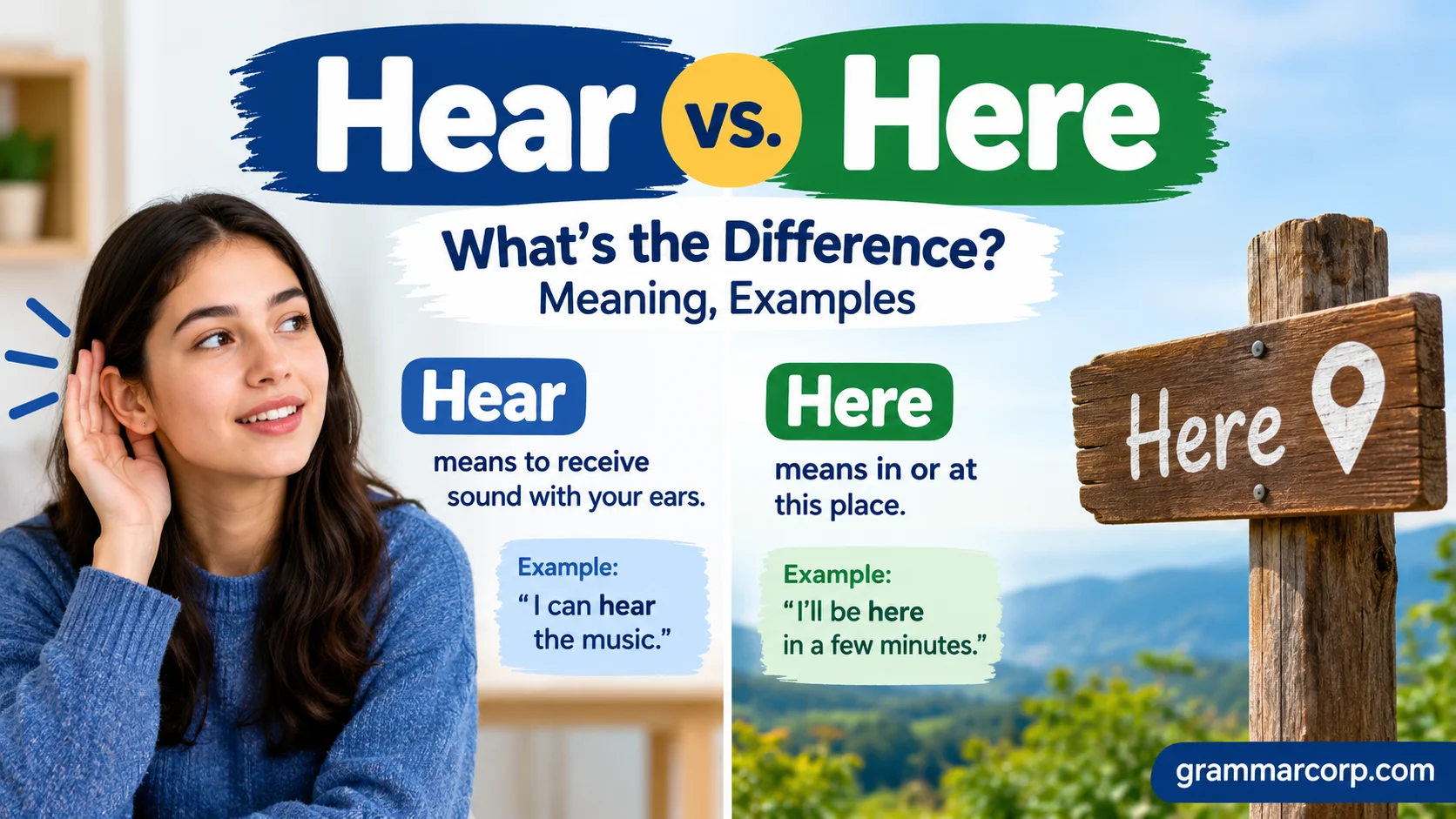
Hear vs. Here: What’s the Difference? Meaning, Examples explains how these homophones differ in meaning, spelling, grammar, and use.
Have you ever hesitated while writing a sentence because you weren’t sure whether to use hear or here? These words have the same sound in standard American English, but their meanings and grammatical uses differ. Hear is a verb related to listening, sound, and receiving information, while here commonly acts as an adverb that refers to a location, a specific place, or a particular point in a discussion.
The best way to remember the difference is to connect each word with its purpose. For example, “I can hear my friend talking” describes listening, while “My friend is here” identifies a location. These practical examples demonstrate how contextual meaning, word choice, and sentence structure affect correct usage.
You might also hear someone say, “I hear you,” to show understanding, or “Come here,” to direct someone toward a specific location. Learning these common expressions, grammar rules, and usage rules can improve your English grammar, English vocabulary, word identification, and overall language understanding. It also helps reduce homophone confusion and avoid spelling mistakes in everyday writing.
Quick Answer
Hear is a verb that means to perceive sound or receive information. Here usually refers to a place, position, or point in a discussion.
- Hear: I can hear the birds singing outside.
- Here: The birds are here in the garden.
Both words have the same pronunciation in standard American English, but their meanings are different. Use hear when talking about sound or receiving information. Choose here when referring to a location or indicating a particular point.
A simple memory trick can help: hear contains the word ear, which connects it to sound. Meanwhile, here points to a place, such as where you are standing.
Comparison Overview
Although hear and here sound alike, they serve different purposes in English. One describes hearing or receiving information, while the other identifies a place or directs attention to a particular point. Understanding this distinction helps you choose the correct word without relying on guesswork.
| Feature | Hear | Here |
| Part of speech | Verb | Primarily an adverb; also used as an interjection |
| Main meaning | To perceive sound or receive information | In, at, or to this place |
| Other uses | To listen to someone or consider information | To introduce something or draw attention |
| Pronunciation in US English | /hɪr/ | /hɪr/ |
| Present form | Hear or hears | Does not have verb forms |
| Past form | Heard | Does not have verb forms |
| Related expression | Hear from someone | Come here |
| Example | I can hear the rain. | The rain is falling here. |
The main difference is grammatical as well as semantic. Hear describes an action or experience, whereas here usually identifies a location or point of reference. The Cambridge Dictionary’s definition of hear confirms its uses for perceiving sounds and receiving information.
Consider these two sentences:
- “I can hear the teacher.” This sentence describes the ability to perceive the teacher’s voice.
- “I am here with the teacher.” This sentence identifies the speaker’s location.
The pronunciation doesn’t help you distinguish these words when speaking. Instead, their meanings and roles in the sentence provide the answer.
Main Differences Between Hear and Here
The easiest way to understand hear vs. here is to examine how each word works in different situations. Their spelling differs by just one letter, but their meanings lead to entirely different sentences.
Hear vs. Here: Meaning and Definition
Hear means to perceive a sound with your ears. It can also mean to receive information, learn about an event, or listen to someone speak. You can hear a bell, hear a friend’s voice, or hear that a meeting has been canceled.
Examples:
- I can hear someone knocking on the door.
- Did you hear the announcement this morning?
- We were happy to hear that you passed your exam.
- The audience came to hear the speaker explain the subject.
Notice that hear doesn’t always refer to sound alone. In “I heard that the store was closing,” the word means that the speaker received information.
Here, on the other hand, usually means in, at, or to the place where someone is or where something is happening. It can also point to a particular part of a conversation, document, or explanation.
Examples:
- Please wait here until I return.
- Your notebook is here on the desk.
- Here is the information you requested.
- Here, we need to examine the next step.
The meaning becomes clear when you look at the context. If the sentence concerns sound or information received, hear may be appropriate. If it points to a place or introduces a point, here is usually the better choice.
Hear vs. Here: Differences in Parts of Speech
Grammar provides another useful way to separate these words.
Hear is a verb. It expresses an action, experience, or state related to perceiving sounds or receiving information. It changes form according to tense and subject.
- I hear the music.
- She hears the music.
- We heard the music yesterday.
- They are hearing the announcement now.
Here is primarily an adverb. It identifies a place or position, often in relation to the speaker. Unlike a verb, it doesn’t change form to show past or present tense.
- Stay here.
- We live here.
- Come here after class.
- Your answer starts here.
Here can also function as an interjection when someone uses it to get attention or offer assistance. For example, “Here, take my umbrella” uses here to introduce an offer.
Remember that a word’s grammatical role depends partly on how you use it in a sentence. The most reliable approach is to consider both its meaning and its function.
Hear vs. Here: Pronunciation and Homophones
Have you ever heard someone say a word and wondered which spelling they intended? That’s exactly why hear and here can cause confusion.
These words are homophones, meaning they have the same pronunciation but different meanings and spellings. In standard American English, both are pronounced /hɪr/. The Cambridge pronunciation guide for hear provides the US pronunciation and a sound-by-sound breakdown.
Because they sound alike, you usually can’t identify the intended word from pronunciation alone. You need context.
For example:
- “Can you hear me?” asks whether someone can perceive your voice.
- “Are you here?” asks whether someone is at a particular location.
In conversation, the situation normally makes the meaning obvious. In writing, however, you must select the correct spelling yourself.
Homophones are common in English. Other examples include their, there, and they’re, as well as write and right. Learning to recognize these word pairs can help you avoid similar errors.
Hear vs. Here: Differences in Sentence Structure
The words also appear in different sentence patterns. Recognizing these patterns can help you choose the correct form when you’re unsure.
Consider the following examples:
| Sentence pattern | Example | Why it works |
| Subject + hear + object | I hear a bird. | Hear describes perceiving a sound. |
| Subject + heard + information | She heard the news. | Heard describes receiving information. |
| Verb + here | Come here. | Here identifies the destination. |
| Here + be verb + noun | Here is your ticket. | Here introduces the ticket. |
| Subject + be verb + here | They are here. | Here identifies their location. |
These patterns aren’t strict formulas for every sentence, but they offer a useful starting point.
For instance, “I heard the news here” contains both words. Heard explains how the speaker learned the news, while here tells you where it happened.
The two words can appear in the same sentence without competing with each other. Each performs a separate job.
What Does Hear Mean?
The word hear is a common English verb associated with sound, communication, and receiving information. It appears in everyday conversation, professional communication, storytelling, and formal settings.
Although people sometimes use hear and listen interchangeably, they don’t mean exactly the same thing. Understanding that distinction will help you use hear more precisely.
Hear as a Verb for Perceiving Sound
The most familiar meaning of hear is to become aware of sound through your ears. You might hear a phone ring, a dog bark, a song play, or someone call your name.
For example:
- I can hear the children playing outside.
- Did you hear that loud noise?
- She couldn’t hear the announcement because the room was noisy.
- We heard the birds singing early in the morning.
In these examples, hear describes receiving sound. It doesn’t necessarily mean that the person deliberately paid attention to it.
Imagine sitting in a classroom while students talk in the hallway. You may hear their voices without trying to listen to their conversation. Your ears register the sound even though your attention remains on your work.
This distinction matters because hearing can happen naturally, while listening generally involves directing your attention toward a sound or speaker.
Hear as a Verb for Receiving Information
Another common meaning of hear is to learn about something through communication. You might hear news from a friend, hear about a job opening, or hear that an event has been postponed.
Examples include:
- I heard that the library will open later tomorrow.
- Have you heard about the new school program?
- We were pleased to hear that everyone arrived safely.
- I haven’t heard from my cousin this week.
In these sentences, hear doesn’t simply mean detecting a sound. It describes receiving or learning information.
This usage is especially common in conversations and emails. For instance, “I look forward to hearing from you” means that the writer hopes to receive a response.
The expression is useful in professional communication because it sounds polite without being overly formal.
Hear vs. Listen: What’s the Difference?
Although hear and listen are related, they describe different aspects of experiencing sound.
Hearing usually means perceiving a sound. Listening means paying attention to it.
Compare these examples:
- I could hear the radio from the kitchen.
- I sat down to listen to the radio.
The first sentence describes sound reaching the speaker. The second describes a deliberate choice to pay attention.
You can hear someone speaking without listening carefully to their words. Similarly, you might listen to a teacher because you want to understand the lesson, not merely because you can hear the teacher’s voice.
Keep this distinction in mind when choosing between the verbs. Use hear for sound perception or receiving information. Use listen to when emphasizing focused attention.
Forms of the Verb Hear
Like other English verbs, hear changes form depending on tense and sentence structure. Learning its common forms will help you use it correctly in conversation and writing.
| Verb form | Example |
| Base form: hear | I hear the doorbell. |
| Third-person singular: hears | He hears the alarm. |
| Simple past: heard | We heard the announcement yesterday. |
| Past participle: heard | I have heard that song before. |
| Present participle: hearing | She is hearing a strange noise. |
The past tense and past participle of hear are both heard. The word is irregular, so you shouldn’t write heared in standard English.
Here are the forms in more context:
- Present: I hear music every morning.
- Past: I heard music yesterday.
- Present perfect: I have heard that explanation before.
- Future: You will hear the results tomorrow.
- Present continuous: We are hearing the final presentation now.
One additional grammar point is worth remembering. In everyday English, hear often appears in expressions such as “hear someone sing” and “hear someone singing.” Both can be correct, although the first can emphasize the complete event while the second often emphasizes an action in progress.
What Does This Mean?
The word here usually identifies a place, position, or point that matters in the current situation. It helps readers and listeners understand where something is happening or which part of a discussion deserves attention.
Unlike hear, here isn’t a verb that changes according to tense. Its meaning depends on the context in which you use it.
Here as an Adverb of Place
The most common use of here is to refer to the place where the speaker is or to a location considered close or relevant.
For example:
- Please sit here beside me.
- I left your backpack here.
- We can finish the assignment here.
- Is the bus stop here, or should we walk farther?
In each sentence, here answers a question about location. It helps the reader identify a place without requiring a detailed description of its physical position.
However, here doesn’t always mean the exact spot where the speaker stands. Its reference depends on the situation. During a phone call, someone might say, “It’s raining here,” referring to their town or region rather than the room they’re sitting in.
Likewise, a person showing someone around an office might say, “We keep the files here.” The word points to the relevant location in that environment.
Here When Giving Directions or Offering Something
You’ll often see here in instructions, directions, and everyday offers. In these situations, the word helps guide another person’s attention or movement.
Examples:
- Come here when you’re ready.
- Put the completed form here.
- Here is your coffee.
- Here, let me carry that bag for you.
- Sign your name here, at the bottom of the page.
Notice how the meaning changes slightly across these examples. In “Here is your coffee,” it introduces something being presented.
This flexibility makes here useful in both spoken and written English.
Here as a Word That Introduces Information
Sometimes here refers to a point in a discussion, document, explanation, or process rather than a physical location.
For example:
- Here, we need to consider the cost.
- Here is where the argument becomes important.
- The instructions end here.
- Here are three reasons to revise the paragraph.
In these examples, here directs attention to a particular part of the information. The speaker isn’t necessarily pointing to a physical place. Instead, the word helps organize the explanation.
This usage is common in teaching, presentations, reports, and instructional writing. It lets readers follow the speaker’s reasoning step by step.
Common Expressions With Here
English contains several familiar expressions that use here. Learning them will help you recognize the word in everyday conversation.
| Expression | Meaning | Example |
| Here and there | In various places or occasionally | We found small bookstores here and there. |
| Here you are | Used when giving something to someone | Here you are. Your receipt is inside the bag. |
| Here we go | Signals the start of an activity or event | The movie is starting. Here we go! |
| From here on | From this point forward | From here on, we’ll check every calculation. |
| Here and now | At the present time or in the current situation | We need to make a decision here and now. |
These expressions have established meanings that go beyond the word’s basic definition. Still, here retains its connection to a place, point, or present situation.
When writing these phrases, use here rather than hear. For example, “Here we go” introduces an activity, while “Hear we go” is incorrect in that context.
When to Use Hear or Here
Choosing between hear and here becomes much easier when you identify what your sentence needs to communicate. Instead of focusing on the sound of the word, consider the meaning you want to express.
When to Use Hear
Use hear when your sentence concerns sound, listening, or receiving information.
Choose hear in these situations:
- When you perceive a sound: “I can hear the rain.”
- When you receive news: “Did you hear the announcement?”
- When you learn about an event: “I heard about the meeting yesterday.”
- When you expect a response: “I hope to hear from you soon.”
- When you pay attention to someone’s explanation: “Please hear me out before deciding.”
The word also appears in common expressions and phrasal verbs. For example, hear from someone means to receive communication from that person. Hear about something means to receive information concerning it. Hear someone out means to listen to someone until they finish explaining their position.
These expressions are useful in personal conversations and professional writing. Consider the sentence, “I haven’t heard from the hiring manager yet.” It communicates that the speaker hasn’t received a response.
When to Use Here
Use here when referring to a location, position, or point in a discussion.
Choose here in these situations:
- To identify a place: “Your shoes are here.”
- To direct someone: “Please come here.”
- To point to a position: “Write your answer here.”
- To introduce something: “Here is the schedule.”
- To identify a stage in an explanation: “Here, we can see the main problem.”
For example, if you’re helping a classmate complete an assignment, you might say, “Put your name here.” You’re pointing to a location on the page, so here is the correct choice.
Likewise, if someone asks where you’re waiting, you might answer, “I’m here near the entrance.” The word identifies your current location.
A Simple Test for Choosing Hear or Here
When you’re unsure which spelling to use, ask yourself what the sentence means.
Which word belongs in your sentence?
Does the sentence refer to sound, listening, or receiving information?
Use hear.
Example: “I can the music.”
Correct: “I can hear the music.”
Does the sentence refer to a place, position, or point?
Use here.
Example: “Please wait .”
Correct: “Please wait here.”
This test works for most everyday uses. If the sentence includes both ideas, examine each word separately rather than assuming you must choose only one.
For example, “I can hear you from here” is correct. Hear describes perceiving someone’s voice, and here identifies the speaker’s location.
Hear vs. Here: Common Mistakes to Avoid
Because hear and here sound alike, writers sometimes choose the wrong spelling even when they understand the sentence’s intended meaning. This mistake often appears in informal messages, emails, school assignments, and online comments.
The best way to avoid it is to check the meaning of the entire sentence rather than relying on pronunciation alone.
Common Hear and Here Errors
Review these examples to see how the wrong word affects meaning.
| Incorrect sentence | Correct sentence | Explanation |
| Come hear, please. | Come here, please. | Here identifies the destination. |
| I can here the music. | I can hear the music. | Hear describes perceiving sound. |
| Your keys are hear. | Your keys are here. | Here identifies the location. |
| I hope to here from you soon. | I hope to hear from you soon. | Hear from means to receive communication. |
| Put your bag hear. | Put your bag here. | Here indicates a place. |
| Did you here the news? | Did you hear the news? | Hear means to receive information. |
These corrections are straightforward once you focus on meaning. Nevertheless, errors can slip through when you write quickly or rely on spell-checking alone.
A spell-checker may not flag here in “I can here the music” because here is a correctly spelled English word. The problem is its use in that particular sentence.
Why Context Matters More Than Sound
Imagine receiving a message that says, “I can’t wait to see you hear.” You can probably guess what the writer intended, but the sentence contains the wrong word.
The intended meaning is “I can’t wait to see you here.” The writer is referring to the place where the person will meet them.
Now consider “I can’t wait to hear your news.” This sentence is correct because the writer expects to receive information.
The examples show why context matters. Both words sound alike, so pronunciation doesn’t settle the spelling question. The meaning does.
Before sending an important message, read the sentence once more and ask whether the word refers to a sound or a place. This small habit can prevent many common errors.
Hear vs. Here in Everyday Situations
Understanding definitions is useful, but real examples show how these words work in different settings. Their meanings remain consistent whether you’re speaking with a friend, writing an email, or giving directions.
Hear vs. Here in Everyday Conversation
In daily conversations, hear often appears when people discuss sounds, news, or communication. Here frequently appears when they talk about locations or show someone where to go.
Consider this exchange:
“Can you hear the announcement?”
“Yes, I can hear it clearly. I’m standing here near the speakers.”
Both words appear naturally in the conversation. The first describes perceiving a sound, while the second identifies a location.
Other examples include:
- “I heard that you’re visiting this weekend.”
- “I’ll be here when you arrive.”
- “Did you hear that the store is closing early?”
- “Your seat is here, next to mine.”
The context makes the intended meaning easy to understand.
Hear vs. Here in School and Education
Students frequently encounter these words in classroom conversations, assignments, and written instructions.
A teacher might say, “Can everyone hear me at the back of the room?” The verb concerns sound and whether students can perceive the teacher’s voice.
The same teacher might point to a worksheet and say, “Write your answer here.” In this case, the word identifies the correct position on the page.
Consider these additional examples:
- I couldn’t hear the instructions clearly.
- Please start your response here.
- We heard an interesting explanation during class.
- The teacher asked us to stop here and review the example.
Students can use the same distinction when proofreading essays. If a sentence refers to hearing a lecture, hear is appropriate. If it identifies a point in the essay or a physical place, here is generally correct.
Hear vs. Here in Workplace Emails
Professional communication offers several common examples of both words.
You might write, “I look forward to hearing from you.” This sentence expresses an expectation of receiving a response. The word hearing is the -ing form of the verb hear.
In a different email, you might write, “The updated figures are here in the attached report.” In this context, here directs the reader to the relevant information.
More examples include:
- “I heard that the meeting has been rescheduled.”
- “Please enter your employee number here.”
- “We haven’t heard back from the supplier.”
- “The section you need is here on page four.”
These distinctions are especially useful in business writing because a spelling mistake can make a message look less polished. Correct word choice helps your communication remain clear and professional.
Hear vs. Here in Text Messages and Social Media
Informal writing often involves quick responses, shortened sentences, and autocorrect. That makes homophones particularly easy to confuse.
For instance, a friend might text, “I’m here outside the theater.” The message identifies the friend’s location.
Another person might ask, “Did you hear the new song?” The question concerns sound or information about the song.
Although readers can often infer the intended meaning from context, the correct spelling still matters. A message such as “I’ll meet you hear” may be understandable, but it contains an avoidable mistake.
A quick reread before sending a message can help you catch these errors. Pay special attention to short words that sound alike but perform different grammatical jobs.
A Practical Case Study: Hear or Here?
Imagine that Maya is organizing a study session with her classmates. She sends two messages to her friend Jordan.
The first message reads:
“I heard that the library closes at six, so let’s meet here at four.”
Both words are correct, but they communicate different ideas.
- Heard: Maya received information about the library’s closing time.
- Here: Maya identifies the meeting location or the place relevant to their conversation.
Now imagine that Maya accidentally writes, “I here that the library closes at six.” The sentence no longer uses the correct verb. She needs hear in its past-tense form, heard, because she’s describing information she received earlier.
This simple example highlights an important lesson: the correct word depends on what you want to say, not how the word sounds.
When you proofread your writing, check the sentence’s meaning first. That approach works better than trying to remember the spelling without considering the context.
Read More : Wracking My Brain or Racking My Brain: Which Is Correct?
Tips to Remember the Difference Between Hear and Here
You don’t need to memorize complicated grammar rules to distinguish these words. A few practical memory tricks can make the difference easier to recall.
Connect Hear With Ear
The word hear contains the letters ear. That connection provides a simple reminder that hear relates to sound.
Think about these examples:
- You hear a song.
- You hear someone calling your name.
- You hear the news from a friend.
- You hope to hear from a colleague.
Whenever the sentence concerns sound or receiving information, think of your ears. This association won’t solve every grammatical question, but it provides a reliable starting point.
Connect Here With a Place
Think of here as a word that points to a place or position. You might use it when directing someone, identifying where something belongs, or showing where information appears.
For example:
- “Come here.”
- “Your phone is here.”
- “Sign your name here.”
- “Here is the explanation.”
You can picture yourself pointing to a chair, a page, or a place nearby. That mental image connects the word with its meaning.
Check the Sentence Before Choosing
Sometimes, a memory trick isn’t enough. In those situations, replace the word with a short explanation of its intended meaning.
Ask yourself:
- Does the sentence mean perceive sound or receive information? Choose hear or the appropriate form of that verb.
- Does the sentence mean at this place, to this place, or at this point? Choose here.
- Does the sentence describe something that happened in the past? Remember that the past form of hear is heard.
For example, in “I the announcement yesterday,” the word refers to receiving information. The correct sentence is “I heard the announcement yesterday.”
In “Please wait ,” the sentence identifies a location. The correct choice is “Please wait here.”
Proofread Homophones Carefully
A spell-checker can catch many spelling errors, but it may not recognize a correctly spelled word used in the wrong context.
For example, both of these words are spelled correctly:
- I can hear the birds.
- The birds are here.
However, “I can here the birds” contains a contextual spelling error. The word here exists, but it doesn’t express the intended meaning.
When proofreading, read each sentence for meaning rather than looking only for red underlines or automatic corrections. This habit can help you catch errors that ordinary spelling tools miss.
Hear vs. Here: Practice Quiz
Test your understanding with these sentences. Fill in each blank with the correct form of hear or the word here. Pay attention to the meaning and grammar of each sentence.
Choose the Correct Word
- I can the birds singing outside.
- Please come and look at this picture.
- Have you the latest announcement?
- Your notebook is right on the table.
- I hope to from you soon.
- Put your completed assignment .
- We a strange noise last night.
- is the information you requested.
- She hasn’t about the schedule change.
- From on, we’ll double-check every answer.
Answer Key and Explanations
| No. | Correct answer | Explanation |
| 1 | hear | The sentence refers to perceiving sound. |
| 2 | here | The word identifies the destination. |
| 3 | heard | The present perfect construction uses the past participle heard. |
| 4 | here | The word identifies where the notebook is located. |
| 5 | hear | The expression hear from you means receive a response. |
| 6 | here | The word points to a position. |
| 7 | heard | The sentence describes a sound perceived in the past. |
| 8 | Here | The word introduces the information being presented. |
| 9 | heard | The present perfect construction requires the past participle heard. |
| 10 | here | The expression from here on means from this point forward. |
If you missed a question, identify the meaning before reviewing the spelling. Most mistakes come from forgetting whether the sentence refers to sound, information, or location.
Once you can explain why a word belongs in a sentence, you’re more likely to remember the correct choice next time.
FAQs:
1. What is the main difference between hear and here?
Hear is a verb that means to perceive sound or receive information by listening. Here is an adverb that refers to a place or location. For example, “I can hear music” describes sound, while “Come here” refers to a place.
2. Are hear and here homophones?
Yes, hear and here are homophones because they have the same pronunciation in standard American English but different meanings and spellings. Their identical sounds can cause confusion when writing, especially for English language learners.
3. How can I remember when to use hear or here?
Connect hear with listening, sounds, and information. Remember here as a word that points to a place. For example, “Can you hear me?” asks about sound, while “Your book is here” identifies a location.
4. Can hear and here be used in the same sentence?
Yes, both words can appear naturally in the same sentence. For example, “I can hear the birds singing here.” In this sentence, hear describes perceiving sound, while here identifies the location where the birds can be heard.
5. What are common mistakes when using hear and here?
A common mistake is using hear when referring to a location or using here when describing sound. For example, “I am hear” is incorrect when you mean “I am here.” Understanding their meanings, grammatical roles, and context helps you choose the correct spelling.
Conclusion:
Understanding the difference between hear and here becomes easier when you remember what each word describes. Hear relates to sound, listening, and receiving information, while here refers to a place or location.
Although these homophones sound alike, their meanings and grammatical uses are different. By practicing with examples, checking the context, and reviewing your writing, you can avoid common spelling mistakes and communicate more clearly in everyday conversations, school assignments, and professional emails.













1 thought on “Hear vs. Here: What’s the Difference? Meaning, Examples”