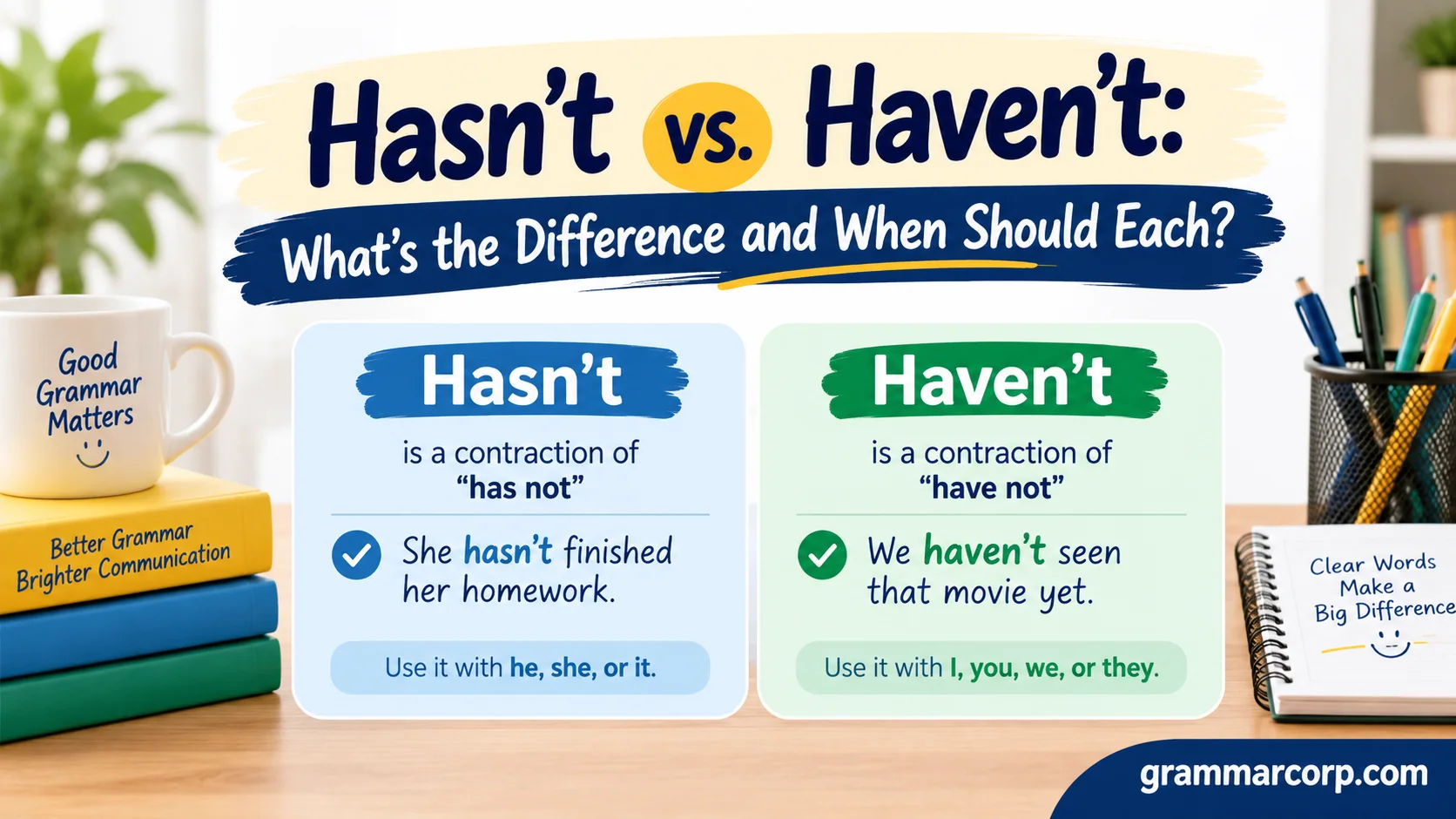
Hasn’t vs. Haven’t: What’s the Difference and When Should Each? Learn the simple grammar rules to choose the correct contraction in everyday English.
Both words are negative contractions, but their use depends on the subject of a sentence. Hasn’t means has not, while haven’t means have not. These forms commonly appear in the present perfect tense to describe actions that haven’t happened, recent events, and situations that remain unfinished. Understanding this difference helps you avoid confusing grammar rules and improve sentence clarity.
Hasn’t generally pairs with he, she, it, and singular third-person nouns. Haven’t pairs with I, you, we, they, and plural nouns. This subject-verb agreement rule helps you choose the correct form. For example, “She hasn’t arrived yet” and “They haven’t arrived yet” are both correct. The words cannot be used interchangeably because each contraction follows a different subject-verb pattern.
Pay attention to auxiliary verbs, helping verbs, and the past participle that follows them. For example, “He hasn’t finished his homework” and “We haven’t finished our homework” demonstrate correct usage. These rules apply to everyday conversations, emails, school assignments, formal writing, and professional communication.
Quick Answer
Use hasn’t with third-person singular subjects, such as he, she, it, and singular nouns. Use haven’t with I, you, we, they, and plural nouns.
- Hasn’t = has not: He hasn’t finished his homework.
- Haven’t = have not: They haven’t finished their homework.
The choice depends on the subject and the grammatical structure, not on whether you’re speaking formally or casually.
Remember this simple rule: he hasn’t, she hasn’t, it hasn’t, but I haven’t, you haven’t, we haven’t, and they haven’t.
Comparison Overview
Although hasn’t and haven’t have similar meanings, they follow different subject–verb agreement rules. The following table gives you a quick reference.
| Feature | Hasn’t | Haven’t |
| Full form | Has not | Have not |
| Main subject rule | Third-person singular | I, you, we, they, and plural subjects |
| Common tense | Present perfect | Present perfect |
| Example with a person | She hasn’t called. | I haven’t called. |
| Example with a noun | The dog hasn’t eaten. | The dogs haven’t eaten. |
| Negative meaning | An action hasn’t happened or a condition hasn’t occurred | An action hasn’t happened or a condition hasn’t occurred |
| Formal alternative | Has not | Have not |
Both contractions are standard in American English. You can use them in everyday conversations, messages, and many professional documents. In particularly formal writing, you might prefer the full forms has not and have not.
The important point is that hasn’t agrees with a singular third-person subject, while haven’t agrees with the other subjects listed above.
Main Differences Between Hasn’t vs. Haven’t
The main difference between hasn’t and haven’t is grammatical agreement. Both contractions contain a negative form of have, but each one works with particular subjects.
Subject–Verb Agreement
English verbs change depending on the subject in certain grammatical forms. With have, the present-tense form becomes has when the subject is third-person singular. The negative contraction follows that same pattern.
Consider these examples:
- He hasn’t finished the assignment.
- She hasn’t finished the assignment.
- The student hasn’t finished the assignment.
- I haven’t finished the assignment.
- You haven’t finished the assignment.
- The students haven’t finished the assignment.
Notice that the verb describing the action doesn’t determine the contraction. The subject does. Whether someone has finished a report, eaten lunch, or visited a place, you must select the contraction that agrees with the subject.
Meaning and Usage
Hasn’t and haven’t both express negation. They indicate that something has not happened, has not been completed, or has not occurred within a relevant period.
For example:
- Maria hasn’t submitted her application.
- We haven’t submitted our applications.
The meaning is similar, but the subjects require different forms.
In the present perfect tense, both contractions can describe experiences, recent events, unfinished actions, or situations connected to the present. The exact meaning depends on the context.
Sentence Structure
In the present perfect tense, the usual structure is:
Subject + hasn’t/haven’t + past participle
Examples:
- The train hasn’t arrived.
- My friends haven’t arrived.
- James hasn’t eaten breakfast.
- We haven’t eaten breakfast.
The verb following the contraction must use its past participle form. For instance, write hasn’t gone, not hasn’t went, and haven’t seen, not haven’t saw.
What Does Hasn’t Mean?
Hasn’t is the contraction of has not. It combines the verb has with the negative word not to make a sentence negative. In American English, this contraction appears frequently in spoken language and everyday writing.
You typically use hasn’t with he, she, it, and singular nouns when describing an action or situation that hasn’t occurred.
For example:
- She hasn’t finished her homework.
- Mark hasn’t called me today.
- The computer hasn’t started yet.
- My neighbor hasn’t returned the package.
- The store hasn’t opened for the day.
Each sentence contains a singular third-person subject. The contraction tells the reader that the action hasn’t happened or reached the expected point.
Hasn’t in the Present Perfect Tense
One of the most common uses of hasn’t is in the present perfect tense. This tense connects a past action or event to the present. It often describes experiences, recent developments, or actions that remain incomplete.
The basic structure is:
Subject + hasn’t + past participle
Here are several examples:
| Sentence | Explanation |
| She hasn’t eaten lunch. | Lunch remains uneaten at the relevant time. |
| He hasn’t finished the book. | He hasn’t completed the book yet. |
| The bus hasn’t arrived. | The expected arrival hasn’t happened. |
| Olivia hasn’t visited Chicago. | She has no such experience up to the relevant point. |
| The company hasn’t announced its decision. | The announcement hasn’t occurred. |
Words such as yet, already, ever, and recently often appear in present perfect sentences. For example, “The manager hasn’t replied yet” emphasizes that a reply is still expected.
However, you don’t need one of these words in every sentence. “She hasn’t eaten” is grammatically complete even without additional context.
Hasn’t With Singular Nouns and Pronouns
Choosing the correct contraction becomes easier when you identify the subject first.
Use hasn’t with singular nouns such as the teacher, my brother, the company, and this machine. The same rule applies to he, she, and it.
Examples:
- The teacher hasn’t graded our papers.
- My brother hasn’t called this week.
- The company hasn’t released its annual report.
- This machine hasn’t worked properly today.
Singular indefinite pronouns also generally take hasn’t when they serve as the subject.
For instance:
- Everyone hasn’t arrived yet. (Grammatical in some contexts, but potentially ambiguous.)
- Nobody hasn’t arrived. (Usually confusing because of the double negative.)
For clarity, prefer “Not everyone has arrived yet” when you mean that some people are still missing. Use “Nobody has arrived yet” when you mean that no one has arrived.
These examples illustrate an important point: correct subject agreement matters, but a grammatically possible sentence may still communicate your meaning poorly.
Hasn’t in Everyday American English
Hasn’t works naturally in conversations, text messages, workplace updates, and informal explanations.
Imagine that your coworker asks whether a report is ready. You might respond, “The supervisor hasn’t approved it yet.” The contraction makes the response sound natural without changing its essential meaning.
In a more formal report, you could write, “The supervisor has not approved the report.” Both versions are correct. The expanded form simply creates a slightly more formal tone.
What Does Haven’t Mean?
Haven’t is the contraction of have not. It serves the same general negative purpose as hasn’t, but it follows a different subject–verb agreement rule.
Use haven’t with I, you, we, and they, as well as plural nouns. It commonly appears in the present perfect tense to describe experiences, unfinished actions, and events that haven’t occurred.
Examples include:
- I haven’t seen that movie.
- You haven’t answered my question.
- We haven’t received the package.
- They haven’t arrived yet.
- The students haven’t submitted their assignments.
In each example, haven’t correctly matches the subject.
Haven’t in the Present Perfect Tense
Like hasn’t, haven’t frequently appears in the present perfect tense. It connects a past action or experience with the present.
The standard structure is:
Subject + haven’t + past participle
Consider these examples:
| Sentence | Explanation |
| I haven’t finished my assignment. | The assignment remains incomplete. |
| You haven’t told me the whole story. | The information hasn’t been shared. |
| We haven’t visited that museum. | The visit hasn’t happened. |
| They haven’t paid the bill. | Payment hasn’t been made. |
| The children haven’t gone to bed. | The expected action hasn’t occurred. |
The past participle remains important. Common forms include done, eaten, gone, seen, written, and taken.
For example, “We haven’t written the email” is correct. “We haven’t wrote the email” is incorrect because wrote is the simple past form, not the past participle.
Haven’t With Singular and Plural You
One detail often confuses English learners: you haven’t is correct whether you refers to one person or multiple people.
English uses you with the verb form have in both cases.
For example:
- You haven’t completed your registration. (One person)
- You haven’t completed your registrations. (Several people)
The number of people doesn’t change the contraction. This differs from he and she, which take hasn’t.
Haven’t With Plural Nouns
Plural nouns take haven’t when they serve as the subject of a sentence.
Examples include:
- The employees haven’t received their schedules.
- My parents haven’t arrived home.
- Those restaurants haven’t reopened.
- The computers haven’t connected to the network.
- Our neighbors haven’t responded to the invitation.
When a sentence contains a long subject, identify the main noun rather than choosing the contraction based on a nearby word.
For example, “The list of students hasn’t been updated” uses hasn’t because the main subject is list. The plural noun students appears inside a phrase that describes the list; it doesn’t control the verb.
This is a useful distinction because nearby nouns can sometimes distract you from the actual subject.
When to Use Hasn’t
Use hasn’t when the subject is third-person singular and the sentence requires a form of has. In the present perfect tense, it is especially common for describing something that hasn’t happened or hasn’t been completed.
With He, She, and It
These pronouns always take hasn’t in standard present perfect negative sentences.
Examples:
- He hasn’t called his parents.
- She hasn’t finished her presentation.
- It hasn’t stopped raining.
- He hasn’t learned the new procedure.
- She hasn’t received the invitation.
You don’t need to memorize each sentence separately. Once you recognize the subject, the correct contraction follows naturally.
With Singular Names and Nouns
Names and singular nouns also take hasn’t.
Examples:
- Daniel hasn’t returned my book.
- Sarah hasn’t chosen a date.
- The restaurant hasn’t confirmed our reservation.
- My phone hasn’t charged completely.
- The package hasn’t reached its destination.
A helpful editing habit is to underline the subject and check whether it refers to one person, object, or organization in the third person.
With Indefinite Pronouns
Words such as everyone, everybody, someone, somebody, anyone, anybody, no one, and nobody generally take singular agreement in standard English.
Examples:
- Everyone hasn’t completed the form. (Potentially ambiguous; “Not everyone has completed the form” is clearer.)
- Someone hasn’t collected the mail.
- Nobody has finished the task yet.
- Nobody hasn’t finished the task. (Avoid this confusing double negative.)
When you want to emphasize that a particular person hasn’t acted, you can write, “Someone hasn’t locked the door.” When you mean that a task remains incomplete for the entire group, “Nobody has finished the task” is clearer.
When to Use Haven’t
Use haven’t with I, you, we, and they, along with plural nouns. This rule applies across many common present perfect sentences.
With I, You, We, and They
These pronouns take haven’t in negative present perfect constructions.
Examples:
- I haven’t checked my email.
- You haven’t explained the problem.
- We haven’t booked our tickets.
- They haven’t completed the project.
The rule remains the same regardless of the action. You can use haven’t with finished, started, eaten, seen, or written as long as the sentence’s subject and structure support it.
With Plural Nouns
Plural subjects also require haven’t.
Examples:
- The teachers haven’t announced the results.
- My cousins haven’t visited us recently.
- The shops haven’t opened yet.
- Several customers haven’t received their orders.
Compare “The customer hasn’t received the order” with “The customers haven’t received their orders.” Changing the subject from singular to plural changes the contraction.
With Compound Subjects
A compound subject joins two or more nouns or pronouns. When the subject is plural, haven’t is generally appropriate.
Examples:
- Emma and Jack haven’t arrived.
- My brother and sister haven’t called.
- The manager and employees haven’t reached an agreement.
However, pay attention to how a compound subject functions in the sentence. Two nouns joined by and generally form a plural subject, but a single combined idea or title can sometimes take singular agreement.
For ordinary sentences involving two separate people or things, haven’t is the safe choice.
Hasn’t vs. Haven’t in Different Tenses and Sentence Structures
Although hasn’t and haven’t commonly appear in the present perfect tense, you can also encounter them in other constructions. Understanding these patterns helps you avoid confusing them with doesn’t, don’t, and other negative forms.
Hasn’t vs. Haven’t in the Present Perfect
The present perfect combines has or have with a past participle. Adding not makes the construction negative.
The formula is:
Subject + hasn’t/haven’t + past participle + additional information
Examples:
- She hasn’t written the letter.
- I haven’t written the letter.
- The train hasn’t left the station.
- The trains haven’t left the station.
Notice how the past participle written and the verb phrase left the station remain unchanged. Only the contraction changes to match the subject.
The present perfect often serves three purposes:
- Unfinished actions: “He hasn’t finished the assignment yet.”
- Life experiences: “We haven’t visited Canada.”
- Recent events with present relevance: “The company hasn’t announced the results.”
The exact interpretation depends on the surrounding context. For example, “I haven’t eaten” could mean that you haven’t eaten today or that you haven’t eaten since a particular event.
Hasn’t vs. Haven’t With Possession
The verbs has and have can express possession, but their negative forms require some care in American English.
You might encounter sentences such as “She hasn’t any money” or “I haven’t any questions.” These constructions are grammatical in some varieties of English, particularly certain British English contexts, but they sound unusual to many American English speakers.
In everyday American English, people generally use doesn’t have or don’t have to express a lack of possession.
| Less natural in American English | More natural American English |
| She hasn’t any money. | She doesn’t have any money. |
| I haven’t a car. | I don’t have a car. |
| He hasn’t any free time. | He doesn’t have any free time. |
| We haven’t enough space. | We don’t have enough space. |
This distinction matters because hasn’t and haven’t don’t replace doesn’t have and don’t have in every sentence.
Compare these examples:
- She hasn’t finished her work. (Present perfect)
- She doesn’t have enough time. (Simple present)
The first sentence describes an action that remains incomplete. The second describes a current lack of time.
Hasn’t vs. Haven’t With Have to
The expression have to means that someone must do something or has an obligation. Its negative simple present forms are doesn’t have to and don’t have to.
For example:
- He doesn’t have to work tomorrow.
- They don’t have to attend the meeting.
These sentences indicate that the people aren’t required to perform the actions.
Hasn’t and haven’t can also appear with have to in the present perfect, but the structure changes:
- He hasn’t had to work late this week.
- They haven’t had to work late this week.
Here, had is the past participle of have. The sentences describe an obligation that hasn’t arisen during the relevant period.
Don’t confuse “He hasn’t had to work late” with “He hasn’t worked late.” The first concerns whether he needed to work late; the second concerns whether he actually did so.
Hasn’t vs. Haven’t in Questions and Short Answers
Negative questions often place hasn’t or haven’t before the subject. These questions can express surprise, check expectations, or ask whether an anticipated event has happened.
Examples:
- Hasn’t she arrived yet?
- Hasn’t the package been delivered?
- Haven’t they finished the project?
- Haven’t you seen this movie?
In standard question structure, the auxiliary verb comes before the subject.
Positive questions follow the same pattern without not:
- Has she arrived yet?
- Have they finished the project?
- Have you seen this movie?
Short answers also follow subject–verb agreement rules.
| Question | Short answer |
| Has she arrived? | No, she hasn’t. |
| Has the train left? | No, it hasn’t. |
| Have they arrived? | No, they haven’t. |
| Have you finished? | No, I haven’t. |
One useful detail: a question beginning with haven’t you can sound surprised or expect an action to have occurred already. “Haven’t you finished yet?” may suggest that the speaker expected the task to be complete.
The tone depends on context, so consider your wording carefully in professional conversations.
Common Mistakes to Avoid With Hasn’t and Haven’t
Even experienced English speakers can make mistakes when a sentence contains a complicated subject or an unfamiliar verb form. The following errors are worth watching for.
Using Hasn’t With a Plural Subject
A plural subject generally requires haven’t, not hasn’t.
- Incorrect: The children hasn’t arrived.
- Correct: The children haven’t arrived.
The same rule applies to plural nouns such as employees, books, cars, and students.
Using Haven’t With a Third-Person Singular Subject
A third-person singular subject requires hasn’t in a present perfect negative sentence.
- Incorrect: Maria haven’t called.
- Correct: Maria hasn’t called.
Remember that names such as Maria, David, and Alex behave like she or he when they refer to one person.
Confusing Hasn’t and Haven’t With Doesn’t and Don’t
This is one of the most important distinctions to understand.
Use hasn’t and haven’t to form the present perfect negative. Use doesn’t and don’t to form the simple present negative with the appropriate subjects.
| Present perfect | Simple present |
| She hasn’t finished the report. | She doesn’t finish reports on time. |
| They haven’t visited us. | They don’t visit us often. |
| He hasn’t eaten breakfast. | He doesn’t eat breakfast regularly. |
| I haven’t watched that series. | I don’t watch television often. |
The simple present can describe habits, routines, general facts, and repeated actions. The present perfect often connects earlier events or experiences to the present.
Choose the tense according to your intended meaning, not simply because one sentence sounds more familiar.
Using the Wrong Past Participle
The present perfect requires a past participle after has or have.
Common errors include:
- Incorrect: She hasn’t went home.
- Correct: She hasn’t gone home.
- Incorrect: They haven’t saw the message.
- Correct: They haven’t seen the message.
- Incorrect: He hasn’t wrote the email.
- Correct: He hasn’t written the email.
Some regular verbs form their past participles by adding -ed, as in finished and completed. Irregular verbs have different forms that you need to learn.
Forgetting That You Takes Haven’t
Whether you refers to one person or several people, haven’t is correct.
- Incorrect: You hasn’t replied.
- Correct: You haven’t replied.
This rule applies in questions and negative statements as well.
Creating Confusing Double Negatives
Using two negative elements can produce a confusing or unintended meaning in standard English.
For example:
- Confusing: Nobody hasn’t called.
- Clearer: Nobody has called.
- Clearer: Nobody has called yet.
- Clearer: Not everyone has called.
If you want to say that no calls have occurred, use “Nobody has called.” If you mean that some people still haven’t called, write “Not everyone has called.”
Read More : Hear vs. Here: What’s the Difference? Meaning, Examples
Hasn’t vs. Haven’t: Examples in Everyday Sentences
Practical examples make subject–verb agreement easier to remember. The following sentences show how these contractions work in familiar situations.
At Home
- My sister hasn’t cleaned her room.
- We haven’t finished preparing dinner.
- The washing machine hasn’t completed its cycle.
- My parents haven’t returned home yet.
At School
- The teacher hasn’t explained the assignment.
- I haven’t studied for the test.
- The students haven’t completed their projects.
- You haven’t submitted your application.
At Work
- The manager hasn’t approved the budget.
- We haven’t received the client’s response.
- The employees haven’t completed their training.
- I haven’t sent the final draft.
While Traveling
- The bus hasn’t arrived at the station.
- We haven’t booked our hotel.
- The passengers haven’t boarded the plane.
- She hasn’t collected her luggage.
Paired Examples: Same Action, Different Subject
Comparing similar sentences is an effective way to learn the difference.
| Hasn’t | Haven’t |
| My brother hasn’t called. | My brothers haven’t called. |
| The child hasn’t eaten. | The children haven’t eaten. |
| The package hasn’t arrived. | The packages haven’t arrived. |
| She hasn’t finished the report. | They haven’t finished the report. |
| The company hasn’t responded. | The companies haven’t responded. |
The key lesson is simple: when the subject changes, check whether the contraction needs to change too.
A Practical Workplace Example
Imagine that a project manager needs to update a team about a delayed report. The manager writes:
“The director hasn’t approved the proposal yet. We haven’t received the final figures from the finance team either. The analysts haven’t completed their review, so the department hasn’t published the report.”
Each contraction matches its subject:
- The director hasn’t: director is singular.
- We haven’t: we takes haven’t.
- The analysts haven’t: analysts is plural.
- The department hasn’t: department is singular.
This example also demonstrates why you should check every clause individually. A paragraph can contain both contractions because each sentence may have a different subject.
Hasn’t vs. Haven’t: Quick Grammar Test
Test your understanding by choosing the correct contraction in each sentence. Pay attention to the subject and the verb structure.
Practice Questions
Fill in each blank with hasn’t or haven’t.
- My brother ______ finished his homework.
- We ______ visited that restaurant before.
- The students ______ received their grades.
- She ______ called me this morning.
- You ______ answered the last question.
- The computer ______ downloaded the file.
- They ______ decided where to go.
- The manager ______ approved the request.
Answers and Explanations
| Sentence | Correct answer | Why? |
| My brother hasn’t finished his homework. | Hasn’t | Brother is singular and third person. |
| We haven’t visited that restaurant before. | Haven’t | We takes haven’t. |
| The students haven’t received their grades. | Haven’t | Students is plural. |
| She hasn’t called me this morning. | Hasn’t | She takes hasn’t. |
| You haven’t answered the last question. | Haven’t | You always takes have in this construction. |
| The computer hasn’t downloaded the file. | Hasn’t | Computer is singular. |
| They haven’t decided where to go. | Haven’t | They takes haven’t. |
| The manager hasn’t approved the request. | Hasn’t | Manager is singular. |
If you answered all eight correctly, you’ve mastered the basic rule. If you missed a few, focus on identifying the subject before choosing the contraction.
FAQs:
1. What is the main difference between hasn’t and haven’t?
Hasn’t means “has not” and is used with he, she, it, and singular third-person nouns. Haven’t means “have not” and is used with I, you, we, they, and plural nouns.
2. Can I use hasn’t and haven’t interchangeably?
No, you cannot use them interchangeably. The correct contraction depends on the subject. For example, “She hasn’t called” is correct, while “She haven’t called” is incorrect.
3. Is hasn’t used with singular or plural subjects?
Hasn’t is generally used with singular third-person subjects, such as he, she, it, and a person’s name. For example, “James hasn’t finished his homework.”
4. When should I use haven’t in a sentence?
Use haven’t with I, you, we, they, and plural nouns. For example, “I haven’t completed the assignment” and “They haven’t arrived yet.”
5. Do hasn’t and haven’t appear in the present perfect tense?
Yes, both contractions commonly appear in the present perfect tense. They combine has or have with not and a past participle, as in “She hasn’t eaten” and “We haven’t eaten.”
Conclusion:
Understanding hasn’t vs. haven’t becomes easier when you focus on the subject of your sentence. Use hasn’t with he, she, it, and singular third-person nouns. Use haven’t with I, you, we, they, and plural nouns.
Both contractions express a negative meaning and commonly appear in the present perfect tense. With regular practice and attention to subject-verb agreement, you can avoid common grammar mistakes and use these forms correctly in everyday conversations, school assignments, emails, and professional writing.








1 thought on “Hasn’t vs. Haven’t: What’s the Difference and When Should Each?”