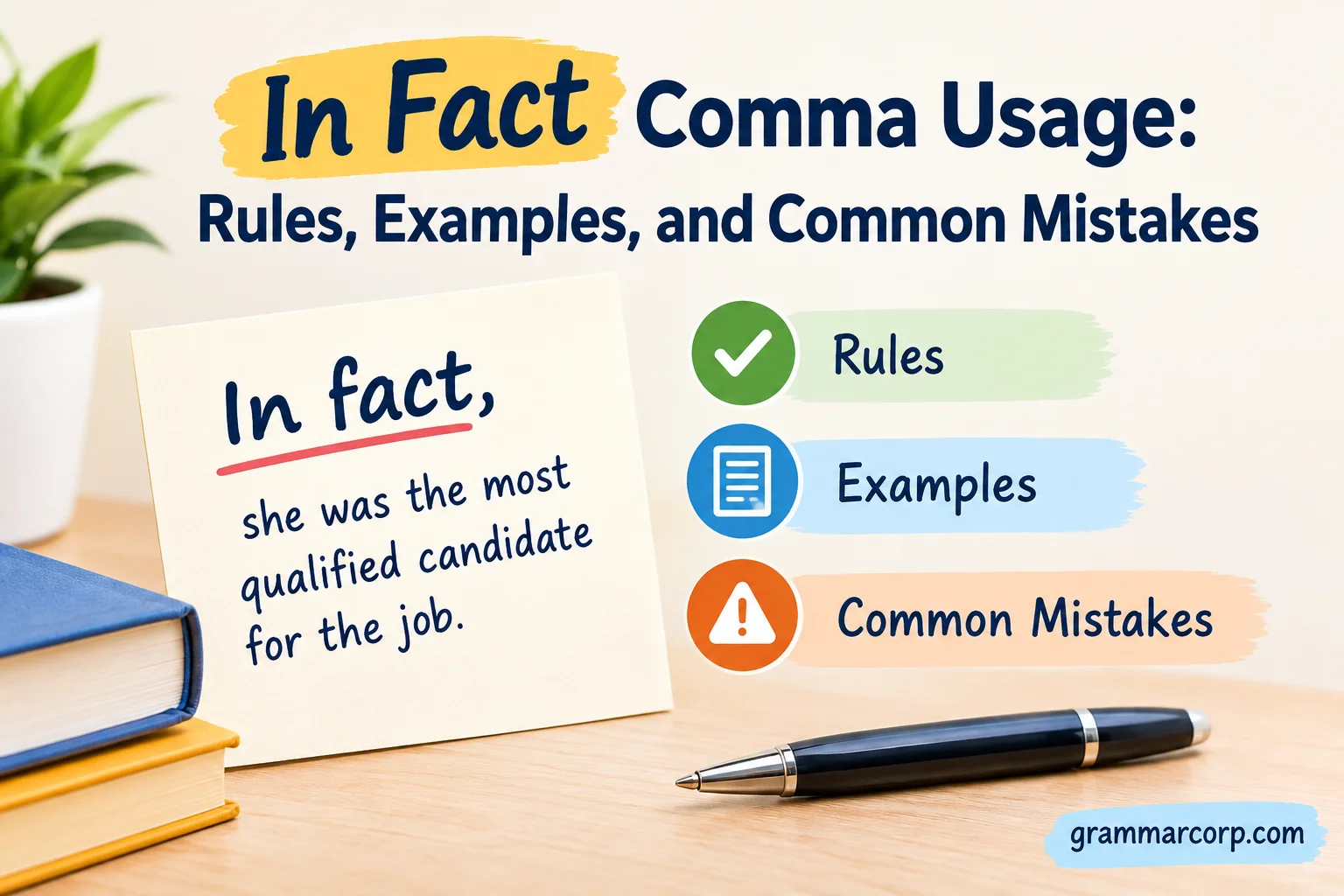
In Fact Comma Usage: Rules, Examples, and Common Mistakes explains how punctuation shapes meaning, flow, and clarity in everyday writing clearly. The central phrase, in fact, is a two-word phrase that can appear as an introductory expression, parenthetical expression, connector, sentence connector, transitional phrase, or emphasis marker. Its phrase functions and phrase position determine how the comma or commas should connect it to the rest of the sentence.
At the beginning of a sentence, an introductory expression is commonly followed by a comma, while a parenthetical expression placed mid-sentence can sit before and after commas. For example, “In fact, the results were better than expected” gives the phrase an opening position, whereas “The results were, in fact, better than expected” gives it a parenthetical role. These punctuation rules help answer common punctuation questions and prevent common mistakes. The choice is not simply about decoration; it can influence sentence structure, emphasis, rhythm, meaning, and the overall connection between a phrase and its clause.
In English grammar punctuation, comma placement should support clear writing, professional writing, and readability rather than create an awkward or confusing sentence. The phrase can introduce information, clarification, or a stronger statement, which is why writers sometimes struggle with whether commas belong before, after, or around the expression.The better approach is to consider whether the meaning stays clear when you drop a comma. If it does, an optional comma may simply create breathing spaces or natural emphasis; if punctuation interrupts the sentence, removing it may make the flow smoother. This balance between general rules and practical judgment helps strengthen writing clarity, writing confidence, and accuracy while reducing grammar mistakes and incorrect punctuation.
Quick Answer:
Does in fact need a comma?
Not always.
When in fact begins a sentence as an introductory expression, a comma normally follows it:
In fact, the evidence supports the original conclusion.
When in fact interrupts a sentence as a parenthetical expression, commas usually surround it:
The evidence, in fact, supports the original conclusion.
However, when in fact fits naturally into the grammatical flow of a sentence without functioning as an interruption, commas can be omitted:
The evidence did in fact support the original conclusion.
So the easiest rule to remember is this:
Use commas when in fact functions as an introductory or parenthetical expression. Don’t add commas automatically when the phrase is integrated into the sentence.
Cambridge Dictionary classifies in fact as a discourse marker and notes that it commonly appears at the front of a clause. It can also appear at the end in informal contexts.
Comparison Overview
The following table gives you the quickest way to compare the main in fact comma usage patterns.
| Position of in fact | Typical punctuation | Example | Main function |
| Beginning of sentence | Comma after in fact | In fact, the plan worked. | Introduces or emphasizes information |
| Middle as an interruption | Commas around in fact | The plan, in fact, worked. | Adds parenthetical emphasis |
| Middle as an integrated phrase | No commas may be needed | The plan did in fact work. | Adds emphasis without a strong interruption |
| End of sentence | Often a preceding comma in parenthetical use | The plan worked, in fact. | Adds afterthought or emphasis |
| After a conjunction | Depends on structure | But in fact, the plan worked. | Emphasizes a contrast or correction |
The key point is that position alone doesn’t determine every punctuation choice. The grammatical role of in fact matters too.
The Chicago-style approach recognizes that transitional expressions don’t necessarily need commas when they don’t create a real break in the sentence.
Main Differences Between In Fact Comma Usage Patterns
The biggest difference comes down to whether in fact stands apart from the sentence or works smoothly inside it.
Introductory “In Fact”
When in fact introduces a complete clause, the standard construction places a comma after the phrase.
In fact, nobody expected the results.
In fact, the second test produced an even clearer result.
Here, in fact prepares the reader for what follows. The comma creates a small boundary between the introductory expression and the main clause.
This pattern appears frequently in essays, reports, articles, emails, and everyday conversation.
Parenthetical “In Fact”
When in fact interrupts the middle of a sentence, commas can mark it as a parenthetical element.
The answer was, in fact, much simpler than we expected.
She is, in fact, the most experienced person on the team.
Remove in fact and the basic sentence still works:
- The answer was much simpler than we expected.
- She is the most experienced person on the team.
That removal test helps identify a parenthetical use.
Integrated “In Fact”
Sometimes in fact sits inside the sentence without a strong interruption.
They did in fact finish the project early.
She did in fact call yesterday.
The report does in fact support the claim.
Here, the phrase emphasizes the truth of the statement while remaining tightly connected to the verb.
This construction is especially common with auxiliary verbs such as did, does, and will.
The phrase can therefore appear without commas even though many writers prefer commas in similar sentences. Style, rhythm, and emphasis all influence the choice.
What Does “In Fact” Mean?
Before deciding where commas belong, it helps to understand what in fact actually does.
The phrase generally means in truth, actually, or as a matter of fact. Writers use it to confirm information, strengthen a statement, correct an assumption, or add a more precise fact.
For example:
Many people assumed the store had closed. In fact, it had moved to another location.
The second sentence corrects the assumption created by the first.
You can also use in fact to intensify a point:
The weather wasn’t merely cold. In fact, temperatures dropped below freezing.
Or to confirm something:
She wasn’t guessing. In fact, she had already checked the records.
That meaning explains why the phrase often appears at the beginning of a sentence. It signals that the following information deserves attention.
When to Put a Comma After “In Fact”
The most straightforward comma after in fact rule applies when the phrase begins a sentence.
“In Fact” at the Beginning of a Sentence
Use a comma after in fact when it serves as an introductory discourse marker.
In fact, the answer was correct.
In fact, we had already discussed this issue.
In fact, the results were better than predicted.
In fact, nobody noticed the change.
The comma tells the reader that in fact introduces the main statement rather than forming an essential grammatical part of it.
“In Fact” After a Previous Statement
You can also begin a new sentence with in fact when the phrase connects the new information to something already mentioned.
The original estimate seemed reasonable. In fact, it was remarkably accurate.
Most readers expected a complicated explanation. In fact, the answer was quite simple.
This use is common because in fact creates a logical bridge between ideas.
“In Fact” After a Conjunction
You may also see constructions such as:
But in fact, the opposite was true.
And in fact, the results confirmed the theory.
Here, the comma follows in fact because it introduces the clause that follows.
However, punctuation becomes more complicated when and, but, or another conjunction connects larger structures. Don’t insert commas mechanically. First determine what the conjunction connects.
For example:
The evidence was strong and, in fact, convincing.
Here, in fact interrupts the adjective phrase convincing, so the punctuation reflects that parenthetical use.
When to Use Commas Around “In Fact”
One of the most common questions about in fact comma usage concerns sentences where the phrase appears in the middle.
When in fact acts as a parenthetical interrupter, place commas around it.
Examples
The decision was, in fact, unavoidable.
The company is, in fact, expanding.
His explanation was, in fact, accurate.
The problem can, in fact, be solved.
In each example, removing in fact leaves a complete sentence.
Compare:
The decision was unavoidable.
The company is expanding.
His explanation was accurate.
The problem can be solved.
The core meaning remains intact.
Why Are Two Commas Used?
Think of the commas as a pair of brackets made from punctuation.
The first comma signals the beginning of the interruption. The second comma closes it.
For example:
The results , in fact, surprised everyone.
The central sentence is:
The results surprised everyone.
The phrase in fact adds emphasis without changing the basic grammatical structure.
This is why the phrase can be described as parenthetical in such constructions.
When “In Fact” Does Not Need Commas
Here’s where many grammar explanations become too rigid.
You shouldn’t assume that every mid-sentence use of in fact requires two commas.
Consider:
She did in fact complete the assignment.
The sentence is grammatical without commas.
Now compare:
She did, in fact, complete the assignment.
This version is also grammatical in many contexts. The commas make in fact feel more like an interruption or aside.
The difference is subtle but useful.
No Commas: Smooth Emphasis
Without commas, the phrase moves smoothly with the verb.
They did in fact agree.
The team has in fact completed the work.
We can in fact verify the information.
This style can sound direct and compact.
Commas: Parenthetical Emphasis
With commas, the phrase receives more separation.
They did, in fact, agree.
The team has, in fact, completed the work.
We can, in fact, verify the information.
This version gives in fact more rhetorical weight.
Neither pattern should be treated as a universal answer for every sentence. The intended rhythm and grammatical relationship matter.
A useful Chicago-style principle is to omit commas around transitional expressions when there is no real break in continuity.
“In Fact” at the Beginning, Middle, and End of a Sentence
The location of in fact strongly affects its punctuation.
At the Beginning
The most common pattern is:
In fact, + complete clause
Examples:
In fact, the store opened earlier than expected.
In fact, the problem was easier to solve than we thought.
In fact, she had already finished the work.
This construction is clear and widely used.
Cambridge Dictionary specifically notes that in fact commonly occurs in front position.
In the Middle
When the phrase acts parenthetically, use commas around it:
The store, in fact, opened earlier than expected.
The problem was, in fact, easier to solve.
She had, in fact, already finished the work.
But remember that integrated versions can omit the commas:
She had in fact already finished the work.
That distinction is one of the most important parts of in fact comma usage.
At the End
Sentence-final in fact is possible, particularly in conversational English.
The whole experience was disappointing, in fact.
It was a complete surprise, in fact.
Cambridge notes that in fact can occur in end position in informal contexts.
However, sentence-final placement can sound less natural in formal prose.
Compare:
The explanation was surprisingly simple, in fact.
with:
In fact, the explanation was surprisingly simple.
The second version usually sounds cleaner in formal writing.
“In Fact” vs. Similar Expressions
Understanding related expressions can make your punctuation choices easier because each one serves a slightly different rhetorical purpose.
In Fact vs. Actually
Both expressions can correct an assumption or emphasize truth.
In fact, the meeting started early.
Actually, the meeting started early.
Actually often sounds more conversational. In fact can sound slightly more deliberate or emphatic.
In Fact vs. Indeed
Indeed can confirm or strengthen a statement.
The evidence is strong. Indeed, it may be decisive.
In fact often adds a concrete correction or factual clarification.
The evidence is strong. In fact, it proves the original claim.
In Fact vs. For Example
These expressions perform different jobs.
In fact strengthens or confirms information.
For example introduces an illustration.
Several methods work well. In fact, the simplest method produced the best result.
Several methods work well. For example, the simplest method produced excellent results.
Don’t treat these expressions as interchangeable simply because they can occupy similar positions.
In Fact vs. As a Matter of Fact
As a matter of fact has a similar meaning but often sounds more conversational or emphatic.
In fact, I already knew about the change.
As a matter of fact, I already knew about the change.
Both can work. The shorter phrase usually creates a tighter sentence.
Common “In Fact” Comma Mistakes
Small punctuation errors can change how a sentence reads. Here are the mistakes worth watching.
Mistake: Forgetting the Introductory Comma
Incorrect:
In fact the results were better than expected.
Standard edited form:
In fact, the results were better than expected.
When in fact opens the sentence as an introductory expression, the comma clearly separates it from the main clause.
Mistake: Adding Commas Automatically
Some writers assume every occurrence needs commas.
She did, in fact, finish the work.
This can be correct.
But:
She did in fact finish the work.
can also be correct when in fact integrates smoothly with the verb phrase.
The better approach is to examine the sentence instead of applying a blanket rule.
Mistake: Using Only One Comma Around a Parenthetical Phrase
Incorrect:
The answer was, in fact much simpler.
If in fact functions as a parenthetical interrupter, close the interruption:
The answer was, in fact, much simpler.
A pair of commas works like opening and closing punctuation.
Mistake: Creating a Comma Splice
This is especially important.
Consider:
The evidence was convincing, in fact, it proved the claim.
That construction places two independent clauses next to each other with commas alone. In fact doesn’t magically turn the comma into valid punctuation.
Better options include:
The evidence was convincing. In fact, it proved the claim.
Or:
The evidence was convincing; in fact, it proved the claim.
The semicolon handles the relationship between the two independent clauses.
Mistake: Overusing “In Fact”
Repeating in fact in every other sentence makes prose feel heavy.
Weak:
In fact, the product works well. In fact, customers like it. In fact, the company reported strong results.
Better:
The product works well. Customers like it and the company reported strong results.
Use in fact when it adds emphasis, correction, or useful contrast. If removing it changes nothing, you may not need it.
Read More : Mastering the Simple Present Tense in American English
In Fact Comma Usage in Different Types of Writing
The best punctuation also depends on the type of writing you’re doing.
Academic Writing
Academic prose benefits from precise transitions.
In fact, the findings support the original hypothesis.
You can also use the phrase parenthetically:
The findings, in fact, support the original hypothesis.
Don’t rely on in fact merely to make an argument sound stronger. The evidence itself should carry the argument.
Business Writing
In reports and professional emails, concise phrasing usually works best.
In fact, the revised process reduced processing time.
Or:
The revised process did in fact reduce processing time.
The second version feels more integrated and direct.
Everyday Writing
Informal communication gives you more freedom.
In fact, I already checked.
I did in fact remember your suggestion.
That was a bigger problem than I expected, in fact.
The final version works as an afterthought, although the first two constructions usually sound more natural.
Articles and Blog Posts
For explanatory writing, in fact can help introduce a surprising or clarifying detail.
Many people assume the rule is complicated. In fact, it’s quite simple.
That’s particularly useful when you’re correcting a common misconception.
A Practical Case Study: Choosing the Right Punctuation
Imagine you’re writing about a business that exceeded its annual target.
You start with:
The company expected modest growth.
Now you want to reveal that actual growth was much stronger.
Option One: New Sentence
In fact, revenue increased by 24%.
This is probably the clearest option when you want the fact to stand out.
Option Two: Parenthetical
Revenue, in fact, increased by 24%.
This gives the phrase a stronger aside-like quality.
Option Three: Integrated
Revenue did in fact increase by 24%.
This feels direct and tightly connected.
What Changes?
The underlying fact stays the same. The presentation changes.
| Version | Effect |
| In fact, revenue increased by 24%. | Strong transition |
| Revenue, in fact, increased by 24%. | Parenthetical emphasis |
| Revenue did in fact increase by 24%. | Integrated emphasis |
That’s the real lesson behind comma placement. Punctuation helps communicate how the writer wants the reader to process the phrase.
A Simple Test for In Fact Comma Usage
When you’re unsure, use this editing process.
Check Whether It Starts the Sentence
If in fact begins the sentence as an introductory expression, use a comma.
In fact, the answer was correct.
Remove the Phrase
If the phrase appears in the middle, temporarily remove it.
The answer was, in fact, correct.
Remove it:
The answer was correct.
The sentence still works, so the commas can mark in fact as a parenthetical interruption.
Read the Integrated Version
Try the sentence without commas:
The answer was in fact correct.
If the phrase flows naturally and doesn’t need a strong interruption, leaving out the commas can be appropriate.
Check for Two Independent Clauses
Never assume in fact can join two complete sentences.
If you have:
The first explanation seemed convincing. The second explanation was stronger.
You can write:
The first explanation seemed convincing. In fact, the second explanation was stronger.
Or:
The first explanation seemed convincing; in fact, the second explanation was stronger.
Don’t use in fact as a substitute for proper sentence boundaries.
Quick Reference: In Fact Comma Rules
| Situation | Recommended pattern | Example |
| Beginning of sentence | In fact, | In fact, the answer was correct. |
| Parenthetical middle position | , in fact, | The answer was, in fact, correct. |
| Integrated middle position | in fact | The answer did in fact seem correct. |
| Sentence-final afterthought | , in fact | The answer was correct, in fact. |
| Joining independent clauses | Use proper sentence punctuation | The answer was correct. In fact, it was obvious. |
FAQs:
Is a comma always needed after “in fact”?
No. A comma is often used when in fact works as an introductory expression, such as “In fact, the results improved.” However, punctuation depends on the sentence’s structure, meaning, and flow.
Should “in fact” have commas around it?
When in fact acts as a parenthetical expression in the middle of a sentence, commas are commonly used on both sides: “The results were, in fact, better than expected.” If removing the phrase leaves a clear sentence, the commas often mark it as an interruption or added emphasis.
Can I use “in fact” without a comma?
Yes. In fact does not always require commas. When it fits naturally into the sentence and removing the comma does not harm clarity or readability, no comma may be appropriate.
What are common mistakes with “in fact” comma usage?
Common grammar mistakes include adding commas automatically, using only one comma around a parenthetical phrase, and ignoring the phrase’s actual role in the sentence. Good punctuation should support the intended meaning instead of making the writing awkward or confusing.
Does comma placement change the meaning of “in fact”?
Usually, the core meaning remains the same, but comma placement can change the emphasis, tone, and rhythm of a sentence. A comma can give in fact more of an aside-like or emphatic role, while leaving it unpunctuated can make the sentence feel more direct.
Conclusion:
Understanding in fact comma usage becomes easier when you focus on the phrase’s role rather than memorizing one fixed rule. Look at whether in fact introduces a sentence, interrupts a sentence, or simply adds emphasis.
Then choose punctuation that keeps the meaning, clarity, and flow natural. With regular practice, these choices become almost automatic, helping you produce more polished, confident, and readable writing.










1 thought on “In Fact Comma Usage: Rules, Examples, and Common Mistakes”