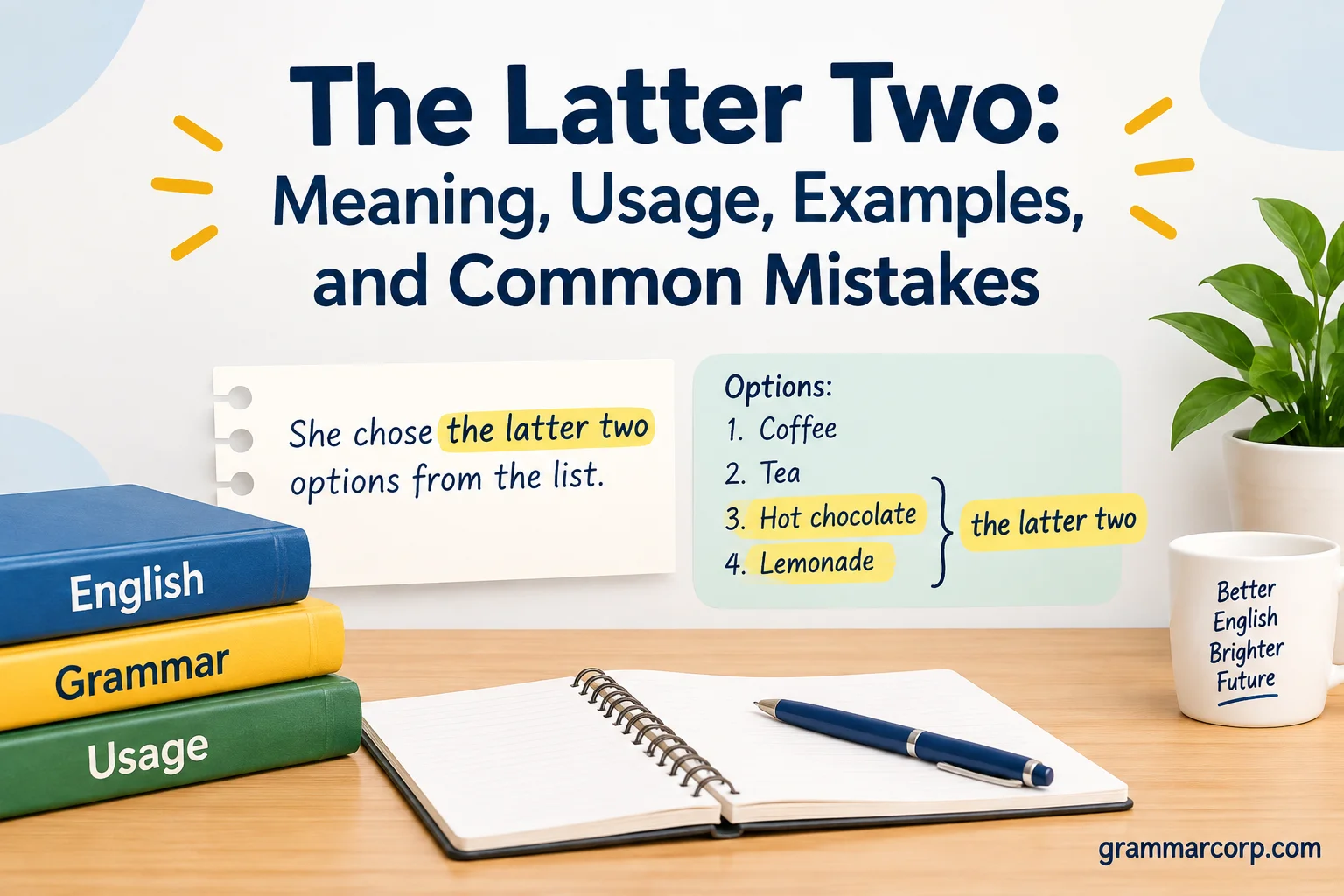
The Latter Two: Meaning, Usage, Examples, Common Mistakes explains how clear English helps readers identify the final two items in a group. In English, small words can avoid repeating long phrases and make a list easier to follow. The latter two is a useful expression used to refer to the final two items in a previously mentioned group. For example, a list that includes apples, bananas, and oranges allows the latter two to mean the second item and third item. This simple concept helps learners understand sequence, order, and meaning without confusion.
The main distinction is that latter has a specific meaning and does not simply mean last. When there are three or more things, the latter two can identify the final pair, while the last two may be a clearer choice and a safer way to talk about them. A quick example using reading, writing, listening, and speaking shows how the latter two means listening and speaking. This method helps avoid repetition, mix-up, and mix-ups, keeping each sentence clear, concise, and easy to follow. For learners, mastering this art takes practice with grammar, vocabulary, reference terms, and terminology.
Former and latter can appear in spoken English, written English, emails, essays, reports, articles, research papers, contracts, and everyday messages. Experienced writers use these terms to support effective communication, while careful phrase usage helps the reader understand the context. The rules are normally used, but they can be applied flexibly because exceptions exist; the key point is to identify the intended final items and build a stronger understanding of the total context with useful Language Resources.
Quick Answer:
The latter two means the last two items, people, choices, or things mentioned in a group or sequence.
For example:
Sarah bought apples, oranges, bananas, and grapes. She ate the latter two first.
Here, the latter two refers to bananas and grapes because they are the final two items mentioned.
The expression is especially useful when a sentence contains several items and you don’t want to repeat their names.
However, there’s an important detail. Latter traditionally refers to the second of two things. In modern English, expressions such as the latter two are also commonly used to identify the final two members of a larger sequence.
Simple meaning of the latter two
| Expression | Meaning |
| The latter | The second of two things previously mentioned |
| The latter two | The final two items in a previously mentioned sequence |
| The former | The first of two things previously mentioned |
| The former two | Usually the first two items in a sequence |
| The last two | The final two items |
| The two latter | A less common and more formal construction referring to the final two |
The safest interpretation comes from context. Readers should be able to identify the two items without guessing.
Comparison Overview
The phrases the latter, the latter two, the last two, and the former are related. They aren’t interchangeable in every sentence.
| Phrase | Basic meaning | Typical use | Example |
| The latter | The second of two | Two-item comparison | Tea and coffee were offered. I chose the latter. |
| The former | The first of two | Two-item comparison | Tea and coffee were offered. I chose the former. |
| The latter two | The final two | Group of several items | We studied four chapters. The latter two were difficult. |
| The last two | The final two | Any clear sequence | I finished the last two chapters. |
| The first two | The initial two | Any clear sequence | I finished the first two chapters. |
| The two latter | The final two | Formal or literary usage | The two latter chapters discuss the same issue. |
The biggest distinction is between the latter and the latter two.
When only two things are being compared, the latter points to the second one.
When a group contains several things, the latter two can point to the final pair.
Example of the difference
Consider this sentence:
We discussed cats and dogs. I preferred the latter.
There are only two items. The latter means dogs.
Now consider:
We discussed cats, dogs, horses, and rabbits. I preferred the latter two.
Here, the latter two means horses and rabbits.
That difference is the key to using the expression correctly.
Main Differences Between the Latter Two
The expression of the latter two differs from several similar phrases. Knowing these differences prevents ambiguity.
The latter vs. the latter two
The latter normally identifies the second item in a pair.
The company offers remote work and office work
The company offers training, mentoring, remote work, and flexible hours. The latter two are especially popular.
The latter two means remote work and flexible hours.
The latter two vs. the last two
These expressions often have the same practical meaning.
I read the last two chapters.
I read the latter two chapters.
Both can refer to the final two chapters.
However, the last two sounds more natural in ordinary conversation. The latter two often sounds more formal or analytical.
Compare:
I watched the last two episodes last night.
This sounds natural and direct.
I watched the latter two episodes last night.
This is grammatically understandable. It has a more formal tone.
The latter two vs. the first two
These expressions work as natural opposites.
The first two lessons explain the basic rules. The latter two focus on advanced applications.
Here:
- The first two = lessons one and two
- The latter two = lessons three and four
This construction works especially well when discussing a clearly ordered set.
The latter two vs. the former two
The word former traditionally identifies the first of two things. Yet the former two can also refer to the first two members of a larger sequence.
For example:
The course contains four modules. The former two cover theory while the latter two focus on practice.
Here the intended division is clear:
- former two = modules one and two
- latter two = modules three and four
Still, first two and last two are often clearer.
What Does the Latter Two Mean?
The latter two means the two items that appear at the end of a previously mentioned list or sequence.
The word latter creates a backward reference. Instead of naming the items again, the writer uses a compact expression that points readers back to the previous sentence.
Consider:
The museum has four major sections: Ancient History, Medieval History, Modern History, and Contemporary History. The latter two contain most of the museum’s digital exhibits.
The latter two are:
- Modern History
- Contemporary History
The expression works because the sequence is explicit.
Why writers use the latter two
There are several practical reasons to use this construction:
- It avoids repetition.
- It creates smoother transitions.
- It keeps sentences shorter.
- It works well in formal writing.
- It helps connect related sentences.
- It allows writers to refer to a pair of previously mentioned items without repeating their full names.
For example:
The report evaluates cost, reliability, speed, and security. The latter two received the highest scores.
This is much shorter than repeating speed and security.
How to Use the Latter Two in a Sentence
The expression usually appears after a group or sequence has already been introduced.
A basic pattern looks like this:
Item A + Item B + Item C + Item D → the latter two = Item C + Item D
For example:
The four applicants had different backgrounds. The latter two had previous management experience.
If the applicants were introduced in a clear order, the latter two refers to applicants three and four.
The latter two as a subject
You can use the latter two as the subject of a sentence.
The latter two were selected for the final interview.
Here, the latter two refers to the final two people already mentioned.
Another example:
The first two proposals were rejected. The latter two received approval.
This construction is concise and easy to follow.
The latter two as an object
The phrase can also function as an object.
We reviewed four documents and archived the latter two.
Here, the latter two refers to documents three and four.
The latter two with a noun
You can place a noun after the expression when you want to make the reference especially clear.
The latter two chapters provide more detailed evidence.
The latter two options are less expensive.
The latter two candidates have more experience.
This structure can be particularly helpful when readers could otherwise lose track of what two refers to.
Examples of the Latter Two
Examples make this expression much easier to understand.
Everyday examples
I bought four books. The latter two were cookbooks.
We visited three stores. The latter two were closed.
She tried four desserts. The latter two were her favorites.
They discussed four possible dates. The latter two worked best.
The class studied four topics. The latter two required more research.
Academic examples
The study examined four variables. The latter two showed a strong relationship.
The first two sections introduce the theory. The latter two examine its practical effects.
Researchers tested four models. The latter two produced similar results.
The paper contains four major arguments. The latter two depend on the same assumption.
Business examples
The company considered four suppliers. The latter two offered better delivery terms.
We received four proposals. The latter two included detailed cost estimates.
The project has four stages. The latter two require additional staff.
The manager reviewed four candidates. The latter two had relevant industry experience.
Technology examples
The software supports four authentication methods. The latter two require additional configuration.
The team tested four database systems. The latter two performed better under heavy workloads.
The application has four security layers. The latter two protect stored data.
Writing and editing examples
The article covers four major topics. The latter two deserve further discussion.
The author presents four arguments. The latter two are supported by recent evidence.
The introduction identifies four problems. The latter two receive the most attention.
The Latter Two in Formal Writing
The latter two is particularly useful in formal writing because it can reduce repetition.
Imagine a report that discusses four departments:
The Finance Department, Human Resources Department, Marketing Department, and Operations Department were surveyed. The latter two reported higher employee satisfaction.
The expression makes the second sentence more compact.
Without it, the sentence would repeat two long department names.
The Finance Department, Human Resources Department, Marketing Department, and Operations Department were surveyed. The Marketing Department and Operations Department reported higher employee satisfaction.
The second version is perfectly clear. Yet the latter two creates a tighter connection between the two sentences.
When formal writing benefits from the phrase
Consider using the latter two when:
- The referenced items have long names.
- The list is short and clearly ordered.
- Repeating the items would make the paragraph clumsy.
- The reader can easily identify the intended pair.
- The writing has a formal or analytical tone.
Avoid it when the reference could confuse the reader.
Common Mistakes With the Latter Two
Although the latter two is straightforward, several mistakes appear frequently.
Using the latter when you mean the final two
This is one of the most important mistakes.
Incorrect or unclear:
The course contains four units. The latter was the most difficult.
If you mean units three and four, the latter doesn’t clearly express that idea.
Better:
The course contains four units. The latter two were the most difficult.
Or simply:
The course contains four units. The last two were the most difficult.
Using the latter two without a clear sequence
The reader needs to know what the two items are.
Unclear:
Several issues were discussed. The latter two were especially important.
If the previous sentence contains many ideas without a clear order, readers may struggle to determine which two you mean.
Better:
The committee discussed funding, staffing, scheduling, and equipment. The latter two were especially important.
Now the reference is clear.
Using latter when only one item exists
Latter doesn’t mean simply “later.”
Incorrect:
The latter option was discussed yesterday.
If only one option was mentioned, latter has no clear contrast.
Better:
The option was discussed yesterday.
If two options were mentioned:
We considered hiring internally or recruiting externally. The latter option was discussed yesterday.
Now the latter has a clear referent.
Confusing latter with later
These words look similar. Their meanings differ.
Latter is used to identify the second of two things or the later part of a sequence.
Later refers to a point in time.
Compare:
The latter proposal was accepted.
Here, latter identifies a proposal.
We will discuss the proposal later.
Here, later refers to time.
A useful memory trick is:
latter = position
later = time
Read More : Delicious or delicious : Which Spelling Is Correct?
The Latter Two vs. The Last Two: Which Is Better?
In many sentences, either phrase can work.
| Situation | Better choice |
| Casual conversation | The last two |
| Simple instructions | The last two |
| Formal analysis | The latter two |
| Academic comparison | The latter two |
| When clarity matters most | The last two |
| When avoiding repetition | Either |
| When referring to a clearly ordered list | Either |
The difference is often about style rather than basic meaning.
For example:
Read the last two pages.
This sounds natural.
Read the latter two pages.
This sounds more formal and somewhat less conversational.
In a research paper, however, the latter two may fit naturally:
The experiment evaluated four conditions. The latter two produced comparable results.
The formal tone works well in that context.
Can You Use the Latter Two for More Than Two Items?
No. The latter two specifically identifies two items.
If you want to refer to the final three items, use a clearer expression.
Instead of:
The latter three
You can say:
The final three
or:
The last three
For example:
The study examined five variables. The final three were related to environmental conditions.
The same principle applies to larger groups.
| Number wanted | Natural expression |
| First item | The first |
| Second item of two | The latter |
| First two | The first two |
| Final two | The latter two / the last two |
| Final three | The final three / the last three |
| Final four | The final four / the last four |
The latter two is therefore precise about the number of items it identifies.
When Should You Avoid the Latter Two?
Sometimes a simple phrase is better.
Avoid it when the list is very long
Suppose a paragraph mentions ten different products. Saying the latter two may force the reader to search backward.
In that situation, repeat the names.
Products A, B, C, D, E, F, G, H, I, and J were evaluated. Products I and J received the highest scores.
This can be clearer than:
Products A, B, C, D, E, F, G, H, I, and J were evaluated. The latter two received the highest scores.
Avoid it when the order isn’t obvious
If the items aren’t presented in a clear sequence, use their names.
Avoid it when the audience needs maximum clarity
Technical documents often benefit from explicit references.
For example:
The final two models, Model C and Model D, had the lowest error rates.
This gives the reader both the relationship and the names.
The Latter Two in British and American English
The latter two is understood in both British and American English.
The expression isn’t restricted to one variety of English. The main difference concerns style and frequency, not basic meaning.
American English often favors simpler constructions such as:
- the last two
- the final two
- the first two
British English also uses these forms while the latter two can fit naturally into formal prose.
The important point is that readers in both varieties can understand the latter two when the context is clear.
A Closer Look at Latter
Understanding latter itself makes the latter two easier to understand.
Traditionally, former and latter work as a pair.
For example:
We can travel by train or by bus. The former is faster.
The former means train.
We can travel by train or by bus. The latter is cheaper.
The latter means bus.
The words establish a simple relationship:
- former → first of two
- latter → second of two
When writers use latter two, they extend this positional idea to the final two members of a sequence.
Latter does not mean better
Another common misunderstanding is that latter carries a positive or negative judgment.
It doesn’t.
Consider:
The company compared traditional advertising with digital advertising. The latter was more effective.
Latter only identifies digital advertising as the second item. It doesn’t mean digital advertising is better because it is “latter.”
The fact that it performed better comes from was more effective.
Case Study: Using the Latter Two in a Report
Imagine a report comparing four marketing channels:
- Search advertising
- Email marketing
- Social media
- Content marketing
A report might say:
The analysis compared search advertising, email marketing, social media, and content marketing. The latter two generated stronger engagement rates.
The reader can immediately determine that the latter two means:
- Social media
- Content marketing
The phrase saves repetition while keeping the relationship between the sentences clear.
Now imagine that the report discusses twenty channels across several pages. In that case, the latter two may become ambiguous.
A better sentence would be:
Social media and content marketing generated stronger engagement rates.
The lesson is simple: brevity should never come at the expense of clarity.
How to Make the Latter Two Clear
A few simple habits make this construction easier to understand.
Keep the reference nearby
Place the latter two close to the sentence that introduces the relevant list.
Good:
The team evaluated cost, speed, reliability, and security. The latter two received the highest ratings.
Less clear:
The team evaluated cost, speed, reliability, and security. Several additional tests followed. The company later reported that the latter two were the strongest areas.
The second example makes readers work harder to determine what the latter two means.
Use a clearly ordered list
The expression works best when items appear in an obvious sequence.
Repeat names when needed
There is nothing wrong with repeating a noun if it improves clarity.
Good writing isn’t about avoiding repetition at all costs. It’s about avoiding unnecessary repetition.
FAQs:
1. What does “the latter two” mean?
“The latter two” refers to the final two items in a group that has already been mentioned. For example, if you mention apples, bananas, and oranges, “the latter two” means bananas and oranges.
2. What is the difference between “the latter two” and “the last two”?
“The latter two” is a more specific expression used to identify the final two items from a previously mentioned group. “The last two” is more direct and commonly used when there is any possibility of confusion.
3. Can I use “the latter two” for three or more items?
Yes. When three or more items have been mentioned, “the latter two” can refer to the final two items in the sequence.
4. Is “the latter two” grammatically correct?
Yes, “the latter two” is grammatically correct when the context clearly identifies the two items being discussed. It should not be used simply as another way to mean “last.”
5. What is an example of “the latter two”?
If a person discusses reading, writing, listening, and speaking, “the latter two” refers to listening and speaking.
Conclusion:
The latter two is a useful expression for referring to the final two items in a previously mentioned group. Although it is similar to the last two, latter has a more specific meaning and depends on clear context.
Understanding this distinction can help you use the phrase correctly in emails, essays, reports, and everyday communication. When there is any chance of confusion, choosing the last two can make your meaning easier for readers to understand.








1 thought on “The Latter Two: Meaning, Usage, Examples, Common Mistakes”